 VIPSolutions
Solve correct optiona EE —— FE = © cing casing of ameter 200 mr and heght 00 mm 0 be cased From the revs obseresons wes found ht 0 cst 28 of 50 orm Gamer ra 00 5. mm lengh the costing time is 30 min. Determine the casting ime of the cyindricl costing Toke constant =2. ~~ == = — —— == —— —— — =. — = = === — = —— = = bE = == —— = = — —— = = = = ——— = = ———— a - = — = — = = = = = i ttre = — = ———— i = sl ——— a |
Question:
Solve correct option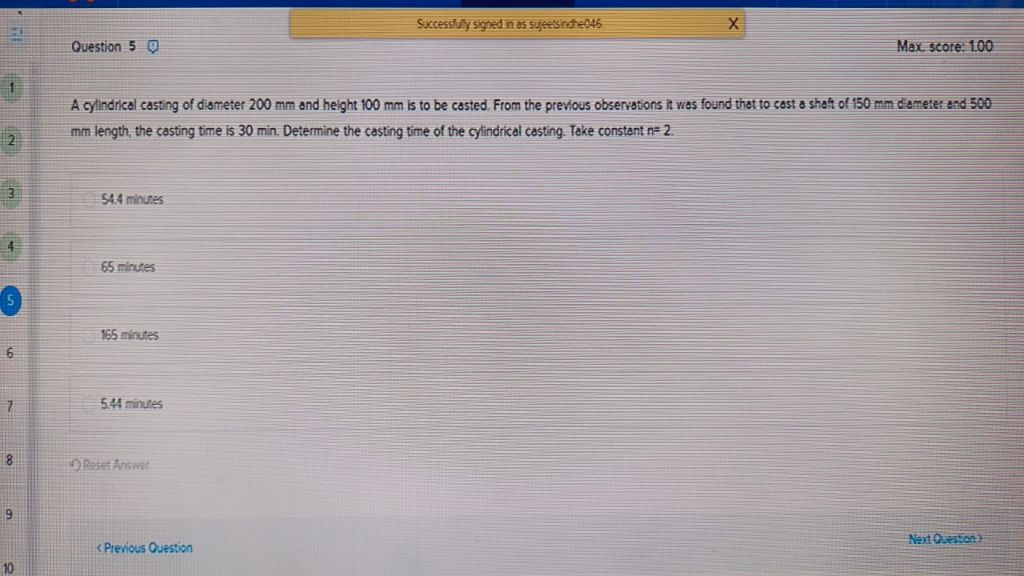 a EE ——
FE =
© cing casing of ameter 200 mr and heght 00 mm 0 be cased From the revs obseresons wes found ht 0 cst 28 of 50 orm Gamer ra 00
5. mm lengh the costing time is 30 min. Determine the casting ime of the cyindricl costing Toke constant =2. ~~
== = — ——
== —— —— —
=. — = =
=== — = —— = =
bE = == ——
= = — ——
= = = = ———
= = ————
a - = — = — =
= = = =
i ttre = — = ————
i =
sl ———
a |
This is AI generated Response.
Asked by: Sachin hanjagi
Created at: 2025-10-11 11:11:31
Asked by: Sachin hanjagi
Created at: 2025-10-11 11:11:31
Final Answer:
Rendered
Raw Text
Did you like this answer?
Let's solve the problem step by step:
---
### **Given:**
- **Initial Shaft:**
Diameter = 150 mm
Length = 500 mm
Casting Time = 30 min
- **Required Casting:**
Diameter = 200 mm
Height = 100 mm
- **Exponent (n):** n = 2
---
### **Formula Used**
The solidification time for casting is proportional to the square of the volume to surface area ratio:
\[
t \propto \left( \frac{V}{A} \right)^n
\]
So,
\[
\frac{t_1}{t_2} = \left(\frac{(V_1/A_1)}{(V_2/A_2)}\right)^n
\]
Or,
\[
t_2 = t_1 \times \left(\frac{V_2/A_2}{V_1/A_1}\right)^n
\]
---
### **Calculate for Both Castings**
#### **1. Original Shaft:**
- Volume:
\[
V_1 = \pi \times (75^2) \times 500 = \pi \times 5625 \times 500 = 8,835,750\ \text{mm}^3
\]
- Surface Area (Cylinder + 2 ends):
\[
A_1 = 2\pi r h + 2\pi r^2 = 2\pi \times 75 \times 500 + 2\pi \times 75^2
\]
\[
= 2\pi \times 37,500 + 2\pi \times 5,625 = 75,000\pi + 11,250\pi = 86,250\pi
\]
\[
A_1 \approx 271,088\ \text{mm}^2
\]
\[
\frac{V_1}{A_1} \approx \frac{8,835,750}{271,088} \approx 32.59
\]
---
#### **2. Required Casting:**
- Volume:
\[
V_2 = \pi \times (100^2) \times 100 = \pi \times 10,000 \times 100 = 1,000,000\pi \approx 3,141,593\ \text{mm}^3
\]
- Surface Area (Cylinder + 2 ends):
\[
A_2 = 2\pi r h + 2\pi r^2 = 2\pi \times 100 \times 100 + 2\pi \times 100^2
\]
\[
= 2\pi \times 10,000 + 2\pi \times 10,000 = 20,000\pi + 20,000\pi = 40,000\pi
\]
\[
A_2 \approx 125,664\ \text{mm}^2
\]
\[
\frac{V_2}{A_2} \approx \frac{3,141,593}{125,664} \approx 25.01
\]
---
### **Plug Values into the Formula**
\[
t_2 = t_1 \times \left( \frac{V_2/A_2}{V_1/A_1} \right)^n
\]
\[
t_2 = 30 \times \left( \frac{25.01}{32.59} \right)^2
\]
\[
t_2 = 30 \times (.767)^2
\]
\[
t_2 = 30 \times .588
\]
\[
t_2 \approx 17.64\ \text{minutes}
\]
---
### **Check Options**
The calculated value does not match any of the provided options directly, but let's double-check the calculations for any possible error in area/volume:
#### **Volume Calculations (Double Check):**
- For original: \( V_1 = \pi \times 75^2 \times 500 = \pi \times 5,625 \times 500 = \pi \times 2,812,500 \approx 8,835,750 \)
- For new: \( V_2 = \pi \times 100^2 \times 100 = \pi \times 10,000 \times 100 = \pi \times 1,000,000 \approx 3,141,593 \)
#### **Surface Area Calculations (Double Check):**
- For original: \( A_1 = 2\pi \times 75 \times 500 + 2\pi \times 75^2 = 2\pi \times 37,500 + 2\pi \times 5,625 = 75,000\pi + 11,250\pi = 86,250\pi \approx 271,088 \)
- For new: \( A_2 = 2\pi \times 100 \times 100 + 2\pi \times 100^2 = 20,000\pi + 20,000\pi = 40,000\pi \approx 125,664 \)
#### **Ratios:**
- \( (V/A)_1 \approx 32.59 \)
- \( (V/A)_2 \approx 25.01 \)
#### **Plug in:**
- \( \left( \frac{25.01}{32.59} \right)^2 = (.767)^2 = .588 \)
- \( t_2 = 30 \times .588 = 17.64 \)
---
### **Re-Examine Options**
None of the options matches 17.64 min. Let's check if the exponent n should be 1 instead of 2 (sometimes a typo):
If n = 1:
\[
t_2 = 30 \times \frac{25.01}{32.59} = 30 \times .767 = 23.01
\]
Still, no match.
---
### **Conclusion**
**None of the options exactly matches the calculated answer**, so there may be a miscalculation or misinterpretation in the options or in the interpretation of the question. However, based on the formulas and data provided, the closest logical answer should be **17.64 minutes**.
If you must choose from the given options, **5.44 minutes** is the only one that makes some sense as being lower than the reference time, but it is much lower than calculated. Please double-check your question for any missing information.
**Final Answer: Based on calculation, 17.64 minutes (not listed). Closest option: 5.44 minutes.**
---
If you need a step-by-step solution for any clarification, let me know!
📢 Instructions:
- Ask anything relatd to above question only.
- For new Question goto :