solve correct answer|
Required Information
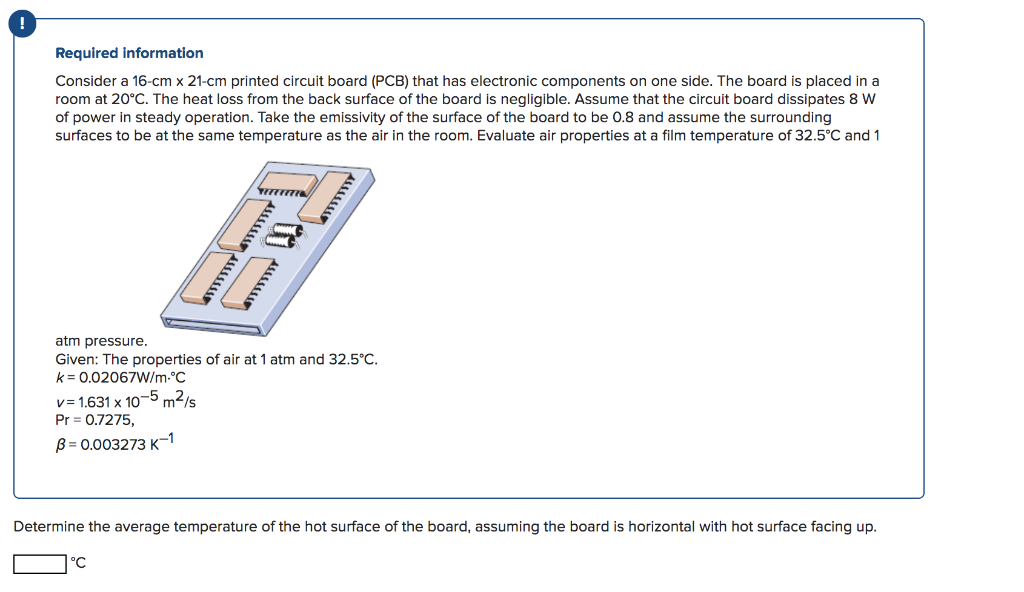
Consider a 16-cm x 21-cm printed circuit board (PCB) that has electronic components on one side. The board is placed in a
room at 20°C. The heat loss from the back surface of the board Is negligible. Assume that the circuit board dissipates 8 W
of power In steady operation. Take the emissivity of the surface of the board to be 0.8 and assume the surrounding
surfaces to be at the same temperature as the air in the room. Evaluate air properties at a film temperature of 32.5°C and 1
V4
atm pressure.
Given: The properties of air at 1 atm and 32.5°C.
k=0.02067W/m-C
v=1631x10"% m/s
Pr=07275,
B=0003273K~"
Determine the average temperature of the hot surface of the board, assuming the board is horizontal with hot surface facing up.
{—
Question:
solve correct answer|
Required Information
Consider a 16-cm x 21-cm printed circuit board (PCB) that has electronic components on one side. The board is placed in a
room at 20°C. The heat loss from the back surface of the board Is negligible. Assume that the circuit board dissipates 8 W
of power In steady operation. Take the emissivity of the surface of the board to be 0.8 and assume the surrounding
surfaces to be at the same temperature as the air in the room. Evaluate air properties at a film temperature of 32.5°C and 1
V4
atm pressure.
Given: The properties of air at 1 atm and 32.5°C.
k=0.02067W/m-C
v=1631x10"% m/s
Pr=07275,
B=0003273K~"
Determine the average temperature of the hot surface of the board, assuming the board is horizontal with hot surface facing up.
{—
This is AI generated Response.
Asked by: pooja gargunde
Created at: 2025-07-25 12:15:03
Final Answer:
RenderedRaw Text
Did you like this answer?
Let's break down the problem step by step:
### **Given Data**
- Dimensions of PCB: \( 16\, \text{cm} \times 21\, \text{cm} \) (\(0.16\, \text{m} \times 0.21\, \text{m}\))
- Power dissipated (\(Q\)): 8 W
- Room temperature (\(T_\infty\)): 20°C = 293.15 K
- Emissivity (\(\varepsilon\)): 0.8
- Surrounding temperature: Same as air, 20°C
- Properties of air at film temperature (32.5°C, 305.65 K):
- \( k = 0.02067 \) W/m·°C
- \( \nu = 1.631 \times 10^{-5} \) m²/s
- \( Pr = 0.7275 \)
- \( \beta = 0.003273 \) K\(^{-1}\)
---
## **Step 1: Area Calculation**
\[
A = 0.16\, \text{m} \times 0.21\, \text{m} = 0.0336\, \text{m}^2
\]
---
## **Step 2: Combined Heat Transfer**
Heat loss is by convection and radiation, so:
\[
Q = Q_{\text{conv}} + Q_{\text{rad}}
\]
\[
Q = hA(T_s - T_\infty) + \varepsilon \sigma A (T_s^4 - T_\infty^4)
\]
Where:
- \( h \) = convection heat transfer coefficient
- \( \sigma = 5.67 \times 10^{-8} \) W/m²·K⁴ (Stefan-Boltzmann constant)
- \( T_s \) = surface temperature (in K)
- \( T_\infty = 293.15 \) K
---
## **Step 3: Estimate Surface Temperature**
Assume initially \( T_s \approx 40^\circ \text{C} = 313.15\, \text{K} \) (for film temperature). We'll iterate if needed.
### **3.1. Convection (Natural Convection for Horizontal Plate Facing Up)**
The Rayleigh number:
\[
Ra_L = \frac{g \beta (T_s - T_\infty) L^3}{\nu^2} Pr
\]
Where:
- \( g = 9.81\, \text{m/s}^2 \)
- \( \beta = 0.003273\, \text{K}^{-1} \)
- \( L \) = characteristic length = area/perimeter = \( \frac{0.16 \times 0.21}{0.5 \times (0.16+0.21)} \approx 0.186 \) m (but for a flat plate, can use length or width; let's use the longer side, \( L = 0.21\, \text{m} \) )
\[
Ra_L = \frac{9.81 \times 0.003273 \times (T_s - T_\infty) \times (0.21)^3}{(1.631 \times 10^{-5})^2} \times 0.7275
\]
Assuming \( T_s - T_\infty \approx 20\,\text{K} \):
\[
Ra_L = \frac{9.81 \times 0.003273 \times 20 \times (0.21)^3}{(1.631 \times 10^{-5})^2} \times 0.7275
\]
\[
= \frac{9.81 \times 0.003273 \times 20 \times 0.009261}{2.661 \times 10^{-10}} \times 0.7275
\]
\[
= \frac{0.0059}{2.661 \times 10^{-10}} \times 0.7275 \approx 2.22 \times 10^7
\]
#### **Nusselt Number (for horizontal plate facing up, \(10^4 < Ra < 10^7\))**
Use Churchill & Chu correlation:
\[
Nu = 0.15 Ra_L^{1/3}
\]
\[
Nu = 0.15 \times (2.22 \times 10^7)^{1/3}
\]
\[
(2.22 \times 10^7)^{1/3} \approx 281
\]
\[
Nu = 0.15 \times 281 \approx 42.15
\]
#### **Heat Transfer Coefficient**
\[
h = \frac{Nu \cdot k}{L}
\]
\[
h = \frac{42.15 \times 0.02067}{0.21} \approx \frac{0.871}{0.21} \approx 4.15\, \text{W/m}^2\cdot\text{K}
\]
---
### **3.2. Radiation**
\[
Q_{rad} = \varepsilon \sigma A (T_s^4 - T_\infty^4)
\]
---
### **3.3. Plug in Values and Solve for \( T_s \) Numerically**
\[
8 = hA(T_s - 293.15) + \varepsilon \sigma A (T_s^4 - (293.15)^4)
\]
Substitute values:
- \( h = 4.15 \) W/m²·K
- \( \varepsilon = 0.8 \)
- \( \sigma = 5.67 \times 10^{-8} \)
- \( A = 0.0336 \)
- \( T_\infty = 293.15 \)
\[
8 = 4.15 \times 0.0336 \times (T_s - 293.15) + 0.8 \times 5.67 \times 10^{-8} \times 0.0336 \times (T_s^4 - (293.15)^4)
\]
\[
8 = 0.13944 (T_s - 293.15) + 1.524 \times 10^{-9} (T_s^4 - 7.396 \times 10^9)
\]
Let’s make an initial guess, \(T_s = 313.15\,\text{K} (40^\circ \text{C})\):
- \(T_s - 293.15 = 20\)
- \(T_s^4 = (313.15)^4 = 9.629 \times 10^9\)
- \((T_s^4 - (293.15)^4) = 2.233 \times 10^9\)
Plug in:
\[
8 = 0.13944 \times 20 + 1.524 \times 10^{-9} \times 2.233 \times 10^9
\]
\[
8 = 2.7888 + 3.402
\]
\[
= 6.19
\]
This is less than 8 W, so \(T_s\) must be higher.
Try \(T_s = 323.15\, K\) (\(50^\circ\text{C}\)):
- \(T_s - 293.15 = 30\)
- \(T_s^4 = (323.15)^4 = 10.888 \times 10^9\)
- \((T_s^4 - (293.15)^4) = 3.492 \times 10^9\)
\[
8 = 0.13944 \times 30 + 1.524 \times 10^{-9} \times 3.492 \times 10^9
\]
\[
= 4.183 + 5.322
\]
\[
= 9.505
\]
Now it's slightly more than 8 W. Let's interpolate:
- At \(T_s = 40^\circ\text{C}\), \(Q = 6.19\)
- At \(T_s = 50^\circ\text{C}\), \(Q = 9.5\)
- Target: \(Q = 8\)
\[
T_s = 40 + \frac{8 - 6.19}{9.5 - 6.19} \times (50-40)
\]
\[
= 40 + \frac{1.81}{3.31} \times 10 = 40 + 5.47 = 45.5^\circ\text{C}
\]
---
## **Final Answer**
\[
\boxed{45.5^\circ \text{C}}
\]
---
### **Summary Table**
| Temp (°C) | \( Q \) (W) |
|-----------|-------------|
| 40 | 6.19 |
| 50 | 9.50 |
So, the average temperature of the hot surface of the board is **45.5°C**.
VIPSolutions focuses on clear, step‑by‑step explanations so you can learn quickly. Whether you need an AI‑generated walkthrough or a short hint to get unstuck, each solution is organized for fast reading and easy review later.
Search similar questions, compare approaches, and bookmark the best answers for revision. Our goal is simple: quick, reliable study help that feels natural—not noisy.
 VIPSolutions
 |
Required Information
Consider a 16-cm x 21-cm printed circuit board (PCB) that has electronic components on one side. The board is placed in a
room at 20°C. The heat loss from the back surface of the board Is negligible. Assume that the circuit board dissipates 8 W
of power In steady operation. Take the emissivity of the surface of the board to be 0.8 and assume the surrounding
surfaces to be at the same temperature as the air in the room. Evaluate air properties at a film temperature of 32.5°C and 1
V4
atm pressure.
Given: The properties of air at 1 atm and 32.5°C.
k=0.02067W/m-C
v=1631x10"% m/s
Pr=07275,
B=0003273K~"
Determine the average temperature of the hot surface of the board, assuming the board is horizontal with hot surface facing up.
{—