 VIPSolutions
solve correct answerProblem 2. This nal bends the flow rom verscally grea 0 30° with the horizontal and dischirges water (1 = 62.4 601) a a speed of ¥ = 30 1. The Some within th nal lf 1.5 , sd he weight of the zc i 100 If Forthes condition, what erica ores st be pple the nozzle at he ange hold ine rom? liam loge
Question:
solve correct answer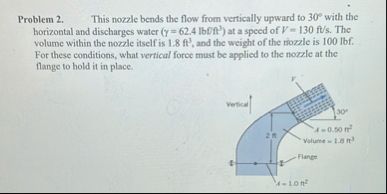 Problem 2. This nal bends the flow rom verscally grea 0 30° with the
horizontal and dischirges water (1 = 62.4 601) a a speed of ¥ = 30 1. The
Some within th nal lf 1.5 , sd he weight of the zc i 100 If
Forthes condition, what erica ores st be pple the nozzle at he
ange hold ine
rom?
liam
loge
This is AI generated Response.
Asked by: pooja gargunde
Created at: 2025-07-29 08:44:22
Asked by: pooja gargunde
Created at: 2025-07-29 08:44:22
Final Answer:
Rendered
Raw Text
Did you like this answer?
Let's break down the problem and solve for the **vertical force** that must be applied at the flange.
### **Given Data**
- Water weight density, \(\gamma\) = **62.4 lbf/ft³**
- Water velocity, \(V\) = **130 ft/s**
- Volume in nozzle, \(V_{nozzle}\) = **1.8 ft³**
- Weight of nozzle, \(W_{nozzle}\) = **100 lbf**
- Area at inlet, \(A_1\) = **1.0 ft²** (vertical)
- Area at outlet, \(A_2\) = **0.5 ft²** (discharges at 30° above horizontal)
### **Required**
Find the **vertical force** (\(F_{vertical}\)) to hold the nozzle in place at the flange.
---
## **Step 1: Find Mass Flow Rate (\(\dot{m}\))**
\[
\dot{m} = \rho Q = \rho A_2 V
\]
\[
\rho = \frac{\gamma}{g} = \frac{62.4}{32.2} = 1.94~\text{slugs/ft}^3
\]
\[
Q = A_2 V = 0.5~\text{ft}^2 \times 130~\text{ft/s} = 65~\text{ft}^3/\text{s}
\]
\[
\dot{m} = 1.94~\text{slugs/ft}^3 \times 65~\text{ft}^3/\text{s} = 126.1~\text{slugs/s}
\]
---
## **Step 2: Control Volume and Forces**
We use the linear momentum equation in the vertical direction:
\[
\sum F_y = \dot{m} (V_{2y} - V_{1y}) + W_{nozzle}
\]
### **Velocities:**
- At **inlet** (vertical): \(V_{1y} = V_1\)
- At **outlet** (30° above horizontal): \(V_{2y} = V_2 \sin(30^\circ)\)
But, the **velocity at outlet** is given as \(V = 130~\text{ft/s}\), let's assume that's \(V_2\).
So,
\[
V_{2y} = 130 \sin(30^\circ) = 130 \times 0.5 = 65~\text{ft/s}
\]
**At the inlet:**
Assuming steady flow, the mass flow rate at the inlet equals outlet.
\[
A_1 V_1 = A_2 V_2 \implies V_1 = \frac{A_2 V_2}{A_1} = \frac{0.5 \times 130}{1.0} = 65~\text{ft/s}
\]
So,
- \(V_{1y} = 65~\text{ft/s}\)
---
## **Step 3: Forces in the Vertical Direction**
Let's denote \(F_{vertical}\) as the **upward force** needed at the flange.
\[
F_{vertical} + W_{nozzle} + (P_1 A_1 - P_2 A_2 \sin(30^\circ)) = \dot{m}(V_{2y} - V_{1y})
\]
Assume the nozzle **discharges to atmosphere** (\(P_2 = 0\)), and if pressure at inlet is atmospheric, the pressure forces cancel. If not, you may need more data, but typically it's asked with atmospheric discharge.
\[
F_{vertical} + 100 = \dot{m}(65 - 65)
\]
\[
F_{vertical} + 100 = 0
\]
\[
F_{vertical} = -100~\text{lbf}
\]
Negative means **downward force** is required, which balances the **weight of the nozzle**.
### **If pressure at inlet is not atmospheric:**
If \(P_1\) is not atmospheric, you'd need to find it via Bernoulli’s equation, but that info isn't given here.
---
## **Final Answer**
\[
\boxed{F_{vertical} = -100~\text{lbf}}
\]
**Interpretation:**
A **downward force of 100 lbf** must be applied at the flange to hold the nozzle in place. This balances the weight of the nozzle itself, as the momentum change in the vertical direction is zero (since the vertical components of velocity in and out are equal).
---
**If you need the effect of pressure at the inlet included, please provide \(P_1\) or clarify if the inlet is at atmospheric pressure.**
📢 Instructions:
- Ask anything relatd to above question only.
- For new Question goto :