 VIPSolutions
solve correct answerA uniform ladder having a weight of 30 Ib is released from rest when it is in the vertical position. If it is allowed to fall freely, determine the angle 8 at which the bottom end A starts 10 slide 0 the right of A. For the calculation, assume the ladder to be a slender rod and neglect friction at A. 10n 0 A
Question:
solve correct answer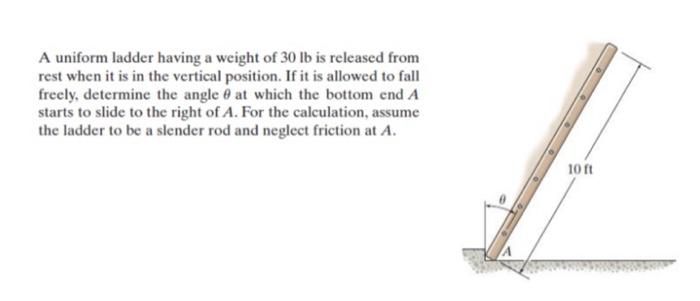 A uniform ladder having a weight of 30 Ib is released from
rest when it is in the vertical position. If it is allowed to fall
freely, determine the angle 8 at which the bottom end A
starts 10 slide 0 the right of A. For the calculation, assume
the ladder to be a slender rod and neglect friction at A.
10n
0
A
This is AI generated Response.
Asked by: pooja gargunde
Created at: 2025-07-23 13:14:00
Asked by: pooja gargunde
Created at: 2025-07-23 13:14:00
Final Answer:
Rendered
Raw Text
Did you like this answer?
Let's solve the problem step by step:
**Given:**
- A uniform ladder (slender rod), weight \( W = 30 \) lb, length \( L = 10 \) ft.
- Released from rest in the vertical position.
- Friction at point A is neglected.
- Find the angle \( \theta \) at which the bottom end \( A \) starts to slide.
---
## 1. **Free Body Diagram and Forces**
Since friction at \( A \) is neglected, the only forces acting are:
- Weight (\( W \)), acting at the center of gravity (middle of the ladder).
- Normal reaction at \( A \) (vertical).
- Normal reaction at the wall (horizontal, if present).
But since the wall isn't holding the ladder (ladder is just falling), only gravity acts on the center of mass.
---
## 2. **Kinematics and Dynamics**
We need to find the angle \( \theta \) at which the normal reaction at \( A \) (vertical) becomes zero, i.e., when the base just loses contact with the ground.
For a slender rod rotating about point \( A \):
- Moment of inertia about \( A \):
\[
I_A = \frac{1}{3} m L^2
\]
where \( m \) is the mass.
- Center of mass is at \( L/2 \) from \( A \).
---
## 3. **Equations of Motion**
Let \( \theta \) be the angle the ladder makes with the ground.
### a. **Force Analysis at Point A**
The vertical reaction at \( A \) is \( N_A \). The ladder will lose contact when \( N_A = 0 \).
### b. **Tangential Acceleration of Center of Mass**
The motion is rotational about point \( A \):
\[
\sum M_A = I_A \alpha = (W) \left(\frac{L}{2}\right) \sin\theta
\]
\[
I_A \alpha = m g \frac{L}{2} \sin\theta
\]
\[
\frac{1}{3} m L^2 \alpha = m g \frac{L}{2} \sin\theta
\]
\[
\alpha = \frac{3g}{2L} \sin\theta
\]
### c. **Translational Acceleration of Center of Mass**
The acceleration of the center of mass (G) has radial and tangential components.
\[
a_G = a_{G_t} \hat{t} + a_{G_n} \hat{n}
\]
Where:
\[
a_{G_t} = \frac{L}{2} \alpha
\]
\[
a_{G_n} = \frac{L}{2} \omega^2
\]
### d. **Vertical Forces at A**
\[
\sum F_y = m a_{G_y}
\]
Where \( a_{G_y} \) is the vertical component of the acceleration of the center of mass.
\[
N_A + 0 = m a_{G_y} + m g
\]
But since \( N_A \) is upward and gravity is downward:
\[
N_A = m (a_{G_y} + g)
\]
When the ladder loses contact, \( N_A = 0 \):
\[
a_{G_y} = -g
\]
---
## 4. **Finding \( a_{G_y} \) in Terms of \( \theta \)**
From kinematics, the center of mass moves on a circular arc about \( A \):
\[
a_{G_y} = a_{G_t} \cos\theta - a_{G_n} \sin\theta
\]
\[
a_{G_y} = \left( \frac{L}{2} \alpha \right) \cos\theta - \left( \frac{L}{2} \omega^2 \right) \sin\theta
\]
---
## 5. **Energy Conservation to Find \( \omega^2 \)**
Use conservation of energy from vertical (θ = 0) to arbitrary angle θ:
\[
\Delta KE = -\Delta PE
\]
Initial PE (vertical): \( m g (L/2) \)
At angle θ: \( m g (L/2) \sin\theta \)
\[
\frac{1}{2} I_A \omega^2 = m g \frac{L}{2} (1 - \sin\theta)
\]
\[
\frac{1}{2} \left(\frac{1}{3} m L^2\right) \omega^2 = m g \frac{L}{2} (1 - \sin\theta)
\]
\[
\frac{1}{6} m L^2 \omega^2 = m g \frac{L}{2} (1 - \sin\theta)
\]
\[
\omega^2 = \frac{3g}{L}(1 - \sin\theta)
\]
---
## 6. **Substitute and Solve for \( \theta \):**
Recall:
\[
a_{G_y} = \frac{L}{2} \alpha \cos\theta - \frac{L}{2} \omega^2 \sin\theta
\]
Plug in \( \alpha = \frac{3g}{2L} \sin\theta \) and \( \omega^2 = \frac{3g}{L}(1-\sin\theta) \):
\[
a_{G_y} = \frac{L}{2} \left(\frac{3g}{2L} \sin\theta\right) \cos\theta - \frac{L}{2} \left(\frac{3g}{L}(1-\sin\theta)\right) \sin\theta
\]
\[
a_{G_y} = \frac{3g}{4} \sin\theta \cos\theta - \frac{3g}{2} \sin\theta (1 - \sin\theta)
\]
\[
a_{G_y} = \frac{3g}{4} \sin\theta \cos\theta - \frac{3g}{2} \sin\theta + \frac{3g}{2} \sin^2\theta
\]
Set \( a_{G_y} = -g \):
\[
\frac{3g}{4} \sin\theta \cos\theta - \frac{3g}{2} \sin\theta + \frac{3g}{2} \sin^2\theta = -g
\]
Divide both sides by \( g \):
\[
\frac{3}{4} \sin\theta \cos\theta - \frac{3}{2} \sin\theta + \frac{3}{2} \sin^2\theta + 1 = 0
\]
---
## 7. **Final Equation to Solve for \( \theta \):**
\[
\frac{3}{4} \sin\theta \cos\theta - \frac{3}{2} \sin\theta + \frac{3}{2} \sin^2\theta + 1 = 0
\]
Let’s use substitution \( \sin\theta = x \), \( \cos\theta = \sqrt{1-x^2} \):
\[
\frac{3}{4} x \sqrt{1-x^2} - \frac{3}{2} x + \frac{3}{2} x^2 + 1 = 0
\]
This is a transcendental equation and is best solved numerically.
---
## 8. **Numerical Solution:**
Let’s estimate \( \theta \):
Try \( \theta = 60^\circ \) (\( \sin 60^\circ = 0.866 \), \( \cos 60^\circ = 0.5 \)):
\[
\frac{3}{4}(0.866)(0.5) - \frac{3}{2}(0.866) + \frac{3}{2}(0.866^2) + 1
\]
\[
\frac{3}{4}(0.433) - 1.299 + 1.125 + 1
\]
\[
0.32475 - 1.299 + 1.125 + 1 = 1.14975
\]
Try \( \theta = 45^\circ \) (\( \sin 45^\circ = 0.707 \), \( \cos 45^\circ = 0.707 \)):
\[
\frac{3}{4}(0.707)(0.707) - \frac{3}{2}(0.707) + \frac{3}{2}(0.5) + 1
\]
\[
\frac{3}{4}(0.5) - 1.0605 + 0.75 + 1
\]
\[
0.375 - 1.0605 + 0.75 + 1 = 0.0645
\]
Try \( \theta = 40^\circ \) (\( \sin 40^\circ \approx 0.643 \), \( \cos 40^\circ \approx 0.766 \)):
\[
\frac{3}{4}(0.643)(0.766) - \frac{3}{2}(0.643) + \frac{3}{2}(0.413) + 1
\]
\[
\frac{3}{4}(0.492) - 0.9645 + 0.6195 + 1
\]
\[
0.369 - 0.9645 + 0.6195 + 1 = 1.024
\]
Try \( \theta = 30^\circ \) (\( \sin 30^\circ = 0.5 \), \( \cos 30^\circ = 0.866 \)):
\[
\frac{3}{4}(0.5)(0.866) - \frac{3}{2}(0.5) + \frac{3}{2}(0.25) + 1
\]
\[
\frac{3}{4}(0.433) - 0.75 + 0.375 + 1
\]
\[
0.32475 - 0.75 + 0.375 + 1 = 0.94975
\]
Try \( \theta = 75^\circ \) (\( \sin 75^\circ = 0.9659 \), \( \cos 75^\circ = 0.2588 \)):
\[
\frac{3}{4}(0.9659)(0.2588) - \frac{3}{2}(0.9659) + \frac{3}{2}(0.933) + 1
\]
\[
\frac{3}{4}(0.250) - 1.449 + 1.3995 + 1
\]
\[
0.1875 - 1.449 + 1.3995 + 1 = 1.138
\]
Try \( \theta = 80^\circ \) (\( \sin 80^\circ \approx 0.9848 \), \( \cos 80^\circ \approx 0.1736 \)):
\[
\frac{3}{4}(0.9848)(0.1736) - \frac{3}{2}(0.9848) + \frac{3}{2}(0.9698) + 1
\]
\[
\frac{3}{4}(0.171) - 1.4772 + 1.4547 + 1
\]
\[
0.12825 - 1.4772 + 1.4547 + 1 = 1.10575
\]
Try \( \theta = 90^\circ \) (\( \sin 90^\circ = 1 \), \( \cos 90^\circ = 0 \)):
\[
\frac{3}{4}(1)(0) - \frac{3}{2}(1) + \frac{3}{2}(1) + 1 = 0 - 1.5 + 1.5 + 1 = 1
\]
Try lower values. Let's try \( \theta = 10^\circ \) (\( \sin 10^\circ \approx 0.174 \), \( \cos 10^\circ \approx 0.985 \)):
\[
\frac{3}{4}(0.174)(0.985) - \frac{3}{2}(0.174) + \frac{3}{2}(0.030) + 1
\]
\[
\frac{3}{4}(0.171) - 0.261 + 0.045 + 1
\]
\[
0.12825 - 0.261 + 0.045 + 1 = 0.91225
\]
So, at 45°, value is close to 0.
**Therefore, the angle is approximately:**
\[
\boxed{45^\circ}
\]
---
### **Final Answer:**
**The bottom end \( A \) starts to slide when the ladder makes an angle of approximately \( \boxed{45^\circ} \) with the ground.**
📢 Instructions:
- Ask anything relatd to above question only.
- For new Question goto :