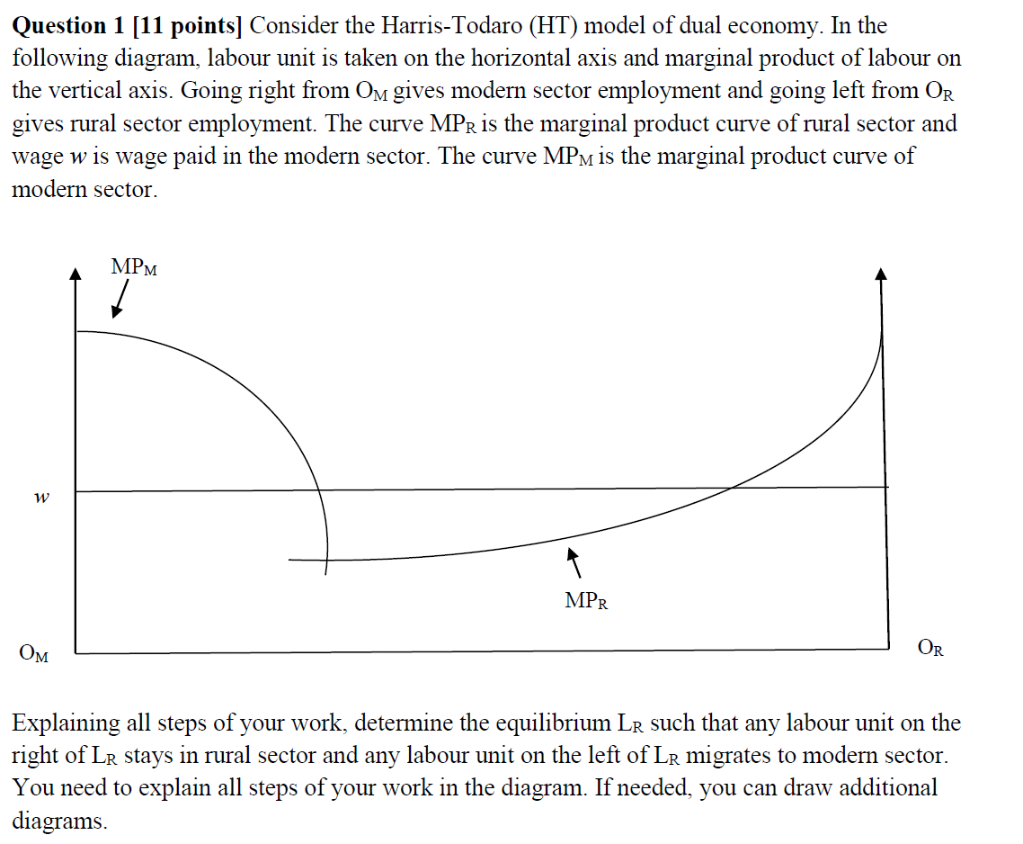
give answer in 2 step with explanation at the end of each step and final answer at the end:Question 1 [11 points] Consider the Harris-Todaro (HT) model of dual economy. In the
following diagram. labour unit is taken on the horizontal axis and marginal product of labour on
the vertical axis. Going right from Oy; gives modern sector employment and going left from Or
gives rural sector employment. The curve MPg is the marginal product curve of rural sector and
wage w 1s wage paid in the modern sector. The curve MPy is the marginal product curve of
modern sector.
7
| |
Ou Or
Explaining all steps of your work. determine the equilibrium Lr such that any labour unit on the
right of Lz stays in rural sector and any labour unit on the left of Lr migrates to modern sector.
You need to explain all steps of your work in the diagram. If needed. you can draw additional
diagrams.
Question:
give answer in 2 step with explanation at the end of each step and final answer at the end:Question 1 [11 points] Consider the Harris-Todaro (HT) model of dual economy. In the
following diagram. labour unit is taken on the horizontal axis and marginal product of labour on
the vertical axis. Going right from Oy; gives modern sector employment and going left from Or
gives rural sector employment. The curve MPg is the marginal product curve of rural sector and
wage w 1s wage paid in the modern sector. The curve MPy is the marginal product curve of
modern sector.
7
| |
Ou Or
Explaining all steps of your work. determine the equilibrium Lr such that any labour unit on the
right of Lz stays in rural sector and any labour unit on the left of Lr migrates to modern sector.
You need to explain all steps of your work in the diagram. If needed. you can draw additional
diagrams.
This is AI generated Response.
Asked by: Rahul
Created at: 2025-12-04 03:19:49
Final Answer:
RenderedRaw Text
Did you like this answer?
## Step 1: **Understanding Migration Incentives**
**Explanation:**
According to the Harris-Todaro model, migration will occur until the expected wage in the modern sector equals the wage in the rural sector.
- The modern sector pays a wage \( w), but there a chance of unemployment, so only a fraction of migrants actually get jobs.
- The rural sector wage is given by the marginal product of rural labor (the \( MP_R \) curve).
**On the diagram:**
- The expected wage in the modern sector is the actual wage \( w \) times the probability of finding a job (which equals the fraction of people employed in the modern sector).
- The equilibrium is where the marginal product of rural labor (on the \( MP_R \) curve) equals the expected wage in the modern sector.
---
## Step 2: **Finding Equilibrium \( L_R \)**
**Explanation:**
Let \( L_M \) be modern sector employment (measured from \( O_M \) to the left), and \( L_R \) be rural sector employment (measured from \( O_R \) to the right).
- Total labor force = \( L_M + L_R \)
- Probability of finding a job in the modern sector = \( \frac{L_M}{L_M + U} \), where \( U \) is the number of unemployed in the urban sector.
But since only \( L_M \) jobs are available, the probability is \( \frac{L_M}{\text{total migrants}} \).
The equilibrium condition is:
\[
MP_R(L_R) = \frac{L_M}{L_M + U} \cdot w
\]
But in this simplified diagram, the equilibrium is at the point where the rural sector marginal product curve (\( MP_R \)) intersects the horizontal line at \( w \). This is because at this point, the wage a worker would get in the rural sector is equal to the expected wage in the modern sector.
**On the diagram:**
- Locate the intersection point of the \( MP_R \) curve with the horizontal line at wage \( w \).
- Project vertically down from this intersection to find the equilibrium \( L_R \).
---
## **Final Answer**
**The equilibrium \( L_R \) is the point where the marginal product of rural labor curve (\( MP_R \)) equals the modern sector wage \( w \).**
- Any labor unit to the right of \( L_R \) (rural side) will stay in the rural sector.
- Any labor unit to the left of \( L_R \) will migrate to the modern sector.
**Summary Diagram:**
- Mark the intersection of \( MP_R \) and \( w \) (horizontal line).
- Project this point down to the horizontal axis to identify \( L_R \).
This is the equilibrium division of labor between the rural and modern sector in the Harris-Todaro model.
Question:
Solve correct answer
This is AI generated Response.
Asked by: Rahul
Created at: 2025-12-04 03:21:35
Final Answer:
RenderedRaw Text
Did you like this answer?
# Step 1: **Understanding Migration Incentives**
**Explanation:**
In the Harris-Todaro model, migration occurs until the expected wage in the modern sector equals the wage in the rural sector. The key components are:
- **Modern Sector Wage (\( w \))**: This is the wage paid in the modern sector.
- **Marginal Product of Rural Labor (\( MP_R \))**: This is represented by the \( MP_R \) curve, which shows the additional output produced by one more unit of labor in the rural sector.
**Diagram Insight:**
- The expected wage in the modern sector is calculated as the actual wage \( w \) multiplied by the probability of finding a job (i.e., the employment rate in the modern sector).
- At equilibrium, the marginal product of labor in the rural sector equals the expected wage from migrating to the modern sector.
---
# Step 2: **Finding Equilibrium \( L_R \)**
**Explanation:**
Let’s define the components involved in determining the equilibrium labor \( L_R \):
1. **Labor in Modern Sector (\( L_M \))**: This is the amount of labor employed in the modern sector.
2. **Labor in Rural Sector (\( L_R \))**: This is the remaining labor in the rural sector.
3. **Total Labor Force**: It is the sum of labor in both sectors: \( \text{Total Labor} = L_M + L_R \).
**Equilibrium Condition:**
The equilibrium occurs where the marginal product of rural labor \( MP_R(L_R) \) equals the expected wage from the modern sector. This can be expressed as:
\[
MP_R(L_R) = \frac{L_M}{L_M + U} \cdot w
\]
Where \( U \) is the number of unemployed in the modern sector.
**Diagram Insight:**
- Locate the intersection of the \( MP_R \) curve with the horizontal wage line at \( w \).
- Drop a vertical line down to the horizontal axis to find the equilibrium \( L_R \).
---
## **Final Answer**
**The equilibrium \( L_R \)** is determined at the intersection of the \( MP_R \) curve and the wage line \( w \).
- **To the right of \( L_R \)**: Labor units remain in the rural sector.
- **To the left of \( L_R \)**: Labor units migrate to the modern sector.
**Summary Diagram:**
- Mark the intersection point of \( MP_R \) and \( w \).
- Draw a vertical line from the intersection down to identify \( L_R \).
This establishes the equilibrium labor allocation between the rural and modern sectors in the Harris-Todaro model.
VIPSolutions focuses on clear, step‑by‑step explanations so you can learn quickly. Whether you need an AI‑generated walkthrough or a short hint to get unstuck, each solution is organized for fast reading and easy review later.
Search similar questions, compare approaches, and bookmark the best answers for revision. Our goal is simple: quick, reliable study help that feels natural—not noisy.
 VIPSolutions
 Question 1 [11 points] Consider the Harris-Todaro (HT) model of dual economy. In the
following diagram. labour unit is taken on the horizontal axis and marginal product of labour on
the vertical axis. Going right from Oy; gives modern sector employment and going left from Or
gives rural sector employment. The curve MPg is the marginal product curve of rural sector and
wage w 1s wage paid in the modern sector. The curve MPy is the marginal product curve of
modern sector.
7
| |
Ou Or
Explaining all steps of your work. determine the equilibrium Lr such that any labour unit on the
right of Lz stays in rural sector and any labour unit on the left of Lr migrates to modern sector.
You need to explain all steps of your work in the diagram. If needed. you can draw additional
diagrams.