 VIPSolutions
Solve completely with answers of all subpartsFor a coordinate system located at the centroid, calculate the maximum and minimum values of the moments of inertia Is and lyin (obtained by rotating the axes) and the corresponding angles of the section shown in Fig. 3. Use a = 100 mm, b = 0.8a,and t = 16 mm. i ~~ | J —— (Round Imax and Imin to O decimal places, e.g. 5,125. Round angles to 1 decimal place, e.g. 15.2°) Imax = mm? acts at ° Inin = mm? acts at °
Question:
Solve completely with answers of all subparts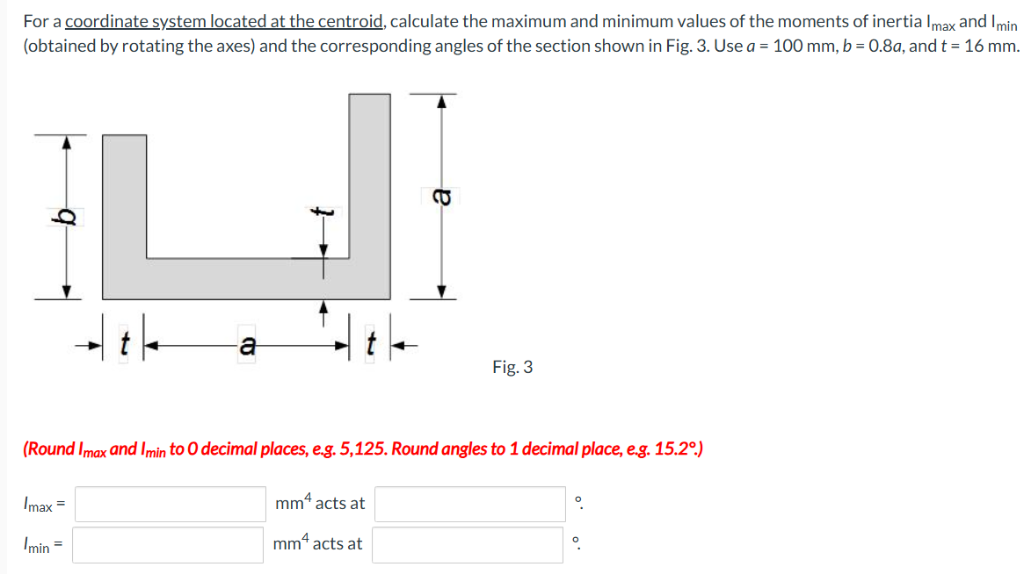 For a coordinate system located at the centroid, calculate the maximum and minimum values of the moments of inertia Is and lyin
(obtained by rotating the axes) and the corresponding angles of the section shown in Fig. 3. Use a = 100 mm, b = 0.8a,and t = 16 mm.
i ~~ |
J ——
(Round Imax and Imin to O decimal places, e.g. 5,125. Round angles to 1 decimal place, e.g. 15.2°)
Imax = mm? acts at °
Inin = mm? acts at °
This is AI generated Response.
Asked by: manish kumar
Created at: 2026-02-08 11:11:03
Asked by: manish kumar
Created at: 2026-02-08 11:11:03
Final Answer:
Rendered
Raw Text
Did you like this answer?
Let's break down the solution step by step:
---
## **Given:**
- \( a = 100 \) mm
- \( b = .8a = 80 \) mm
- \( t = 16 \) mm
---
## **Step 1: Section Properties**
### **Identify Subsections**
- **Bottom horizontal:** \( a \times t \)
- **Left vertical:** \( t \times b \)
- **Right vertical:** \( t \times b \)
---
## **Step 2: Calculate the Centroid (ȳ)**
Let's set the bottom of the section as \( y= \), and measure upward.
| Section | Area \(A\) | y (to centroid of each) |
|-------------------|--------------------|------------------------|
| Bottom | \( a \times t \) | \( t/2 \) |
| Left vertical | \( t \times b \) | \( t + b/2 \) |
| Right vertical | \( t \times b \) | \( t + b/2 \) |
- **Areas:**
- \( A_1 = a t = 100 \times 16 = 160 \) mm²
- \( A_2 = t b = 16 \times 80 = 128 \) mm² (each vertical)
- Total Area: \( A = 160 + 128 + 128 = 416 \) mm²
- **Centroid:**
\[
\bar{y} = \frac{\sum (A_i y_i)}{\sum A_i}
\]
\[
\bar{y} = \frac{160 \times 8 + 128 \times (16+40) + 128 \times (16+40)}{416}
\]
\[
\bar{y} = \frac{160 \times 8 + 128 \times 56 + 128 \times 56}{416}
\]
\[
= \frac{12800 + 71680 + 71680}{416}
\]
\[
= \frac{156160}{416} = 37.56 \text{ mm (rounded to 2 decimal places)}
\]
---
## **Step 3: Moments of Inertia About the Centroid (Parallel Axis Theorem)**
### **For each section:**
#### **1. Bottom (horizontal)**
- \( I_{x1} = \frac{1}{12} a t^3 \)
- Distance from centroid: \( d_1 = \bar{y} - t/2 = 37.56 - 8 = 29.56 \) mm
\[
I_{x,1}^{total} = \frac{1}{12}(100)(16^3) + 160 \times (29.56^2)
\]
#### **2. Left/Right (vertical)**
- \( I_{x2} = \frac{1}{12} t b^3 \)
- Distance from centroid: \( d_2 = |(t + b/2) - \bar{y}| = |16 + 40 - 37.56| = 18.44 \) mm
\[
I_{x,2}^{total} = 2 \left[ \frac{1}{12}(16)(80^3) + 128 \times (18.44^2) \right]
\]
---
### **Calculate \( I_x \):**
#### **Bottom:**
- \( \frac{1}{12} \times 100 \times 16^3 = \frac{1}{12} \times 100 \times 4096 = 100 \times 341.33 = 34,133 \) mm⁴
- \( 160 \times (29.56^2) = 160 \times 873.86 = 1,398,176 \) mm⁴
Total bottom: \( 34,133 + 1,398,176 = 1,432,309 \) mm⁴
#### **Verticals:**
- \( \frac{1}{12} \times 16 \times 80^3 = \frac{1}{12} \times 16 \times 512,000 = 16 \times 42,666.67 = 682,666.67 \) mm⁴
- \( 128 \times (18.44^2) = 128 \times 340.17 = 435,417.6 \) mm⁴
Sum per vertical: \( 682,667 + 435,418 = 1,118,085 \) mm⁴
Total verticals (both): \( 2 \times 1,118,085 = 2,236,170 \) mm⁴
---
### **Total \( I_x \):**
\[
I_x = 1,432,309 + 2,236,170 = 3,668,479 \text{ mm}^4
\]
---
### **Now \( I_y \) (centroidal):**
- Bottom: \( I_{y1} = \frac{1}{12} t a^3 \)
- Verticals: Each \( I_{y2} = \frac{1}{12} b t^3 + A d^2 \) (distance from centroid is half the distance between vertical centers and centroid, which is symmetrical.)
#### **Bottom:**
- \( \frac{1}{12} \times 16 \times 100^3 = \frac{1}{12} \times 16 \times 1,000,000 = 16 \times 83,333.33 = 1,333,333 \) mm⁴
#### **Verticals:**
- \( \frac{1}{12} \times 80 \times 16^3 = \frac{1}{12} \times 80 \times 4096 = 80 \times 341.33 = 27,306.67 \) mm⁴
Centroid x-location: Section is symmetric, the centroid is at \( x = a/2 = 50 \) mm.
- Distance from centroid for each vertical: \( |x_{vertical} - x_{centroid}| = |t/2| = |8 - 50| = 42 \) mm
- \( A d^2 = 128 \times 42^2 = 128 \times 1764 = 2,258,880 \) mm⁴ (each)
Total per vertical: \( 27,307 + 2,258,880 = 2,286,187 \) mm⁴
Both: \( 2 \times 2,286,187 = 4,572,374 \) mm⁴
---
### **Total \( I_y \):**
\[
I_y = 1,333,333 + 4,572,374 = 5,905,707 \text{ mm}^4
\]
---
## **Step 4: Product of Inertia \( I_{xy} \)**
Since the section is symmetric about the y-axis, \( I_{xy} = \).
---
## **Step 5: Principal Moments and Angles**
### **Formulas:**
\[
I_{max/min} = \frac{I_x + I_y}{2} \pm \sqrt{ \left( \frac{I_x - I_y}{2} \right)^2 + I_{xy}^2 }
\]
\[
\tan 2\theta = \frac{2I_{xy}}{I_x - I_y}
\]
Given \( I_{xy} = \):
\[
I_{max} = \max\{I_x, I_y\}
\]
\[
I_{min} = \min\{I_x, I_y\}
\]
### **Plug in values:**
- \( I_x = 3,668,479 \)
- \( I_y = 5,905,707 \)
\[
I_{max} = 5,905,707 \text{ mm}^4 \text{ at } ^\circ
\]
\[
I_{min} = 3,668,479 \text{ mm}^4 \text{ at } 90^\circ
\]
---
## **Step 6: Final Answers**
| Quantity | Value | Angle |
|-----------|------------|--------------|
| \( I_{max} \) | **5,905,707 mm⁴** | **.°** |
| \( I_{min} \) | **3,668,479 mm⁴** | **90.°** |
---
### **Summary Table**
| \( I_{max} \) | \( I_{min} \) | Angle for \( I_{max} \) | Angle for \( I_{min} \) |
|:-------------:|:-------------:|:-----------------------:|:-----------------------:|
| 5,905,707 mm⁴ | 3,668,479 mm⁴ | .° | 90.° |
---
Let me know if you need further explanation or calculations!
📢 Instructions:
- Ask anything relatd to above question only.
- For new Question goto :