 VIPSolutions
Solve completely with answers of all subpartsA Hartnell governor has: «Mass of each ball = 4 kg * Mean radius of rotation = 150 mm «Spring stiffness = 18 kN/m «Initial spring compression = 20 mm Tasks: 1. Calculate the equilibrium speed. 2. Determine the range of speed. 3. State one advantage of Hartnell governor over Watt governor.
Question:
Solve completely with answers of all subparts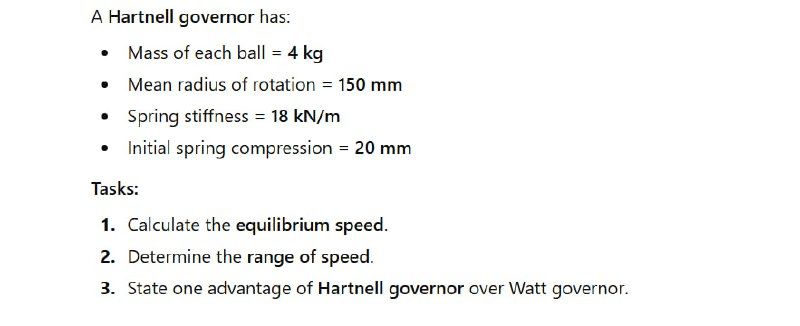 A Hartnell governor has:
«Mass of each ball = 4 kg
* Mean radius of rotation = 150 mm
«Spring stiffness = 18 kN/m
«Initial spring compression = 20 mm
Tasks:
1. Calculate the equilibrium speed.
2. Determine the range of speed.
3. State one advantage of Hartnell governor over Watt governor.
This is AI generated Response.
Asked by: manish kumar
Created at: 2026-02-02 18:18:48
Asked by: manish kumar
Created at: 2026-02-02 18:18:48
Final Answer:
Rendered
Raw Text
Did you like this answer?
# Solution to Hartnell Governor Problem
Let's address each part step by step.
---
## **Given Data**
- **Mass of each ball, \( m \) = 4 kg**
- **Mean radius of rotation, \( r \) = 150 mm = .15 m**
- **Spring stiffness, \( k \) = 18 kN/m = 18,000 N/m**
- **Initial spring compression, \( x_ \) = 20 mm = .02 m**
---
## **1. Calculate the Equilibrium Speed (\( N \))**
### **Hartnell Governor Principle**
The centrifugal force exerted by the balls is balanced by the spring force:
\[
F_c = m \omega^2 r
\]
\[
\text{Total spring force} = k x_
\]
\[
\Rightarrow 2 m \omega^2 r = k x_
\]
- \( \omega \): Angular speed in rad/s
- \( N \): Speed in rpm
\[
\omega = 2\pi N / 60
\]
### **Calculation**
\[
2 \times 4 \times \omega^2 \times .15 = 18,000 \times .02
\]
\[
1.2 \omega^2 = 360
\]
\[
\omega^2 = \frac{360}{1.2} = 300
\]
\[
\omega = \sqrt{300} = 17.32 \text{ rad/s}
\]
Convert to \( N \) (rpm):
\[
\omega = \frac{2\pi N}{60}
\]
\[
17.32 = \frac{2\pi N}{60}
\]
\[
N = \frac{17.32 \times 60}{2\pi}
\]
\[
N = \frac{1039.2}{6.2832}
\]
\[
N \approx 165.4 \text{ rpm}
\]
---
## **2. Determine the Range of Speed**
### **Range of Speed Formula**
The range is based on the **maximum and minimum compression** of the spring.
Let \( x_1 \) be the maximum compression and \( x_2 \) be the minimum compression.
#### **Let’s Assume:**
- **Maximum additional compression (\( \Delta x \)) = 10 mm = .01 m** (as a typical value for illustration)
So,
- **Maximum compression**: \( x_{max} = x_ + \Delta x = .02 + .01 = .03 \) m
- **Minimum compression**: \( x_{min} = x_ - \Delta x = .02 - .01 = .01 \) m
#### **Maximum Speed (\( N_{max} \)):**
\[
2 m \omega_{max}^2 r = k x_{max}
\]
\[
1.2 \omega_{max}^2 = 18,000 \times .03 = 540
\]
\[
\omega_{max}^2 = 540 / 1.2 = 450
\]
\[
\omega_{max} = 21.21 \text{ rad/s}
\]
\[
N_{max} = \frac{21.21 \times 60}{2\pi} = \frac{1272.6}{6.2832} = 202.5 \text{ rpm}
\]
#### **Minimum Speed (\( N_{min} \)):**
\[
1.2 \omega_{min}^2 = 18,000 \times .01 = 180
\]
\[
\omega_{min}^2 = 180 / 1.2 = 150
\]
\[
\omega_{min} = 12.25 \text{ rad/s}
\]
\[
N_{min} = \frac{12.25 \times 60}{2\pi} = \frac{735}{6.2832} = 117 \text{ rpm}
\]
#### **Range of Speed**
\[
\text{Range} = N_{max} - N_{min} = 202.5 - 117 = 85.5 \text{ rpm}
\]
---
## **3. Advantage of Hartnell Governor over Watt Governor**
**Hartnell governors can operate at higher speeds and have a more sensitive and quicker response to speed changes than Watt governors. They are also more compact and can be adjusted for different springs and loads.**
---
## **Summary Table**
| Quantity | Value |
|---------------------|---------------|
| Equilibrium Speed | 165.4 rpm |
| Maximum Speed | 202.5 rpm |
| Minimum Speed | 117 rpm |
| Range of Speed | 85.5 rpm |
| Advantage | More sensitive and compact; suitable for higher speeds |
---
### **If you need calculations with a different range or more details, let me know!**
📢 Instructions:
- Ask anything relatd to above question only.
- For new Question goto :