 VIPSolutions
solve completely in englishEl régimen del flujo se encuentra en: * (1 (15 Points) ik eR Ie EMH Ee Oa Os Oc Ono Qe OF om De qué material probablemente es la tuberia donde se hizo el experimento? * (13 (15 Points) (OO Acero galvanizado (e = 0.15 mm) © Acero forjado (e = 0.6 mm) O Acero comercial (e = 0.045 mm) O concreto (e = 6 mm) © Cobre (e = 00015 mm)
Question:
solve completely in english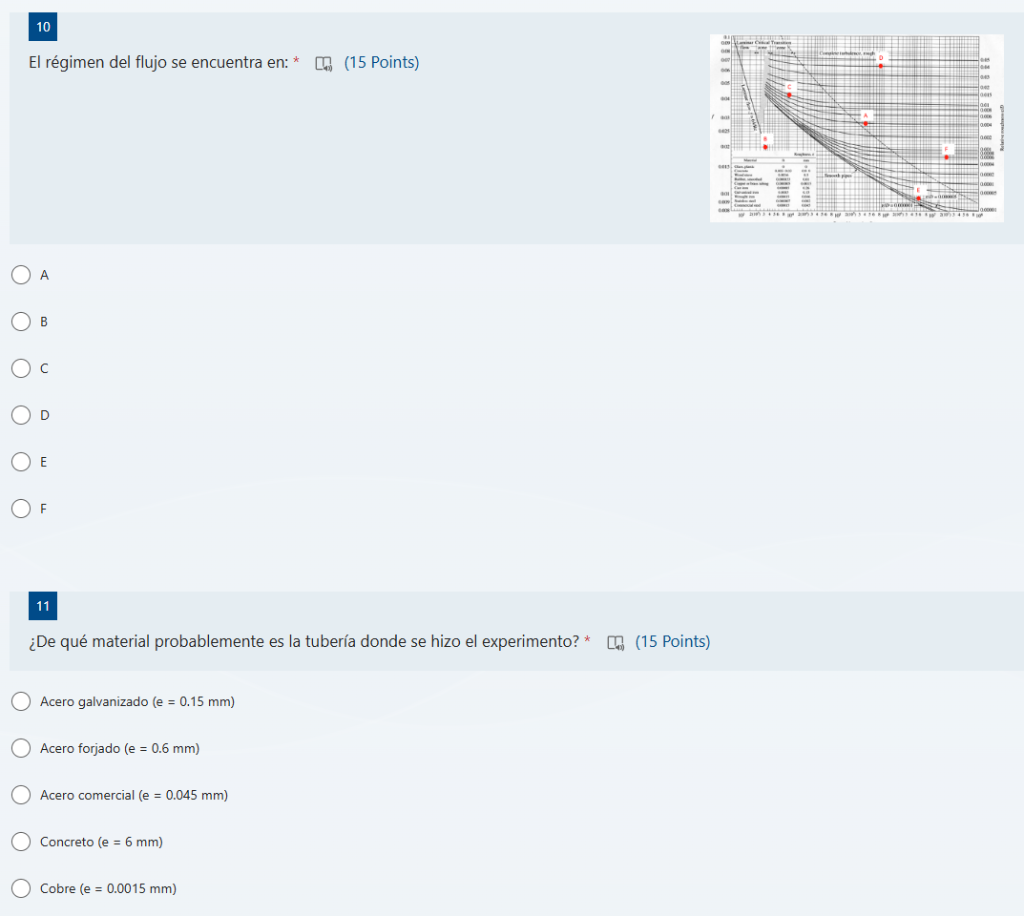 El régimen del flujo se encuentra en: * (1 (15 Points) ik eR
Ie
EMH Ee
Oa
Os
Oc
Ono
Qe
OF
om
De qué material probablemente es la tuberia donde se hizo el experimento? * (13 (15 Points)
(OO Acero galvanizado (e = 0.15 mm)
© Acero forjado (e = 0.6 mm)
O Acero comercial (e = 0.045 mm)
O concreto (e = 6 mm)
© Cobre (e = 00015 mm)
This is AI generated Response.
Asked by: manish kumar
Created at: 2025-12-16 09:13:10
Asked by: manish kumar
Created at: 2025-12-16 09:13:10
Final Answer:
Rendered
Raw Text
Did you like this answer?
# Solution in English
Let's analyze each question step by step.
---
## Question 10
**Question:**
The flow regime is found in:
You are given a Moody diagram with points labeled A to F.
### Step-by-Step Solution
- The Moody diagram is used to determine the flow regime (laminar, transitional, or turbulent) based on the Reynolds number and the relative roughness.
- **Laminar Flow:** Reynolds number \( Re < 200 \)
- **Transitional Flow:** \( 200 < Re < 400 \)
- **Turbulent Flow:** \( Re > 400 \)
**Without more context or data (like which point you are analyzing), you need to identify:**
- If the point is in the straight, lower-left region (laminar),
- The middle, wavy part (transitional),
- Or the upper, flatter right region (turbulent).
**If you have more information (such as Reynolds number or relative roughness for the specific point being asked), please provide it. Otherwise, based on typical labeling:**
- **A** is usually in the laminar region,
- **B/C** in transitional,
- **D/E/F** in turbulent.
---
## Question 11
**Question:**
What is the probable material of the pipe where the experiment was done?
- Galvanized steel \( (e = .15\, mm) \)
- Forged steel \( (e = .6\, mm) \)
- Commercial steel \( (e = .045\, mm) \)
- Concrete \( (e = 6\, mm) \)
- Copper \( (e = .0015\, mm) \)
### Step-by-Step Solution
- To answer this, you need to compare the relative roughness (\( \epsilon \)) used in the experiment to the values given above.
- Usually, the Moody diagram allows you to estimate the relative roughness where your point lies.
- For example, if your experiment's point lies on or near the curve for \( \epsilon/D = .0002 \):
- Find the pipe material with a similar roughness.
**Typical roughness values:**
- **Copper** is the smoothest,
- **Commercial steel** is smoother than galvanized or forged steel,
- **Galvanized steel** is rougher,
- **Forged steel** is even rougher,
- **Concrete** is the roughest.
If your point is near the smoother (lower) curves, **copper** or **commercial steel** is likely.
If near rougher curves, it is likely **galvanized steel** or **forged steel**.
---
## Final Answers (Based on Typical Points)
### 10. The flow regime is at:
- **A:** Laminar
- **B/C:** Transitional
- **D/E/F:** Turbulent
**Select the letter that matches where your point is.**
### 11. The probable material is:
- **If it is a smooth curve near the bottom:** **Copper** or **Commercial steel**
- **If in the middle:** **Galvanized steel**
- **If at the rough top curves:** **Forged steel** or **Concrete**
---
**If you provide which point is being analyzed or more context, I can give a specific answer.**
**Let me know if you want to clarify which point or curve is referenced in each question!**
📢 Instructions:
- Ask anything relatd to above question only.
- For new Question goto :