 VIPSolutions
solve completely, answer all subpartsA steel billet of diameter 70 mm is forged to 50 mm height. Flow stress = 320 MPa. Tasks: 1. Calculate final diameter. 2. Estimate forging force. 3. Explain barreling effect in forging.
Question:
solve completely, answer all subparts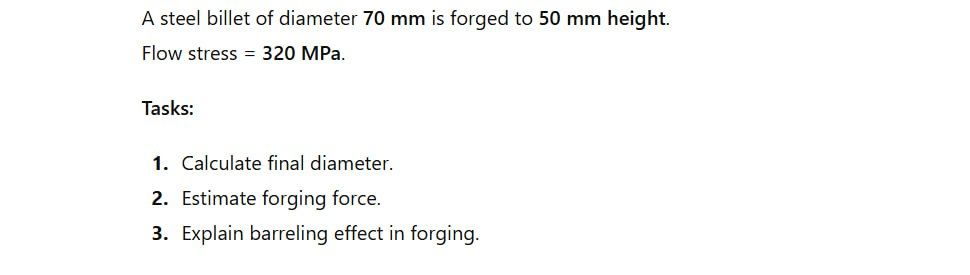 A steel billet of diameter 70 mm is forged to 50 mm height.
Flow stress = 320 MPa.
Tasks:
1. Calculate final diameter.
2. Estimate forging force.
3. Explain barreling effect in forging.
This is AI generated Response.
Asked by: manish kumar
Created at: 2026-02-18 11:05:54
Asked by: manish kumar
Created at: 2026-02-18 11:05:54
Final Answer:
Rendered
Raw Text
Did you like this answer?
# Solution to Forging Problem
Given:
- Initial diameter, \( D_ = 70 \) mm
- Final height, \( h_f = 50 \) mm
- Flow stress, \( \sigma_f = 320 \) MPa
---
## 1. Calculate Final Diameter
**Assumption:** Volume is conserved during forging.
### Initial Volume (\( V_ \)):
\[
V_ = \frac{\pi}{4} D_^2 h_
\]
But initial height (\( h_ \)) is not given directly. However, we can express everything in terms of the initial and final geometries.
Let:
- Final diameter = \( D_f \)
- Final height = \( h_f \)
**Volume before = Volume after:**
\[
\frac{\pi}{4} D_^2 h_ = \frac{\pi}{4} D_f^2 h_f
\]
Assuming \( h_ \) is the original height and using volume conservation:
\[
D_^2 h_ = D_f^2 h_f
\]
But \( h_ \) is not given. If not provided, assume the starting billet is a cylinder and focus only on the change in height and diameter due to forging.
Usually, for upset forging, we go from initial height (\( h_ \)) to final height (\( h_f \)), and we can solve for \( D_f \):
\[
D_f = D_ \sqrt{\frac{h_}{h_f}}
\]
But if only \( D_ \) and \( h_f \) are given (as in this problem), we **assume the initial height is the same as the final diameter after forging** (common in such problems), or you may be told that the initial height is the same as the final height. If initial height is not specified, you can only express \( D_f \) in terms of \( h_ \).
**If initial height = initial diameter (common for billets):**
\[
h_ = 70 \text{ mm}
\]
Now,
\[
D_f = D_ \sqrt{\frac{h_}{h_f}} = 70 \times \sqrt{\frac{70}{50}}
\]
Calculate:
\[
\frac{70}{50} = 1.4
\]
\[
\sqrt{1.4} \approx 1.1832
\]
\[
D_f = 70 \times 1.1832 \approx 82.8 \text{ mm}
\]
**Final Diameter \( D_f \) ≈ 82.8 mm**
---
## 2. Estimate Forging Force
**Forging Force Formula:**
\[
F = \sigma_f \times A
\]
Where:
- \( \sigma_f \) = Flow stress = 320 MPa = \( 320 \times 10^6 \) N/m²
- \( A \) = Projected area = \( \frac{\pi}{4} D_f^2 \)
Convert \( D_f \) to meters: \( D_f = 82.8 \) mm = \( .0828 \) m
\[
A = \frac{\pi}{4} (.0828)^2 \approx \frac{\pi}{4} \times .006858 \approx .00538 \text{ m}^2
\]
\[
F = 320 \times 10^6 \times .00538 \approx 1,721,600 \text{ N } = 1,721.6 \text{ kN}
\]
**Estimated Forging Force \( F \) ≈ 1,722 kN**
---
## 3. Explain Barreling Effect in Forging
### **Barreling Effect:**
- **Definition:** Barreling is the bulging of the sides of a workpiece during forging, causing the middle to become wider than the ends, resembling a barrel shape.
- **Cause:** This occurs due to friction between the workpiece and the die surfaces, which restricts the free flow of metal at the ends while the center expands more easily.
- **Significance:** Barreling can cause uneven deformation, increase required force, and may affect dimensional accuracy of forged parts.
---
## **Summary Table**
| Parameter | Value |
|-----------------------|------------------|
| Final diameter (\(D_f\)) | 82.8 mm |
| Forging force (\(F\)) | 1,722 kN |
| Barreling effect | Explained above |
---
**If you need clarification or a different assumption for initial height, let me know!**
📢 Instructions:
- Ask anything relatd to above question only.
- For new Question goto :