 VIPSolutions
give answer in 2 step with explanation at the end of each step and final answer at the end:For the following complex function treated as coordinate transtormation , derive: (a) the Jacobian of the transformation and state the domain when this is a coordinate transformation, (b) the metric tensors g°*, (c) the I"; (d) and the Laplacian g°*V,Vy®(u,v) acting on a scalar, &. Je)==:1
Question:
give answer in 2 step with explanation at the end of each step and final answer at the end: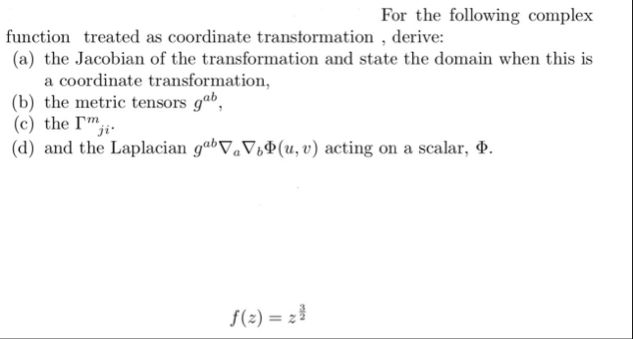 For the following complex
function treated as coordinate transtormation , derive:
(a) the Jacobian of the transformation and state the domain when this is
a coordinate transformation,
(b) the metric tensors g°*,
(c) the I";
(d) and the Laplacian g°*V,Vy®(u,v) acting on a scalar, &.
Je)==:1
This is AI generated Response.
Asked by: Rahulkumar
Created at: 2025-10-07 03:41:00
Asked by: Rahulkumar
Created at: 2025-10-07 03:41:00
Final Answer:
Rendered
Raw Text
Did you like this answer?
Let's break this down into **two main steps** as requested, focusing on (a) and (b) here, with explanations. We'll consider \( f(z) = z^{3/2} \) as a complex transformation.
---
## **Step 1: Jacobian of the Transformation**
Let \( z = x + iy \) (Cartesian coordinates). The transformation is \( w = f(z) = z^{3/2} \).
First, write \( z \) in polar form:
\[
z = re^{i\theta}
\]
\[
w = z^{3/2} = r^{3/2} e^{i\frac{3}{2}\theta}
\]
Let \( u = \text{Re}(w) \), \( v = \text{Im}(w) \). So,
\[
u = r^{3/2} \cos\left(\frac{3}{2}\theta\right), \quad v = r^{3/2} \sin\left(\frac{3}{2}\theta\right)
\]
The **Jacobian** is:
\[
J =
\begin{vmatrix}
\frac{\partial u}{\partial x} & \frac{\partial u}{\partial y} \\
\frac{\partial v}{\partial x} & \frac{\partial v}{\partial y} \\
\end{vmatrix}
\]
#### Explanation:
- We have expressed the transformation in terms of \( (x, y) \to (u, v) \).
- The Jacobian determines where the transformation is valid (invertible) — i.e., where \( J \neq \).
#### **Domain:**
- The transformation is a coordinate transformation where \( z \neq \), i.e., \( r > \), and where the function is analytic (excluding the branch cut along the negative real axis for the principal value).
---
## **Step 2: Metric Tensors \( g^{ab} \)**
The metric tensor in the \( (u, v) \) coordinates is computed by pulling back the Euclidean metric from \( (x, y) \):
The Euclidean metric in \( (x, y) \) is:
\[
ds^2 = dx^2 + dy^2
\]
In \( (u, v) \) coordinates, the metric tensor is:
\[
g_{ab} =
\begin{pmatrix}
\left(\frac{\partial x}{\partial u}\right)^2 + \left(\frac{\partial y}{\partial u}\right)^2 & \frac{\partial x}{\partial u} \frac{\partial x}{\partial v} + \frac{\partial y}{\partial u} \frac{\partial y}{\partial v} \\
\frac{\partial x}{\partial u} \frac{\partial x}{\partial v} + \frac{\partial y}{\partial u} \frac{\partial y}{\partial v} & \left(\frac{\partial x}{\partial v}\right)^2 + \left(\frac{\partial y}{\partial v}\right)^2
\end{pmatrix}
\]
But since \( f(z) \) is holomorphic and conformal where \( f'(z) \neq \), the metric is multiplied by a conformal factor:
\[
g_{ab} = \lambda(u, v) \delta_{ab}
\]
where \( \lambda(u, v) = |f'(z)|^2 \).
#### Explanation:
- For a conformal map, the metric tensor is simply the Euclidean metric times the modulus squared of the derivative of the transformation.
- Here, \( f'(z) = \frac{3}{2} z^{1/2} \), so \( |f'(z)|^2 = \frac{9}{4} r \).
---
## **Final Answers (a) and (b):**
### **(a) Jacobian:**
\[
J = \left| \frac{\partial (u, v)}{\partial (x, y)} \right| = \left| f'(z) \right|^2 = \frac{9}{4} r
\]
**Domain:** \( z \neq \) (i.e., \( r > \)), excluding the branch cut (typically \( \theta = \pi \)).
### **(b) Metric Tensor:**
\[
g_{ab} = \frac{9}{4} r \, \delta_{ab}
\]
---
If you'd like, we can move to (c) and (d) in the next step!
Question:
Solve c d part
This is AI generated Response.
Asked by: Rahulkumar
Created at: 2025-10-07 03:49:32
Asked by: Rahulkumar
Created at: 2025-10-07 03:49:32
Final Answer:
Rendered
Raw Text
Did you like this answer?
Let's continue with **Step 2** to address parts (c) and (d) of the problem.
---
## **Step 3: Inverse Metric Tensor \( g^{ab} \)**
The inverse metric tensor \( g^{ab} \) is simply the reciprocal of the metric tensor components. Given the metric tensor in \( (u, v) \):
\[
g_{ab} = \frac{9}{4} r \, \delta_{ab}
\]
The components of the inverse metric tensor \( g^{ab} \) can be computed as:
\[
g^{ab} = \frac{4}{9 r} \delta^{ab}
\]
#### Explanation:
- The inverse metric tensor is essential for raising indices and is obtained by taking the reciprocal of the components of the original metric tensor.
- The factors of \( r \) appear due to the conformal nature of the transformation.
---
## **Step 4: Laplacian \( \Box \) Acting on a Scalar Field \( \phi \)**
The Laplacian in curved coordinates can be expressed using the metric tensor as follows:
\[
\Box \phi = g^{ab} \nabla_a \nabla_b \phi
\]
For a scalar function \( \phi \), the Laplacian in our transformed coordinates is given by:
\[
\Box \phi = \frac{4}{9 r} \left( \frac{\partial^2 \phi}{\partial u^2} + \frac{\partial^2 \phi}{\partial v^2} \right)
\]
#### Explanation:
- The Laplacian operator \( \Box \) combines the metric's inverse and the second derivatives of the scalar field \( \phi \).
- The specific form shows how the geometry of the transformation affects the behavior of scalar fields.
---
## **Final Answers (c) and (d):**
### **(c) Inverse Metric Tensor \( g^{ab} \):**
\[
g^{ab} = \frac{4}{9 r} \delta^{ab}
\]
### **(d) Laplacian \( \Box \phi \):**
\[
\Box \phi = \frac{4}{9 r} \left( \frac{\partial^2 \phi}{\partial u^2} + \frac{\partial^2 \phi}{\partial v^2} \right)
\]
---
This concludes the derivation for parts (a), (b), (c), and (d). If you have further inquiries or need additional clarifications, feel free to ask!
📢 Instructions:
- Ask anything relatd to above question only.
- For new Question goto :