 VIPSolutions
Solve as per chegg guidelines and add explanation in each step and write final answer and not use = more than once in same lineIV. Let a) = 1, and define the 3 i =v2+a, Prove that the sequence {s,} converges. | is increasing and bounded above.
Question:
Solve as per chegg guidelines and add explanation in each step and write final answer and not use = more than once in same line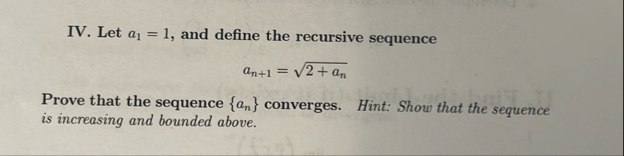 IV. Let a) = 1, and define the 3
i =v2+a,
Prove that the sequence {s,} converges. |
is increasing and bounded above.
This is AI generated Response.
Asked by: Munni kumari
Created at: 2025-07-14 18:27:36
Asked by: Munni kumari
Created at: 2025-07-14 18:27:36
Final Answer:
Rendered
Raw Text
Did you like this answer?
Given:
- \( a_1 = 1 \)
- The recursive sequence: \( a_{n+1} = \sqrt{2 + a_n} \)
We need to **prove that the sequence \( \{a_n\} \) converges**.
*Hint: Show that the sequence is increasing and bounded above.*
---
### **Step 1: Show that the sequence is increasing**
We want to show \( a_{n+1} > a_n \) for all \( n \).
#### **Base Case:**
- \( a_1 = 1 \)
- \( a_2 = \sqrt{2 + a_1} \)
- \( a_2 = \sqrt{2 + 1} \)
- \( a_2 = \sqrt{3} \)
- Since \( \sqrt{3} \approx 1.732 > 1 \), \( a_2 > a_1 \)
#### **Inductive Step:**
Assume \( a_n > a_{n-1} \) for some \( n \geq 1 \).
Consider \( a_{n+1} = \sqrt{2 + a_n} \) and \( a_n = \sqrt{2 + a_{n-1}} \)
Since the function \( f(x) = \sqrt{2 + x} \) is **increasing** (the derivative \( f'(x) = \frac{1}{2\sqrt{2 + x}} > 0 \)),
if \( a_n > a_{n-1} \), then \( a_{n+1} = f(a_n) > f(a_{n-1}) = a_n \).
**Conclusion:** By induction, the sequence is increasing.
---
### **Step 2: Show that the sequence is bounded above**
We want to find an upper bound \( M \) such that \( a_n < M \) for all \( n \).
Suppose \( a_n < 2 \) for all \( n \).
**Base Case:**
- \( a_1 = 1 < 2 \)
**Inductive Step:**
Assume \( a_n < 2 \).
- \( a_{n+1} = \sqrt{2 + a_n} < \sqrt{2 + 2} \)
- \( a_{n+1} < \sqrt{4} \)
- \( a_{n+1} < 2 \)
So by induction, \( a_n < 2 \) for all \( n \).
---
### **Step 3: Conclude convergence**
The sequence \( \{a_n\} \) is **increasing** and **bounded above**.
By the **Monotone Convergence Theorem**, an increasing and bounded sequence converges.
---
### **Step 4: Find the limit (optional)**
Let the limit be \( L \):
- \( L = \sqrt{2 + L} \)
- Square both sides: \( L^2 = 2 + L \)
- Rearranged: \( L^2 - L - 2 = 0 \)
- Factor: \( (L - 2)(L + 1) = 0 \)
- Solutions: \( L = 2 \) or \( L = -1 \)
Since the terms are all positive and less than 2, the limit is \( \boxed{2} \).
---
### **Final Answer**
**The sequence \( \{a_n\} \) is increasing and bounded above, so it converges. The limit of the sequence is \( 2 \).**
📢 Instructions:
- Ask anything relatd to above question only.
- For new Question goto :