 VIPSolutions
Solve all parts completely in englishUn cilindro uniforme de 3 kg, de 400 mm de didmetro, rueda sind. uperficie inclinada, esta acoplada a un k amortiguador ¢ = 5 N.s/m y a un resorte de constante de rigidez k = 8 N/m. Si la masa se ubica a 0.1 m arriba del punto /- xg de equilibrio y se suelta con una velocidad de 1,72 m/s hacia pC abajo. determine: La posicion de la masa en funcién del tiempo Eee
Question:
Solve all parts completely in english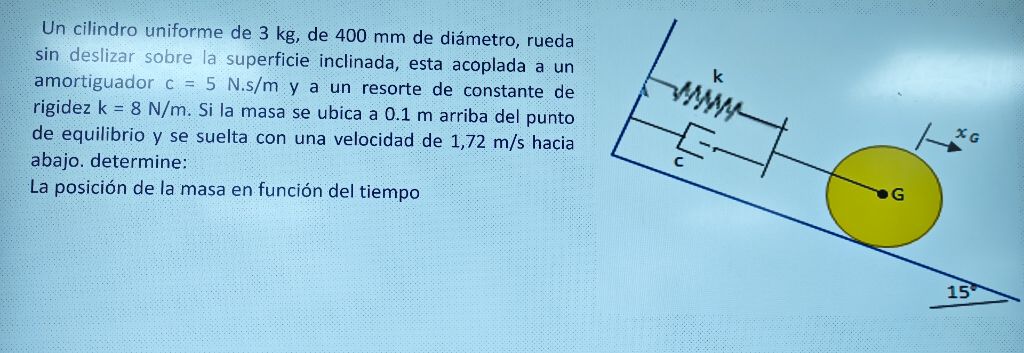 Un cilindro uniforme de 3 kg, de 400 mm de didmetro, rueda
sind. uperficie inclinada, esta acoplada a un k
amortiguador ¢ = 5 N.s/m y a un resorte de constante de
rigidez k = 8 N/m. Si la masa se ubica a 0.1 m arriba del punto /- xg
de equilibrio y se suelta con una velocidad de 1,72 m/s hacia pC
abajo. determine:
La posicion de la masa en funcién del tiempo
Eee
This is AI generated Response.
Asked by: manish kumar
Created at: 2025-12-08 10:32:34
Asked by: manish kumar
Created at: 2025-12-08 10:32:34
Final Answer:
Rendered
Raw Text
Did you like this answer?
Let's solve the problem step by step.
---
## **Given Data**
- **Mass, \( m \):** \( 3\, \text{kg} \)
- **Diameter, \( d \):** \( 400\, \text{mm} = .4\, \text{m} \) ⇒ **Radius, \( r \):** \( .2\, \text{m} \)
- **Incline angle, \( \theta \):** \( 15^\circ \)
- **Damping coefficient, \( c \):** \( 5\, \text{N}\cdot\text{s}/\text{m} \)
- **Spring constant, \( k \):** \( 8\, \text{N}/\text{m} \)
- **Initial displacement, \( x_ \):** \( .1\, \text{m} \) (above equilibrium)
- **Initial velocity, \( v_ \):** \( -1.72\, \text{m/s} \) (downwards)
- **No slipping:** Pure rolling condition
---
## **1. Model the System (Equation of Motion)**
For a cylinder rolling **without slipping** on an incline with a spring and damper:
### **a. Free-Body Diagram**
Forces along the incline (\( x \)-direction):
- Spring force: \( -kx \)
- Damping force: \( -c\dot{x} \)
- Component of gravity: \( mg\sin\theta \)
- Friction (ensures no slip, but does not do work since there is no slipping)
### **b. Rotational Inertia**
Uniform cylinder: Moment of inertia about center, \( I_G = \frac{1}{2}mr^2 \)
### **c. Rolling Condition**
No slip: \( a = r\alpha \) ⇒ \( \ddot{x} = r\ddot{\theta} \)
### **d. Equation of Motion**
Apply Newton’s second law for translation and rotation:
#### **Translation:**
\[
m\ddot{x} = -kx - c\dot{x} + mg\sin\theta + F_f
\]
where \( F_f \) is the friction force **up the incline**.
#### **Rotation:**
\[
I_G\ddot{\theta} = F_f r
\]
But \( \ddot{x} = r\ddot{\theta} \Rightarrow \ddot{\theta} = \frac{\ddot{x}}{r} \):
\[
I_G \frac{\ddot{x}}{r} = F_f r \implies F_f = \frac{I_G}{r^2} \ddot{x}
\]
#### **Combine:**
Substitute \( F_f \):
\[
m\ddot{x} = -kx - c\dot{x} + mg\sin\theta + \frac{I_G}{r^2} \ddot{x}
\]
\[
\left(m + \frac{I_G}{r^2}\right) \ddot{x} + c\dot{x} + kx = mg\sin\theta
\]
For a solid cylinder, \( I_G = \frac{1}{2}mr^2 \):
\[
m + \frac{\frac{1}{2}mr^2}{r^2} = m + \frac{1}{2}m = \frac{3}{2}m
\]
So,
\[
\frac{3}{2}m \ddot{x} + c\dot{x} + kx = mg\sin\theta
\]
Or,
\[
\boxed{
\ddot{x} + \frac{2c}{3m}\dot{x} + \frac{2k}{3m}x = \frac{2g\sin\theta}{3}
}
\]
---
## **2. Substitute Numerical Values**
Given:
- \( m = 3\, \text{kg} \)
- \( c = 5\, \text{N}\cdot\text{s}/\text{m} \)
- \( k = 8\, \text{N}/\text{m} \)
- \( g = 9.81\, \text{m}/\text{s}^2 \)
- \( \theta = 15^\circ \)
Plug into the equation:
- \( \frac{2c}{3m} = \frac{2 \times 5}{3 \times 3} = \frac{10}{9} \approx 1.111\, \text{s}^{-1} \)
- \( \frac{2k}{3m} = \frac{2 \times 8}{3 \times 3} = \frac{16}{9} \approx 1.778\, \text{s}^{-2} \)
- \( \frac{2g\sin\theta}{3} = \frac{2 \times 9.81 \times \sin 15^\circ}{3} \)
- \( \sin 15^\circ \approx .2588 \)
- \( \frac{2 \times 9.81 \times .2588}{3} \approx \frac{5.075}{3} \approx 1.692\, \text{m/s}^2 \)
So:
\[
\boxed{
\ddot{x} + 1.111\,\dot{x} + 1.778\,x = 1.692
}
\]
---
## **3. Solve the Differential Equation**
### **a. Homogeneous Solution**
\[
\ddot{x} + 1.111\,\dot{x} + 1.778\,x =
\]
Characteristic equation:
\[
r^2 + 1.111r + 1.778 =
\]
Discriminant:
\[
\Delta = (1.111)^2 - 4(1.778) = 1.234 - 7.112 = -5.878
\]
Negative, so **underdamped**.
Roots:
\[
r = \frac{-1.111 \pm \sqrt{-5.878}}{2} = -.5555 \pm j1.213
\]
So,
\[
x_h(t) = e^{-.5555 t} \left[ A \cos(1.213 t) + B \sin(1.213 t) \right]
\]
### **b. Particular Solution**
The particular solution for a constant right side is a constant:
\[
x_p = \frac{1.692}{1.778} = .952
\]
### **c. General Solution**
\[
\boxed{
x(t) = .952 + e^{-.5555 t} \left[ A \cos(1.213 t) + B \sin(1.213 t) \right]
}
\]
---
## **4. Initial Conditions**
Given:
- \( x() = x_ = .1 \) m (above equilibrium)
- \( \dot{x}() = v_ = -1.72 \) m/s
At \( t = \):
\[
x() = .952 + A = .1 \implies A = .1 - .952 = -.852
\]
Now, for \( \dot{x}() \):
\[
\dot{x}(t) = e^{-.5555 t} [ -.5555 A \cos(1.213 t) - .5555 B \sin(1.213 t) - A \cdot 1.213 \sin(1.213 t) + B \cdot 1.213 \cos(1.213 t) ]
\]
At \( t = \):
\[
\dot{x}() = [ -.5555 A + 1.213 B ]
\]
\[
-1.72 = -.5555(-.852) + 1.213 B
\]
\[
-1.72 = .473 + 1.213 B
\]
\[
1.213 B = -1.72 - .473 = -2.193
\]
\[
B = \frac{-2.193}{1.213} = -1.808
\]
---
## **5. **Final Solution**
\[
\boxed{
x(t) = .952 + e^{-.5555 t} \Big[ -.852 \cos(1.213 t) - 1.808 \sin(1.213 t) \Big]
}
\]
---
### **Summary Table**
| Parameter | Value |
|-----------|-------|
| \( m \) | \( 3\, \text{kg} \) |
| \( r \) | \( .2\, \text{m} \) |
| \( \theta \) | \( 15^\circ \) |
| \( c \) | \( 5\, \text{N}\cdot\text{s}/\text{m} \) |
| \( k \) | \( 8\, \text{N}/\text{m} \) |
| \( x_ \) | \( .1\, \text{m} \) |
| \( v_ \) | \( -1.72\, \text{m/s} \) |
| \( x(t) \) | \( .952 + e^{-.5555 t} [ -.852 \cos(1.213 t) - 1.808 \sin(1.213 t) ] \) |
---
## **Interpretation**
- The system is **underdamped** (oscillatory with decaying amplitude).
- The cylinder's position as a function of time is given by the above formula.
- The equilibrium position is at \( x = .952\, \text{m} \) **down the incline** from the spring's unstretched length.
---
If you need a plot or further explanation, let me know!
📢 Instructions:
- Ask anything relatd to above question only.
- For new Question goto :