 VIPSolutions
Solve all parts completely in english2.- Determine el desplazamiento x(t) de estado permanente, si y(t) = 0,1 cos (120t) (en f—— x(t) 2 pulgadas), donde t esta en segundos, la masa m K y(t) = 0,01 Ib?/pulg, la constante de rigidez k = 100 k Ib/pulg y la constante de amortiguamiento c = SE B 21 Ib s/pulg. Para este caso, determine la = © — amplitud y el angulo de fase de la solucién particular.
Question:
Solve all parts completely in english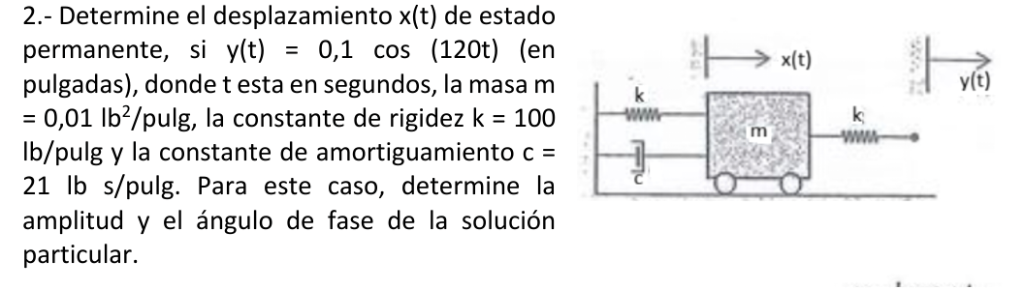 2.- Determine el desplazamiento x(t) de estado
permanente, si y(t) = 0,1 cos (120t) (en f—— x(t) 2
pulgadas), donde t esta en segundos, la masa m K y(t)
= 0,01 Ib?/pulg, la constante de rigidez k = 100 k
Ib/pulg y la constante de amortiguamiento c = SE B
21 Ib s/pulg. Para este caso, determine la = © —
amplitud y el angulo de fase de la solucién
particular.
This is AI generated Response.
Asked by: manish kumar
Created at: 2025-12-13 08:54:02
Asked by: manish kumar
Created at: 2025-12-13 08:54:02
Final Answer:
Rendered
Raw Text
Did you like this answer?
# Solution to Problem 2
**Given:**
- Forcing function: \( y(t) = .1 \cos(120t) \) (in inches)
- \( t \) is in seconds
- \( m = .01 \) lb·s²/in
- \( k = 100 \) lb/in
- \( c = 21 \) lb·s/in
We are to **determine the steady-state displacement \( x(t) \)**, **amplitude**, and **phase angle** for the particular solution.
---
## 1. **Equation of Motion**
For a mass-spring-damper system with base excitation:
\[
m\ddot{x} + c\dot{x} + kx = k y(t)
\]
---
## 2. **Substitute Known Values**
\[
.01\ddot{x} + 21\dot{x} + 100x = 100 \cdot .1 \cos(120t)
\]
\[
.01\ddot{x} + 21\dot{x} + 100x = 10 \cos(120t)
\]
---
## 3. **Standardize the Equation**
Divide both sides by \( .01 \):
\[
\ddot{x} + 210\dot{x} + 10000x = 100 \cos(120t)
\]
---
## 4. **Steady-State Solution (Particular Solution)**
Assume a solution of the form:
\[
x_p(t) = X \cos(120t - \phi)
\]
---
## 5. **Find Amplitude \( X \) and Phase \( \phi \)**
- \( \omega = 120 \) rad/s
- General forced response amplitude for \( F_\cos(\omega t) \):
\[
X = \frac{F_}{\sqrt{(k - m\omega^2)^2 + (c\omega)^2}}
\]
Where \( F_ = 100 \) (from above).
Now calculate:
- \( k - m\omega^2 = 10000 - .01 \times (120)^2 = 10000 - .01 \times 14400 = 10000 - 144 = 9856 \)
- \( c\omega = 210 \times 120 = 252000 \)
So,
\[
X = \frac{100}{\sqrt{9856^2 + 252000^2}}
\]
Calculate denominator:
- \( 9856^2 = 97,144,576 \)
- \( 252000^2 = 63,504,000,000 \)
- Sum: \( 63,504,000,000 + 97,144,576 = 63,601,144,576 \)
- Square root: \( \sqrt{63,601,144,576} \approx 252,188 \)
So,
\[
X \approx \frac{100}{252,188} \approx .00397 \text{ in}
\]
---
## 6. **Phase Angle \( \phi \)**
\[
\tan \phi = \frac{c\omega}{k - m\omega^2}
\]
\[
\tan \phi = \frac{252,000}{9856} \approx 25.58
\]
\[
\phi = \arctan(25.58) \approx 87.8^\circ
\]
---
## 7. **Final Steady-State Solution**
\[
\boxed{
x(t) = .00397 \cos(120t - 87.8^\circ) \quad \text{(inches)}
}
\]
---
### **Summary Table**
| Quantity | Value |
|---------------|----------------------------|
| Amplitude | \( .00397 \) in |
| Phase Angle | \( 87.8^\circ \) |
| \( x(t) \) | \( .00397 \cos(120t - 87.8^\circ) \) in |
---
## **Physical Meaning**
- The system's displacement \( x(t) \) is a sinusoid at the same frequency as the input, but with a much smaller amplitude and a significant phase lag due to the damping and high frequency.
📢 Instructions:
- Ask anything relatd to above question only.
- For new Question goto :