 VIPSolutions
Solve all parts completely5. Determine the force F needed to lift the bucket having a weight of 1001b. Hint: Note that the coordinates s4 and sp can be related to the constant vertical length / of the cord. — ¥ | | |] ; 55 [ | B | /, 2 El 0 Po £7 7 . i y riz ; ¥ Fa
Question:
Solve all parts completely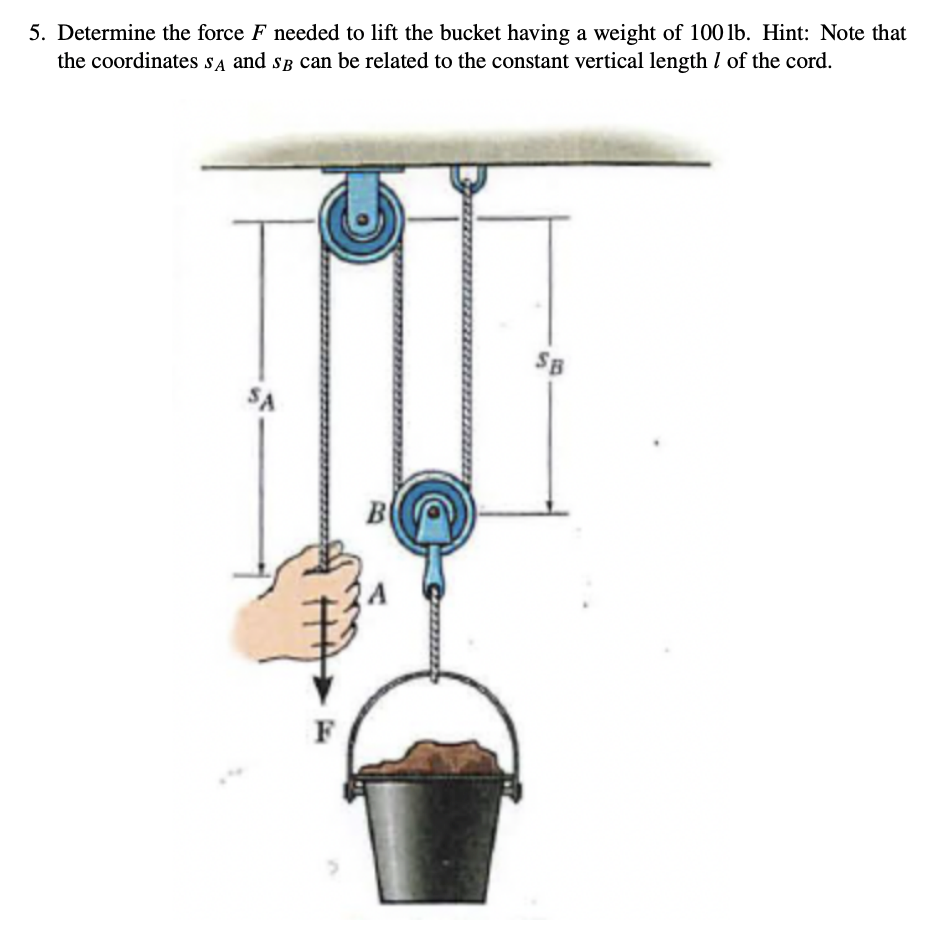 5. Determine the force F needed to lift the bucket having a weight of 1001b. Hint: Note that
the coordinates s4 and sp can be related to the constant vertical length / of the cord.
— ¥
| | |]
; 55
[ |
B | /,
2
El 0
Po £7 7 . i y
riz ;
¥ Fa
This is AI generated Response.
Asked by: manish kumar
Created at: 2025-12-09 11:24:39
Asked by: manish kumar
Created at: 2025-12-09 11:24:39
Final Answer:
Rendered
Raw Text
Did you like this answer?
Let's solve the problem step by step.
---
## **Step 1: Understanding the System**
This is a basic **pulley system** (movable pulley).
- The **bucket** has a weight \( W = 100 \) lb.
- You apply a **force \( F \)** downward at point \( A \).
- The **cord passes over a fixed pulley**, then through a movable pulley attached to the bucket.
---
## **Step 2: Relating Cord Lengths**
Let:
- \( s_A \) = distance from the support to point A (where the force is applied)
- \( s_B \) = distance from the support to the bucket
Since the total length \( l \) of the cord is constant, we have:
\[
s_A + 2s_B = \text{constant}
\]
- When you pull the cord at \( A \) down by a distance \(\Delta s_A\), the bucket rises by \(\Delta s_B\), such that
\[
\Delta s_A + 2\Delta s_B = \implies \Delta s_A = -2\Delta s_B
\]
- Thus, **for every 2 units the cord is pulled down at \( A \), the bucket rises by 1 unit.**
---
## **Step 3: Virtual Work Principle**
Let’s use **virtual work** to relate the forces.
- The **work done by the applied force \( F \)** is:
\[
\delta W_F = F\,\delta s_A
\]
- The **work done against the weight \( W \)** is:
\[
\delta W_W = -W\,\delta s_B
\]
(Negative because the weight acts downward, but the bucket moves up.)
**Set the total virtual work to zero:**
\[
F\,\delta s_A - W\,\delta s_B =
\]
From above: \( \delta s_A = -2\,\delta s_B \)
Plug in:
\[
F \cdot (-2\,\delta s_B) - W\,\delta s_B = \\
(-2F - W)\delta s_B =
\]
Since \(\delta s_B \neq \):
\[
-2F - W = \implies 2F = -W \implies F = -\frac{W}{2}
\]
The negative means the force is in the opposite direction to \( W \) (which matches the diagram; you pull down to lift the bucket).
So, **magnitude**:
\[
F = \frac{W}{2}
\]
---
## **Step 4: Plug in the Values**
Given \( W = 100 \) lb:
\[
F = \frac{100}{2} = 50~\text{lb}
\]
---
## **Final Answer**
### **The force \( F \) needed to lift the bucket is:**
\[
\boxed{50~\text{lb}}
\]
---
### **Summary Table**
| Parameter | Value |
|-----------|----------------|
| Weight \( W \) | 100 lb |
| Required force \( F \) | 50 lb |
---
**Key Concept:**
*A movable pulley system with one movable and one fixed pulley gives a mechanical advantage of 2. Thus, the force required is half the weight.*
📢 Instructions:
- Ask anything relatd to above question only.
- For new Question goto :