 VIPSolutions
give answer in 2 step with explanation at the end of each step and final answer at the end:Exercise 2 Explain 1. why the NS sector describes only bosonic states and the R sector only fermionic ones 2, why closed strings have four distinct sectors (NS-NS, NS R, RNS, and R-R), and discuss which of them correspond to bosonic states and which to fermionic states. 1 Exercise 3 The conserved current associated with the global world-sheet supersymmetry of the RNS string is the world-sheet supercurrent. Use the Noether's theorem to construct the explicit form of such current
Question:
give answer in 2 step with explanation at the end of each step and final answer at the end: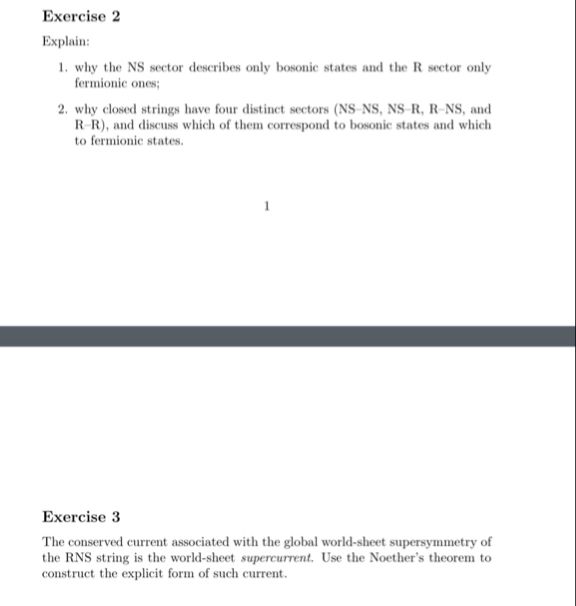 Exercise 2
Explain
1. why the NS sector describes only bosonic states and the R sector only
fermionic ones
2, why closed strings have four distinct sectors (NS-NS, NS R, RNS, and
R-R), and discuss which of them correspond to bosonic states and which
to fermionic states.
1
Exercise 3
The conserved current associated with the global world-sheet supersymmetry of
the RNS string is the world-sheet supercurrent. Use the Noether's theorem to
construct the explicit form of such current
This is AI generated Response.
Asked by: Rahul
Created at: 2025-11-08 08:03:11
Asked by: Rahul
Created at: 2025-11-08 08:03:11
Final Answer:
Rendered
Raw Text
Did you like this answer?
## Exercise 2 Solution
### Step 1: Why the NS sector describes only bosonic states and the R sector only fermionic ones
**Explanation:**
- **NS (Neveu-Schwarz) Sector:**
In the NS sector, the boundary conditions for the worldsheet fermions are **antiperiodic**. This means that the fermionic modes are half-integer moded (i.e., their mode numbers are \( r = n + 1/2 \), where \( n \) is an integer). The ground state in the NS sector is a scalar (bosonic), and the first excited state is created by a single fermionic oscillator, which still forms a bosonic representation due to the statistics from the vacuum structure.
- **R (Ramond) Sector:**
In the R sector, the boundary conditions for the worldsheet fermions are **periodic**. The fermionic modes are integer moded (\( r = n \)), and the ground state is degenerate due to the presence of zero modes. These zero modes satisfy a Clifford algebra and generate a representation of the spacetime gamma matrices, resulting in a ground state that is a spacetime spinor (fermion).
**Summary for Step 1:**
- NS sector → Bosonic states
- R sector → Fermionic states
---
### Step 2: Why closed strings have four distinct sectors, and which correspond to bosonic/fermionic states
**Explanation:**
- **Closed String Sectors:**
Closed strings have both left-moving and right-moving modes, and each can independently be in either the NS or R sector. This gives four possible combinations:
- NS-NS (Left: NS, Right: NS)
- NS-R (Left: NS, Right: R)
- R-NS (Left: R, Right: NS)
- R-R (Left: R, Right: R)
- **Bosonic vs. Fermionic States:**
- **NS-NS and R-R:** Both left and right sectors are either bosonic (NS) or both are fermionic (R). The combination of two bosonic sectors (NS-NS) or two fermionic sectors (R-R) results in an overall **bosonic state**, because a product of two fermions (spinors) can make either a scalar or higher-spin boson.
- **NS-R and R-NS:** Here, one side is bosonic (NS) and the other is fermionic (R). The combination of a bosonic and a fermionic sector gives an overall **fermionic state**.
**Summary for Step 2:**
- NS-NS and R-R → Bosonic states
- NS-R and R-NS → Fermionic states
---
## **Final Answer**
1. The NS sector describes only bosonic states because its ground state is a scalar, while the R sector describes only fermionic states because its ground state is a spacetime spinor due to the presence of fermionic zero modes.
2. Closed strings have four sectors (NS-NS, NS-R, R-NS, R-R) because both left- and right-movers can independently be in NS or R sectors. NS-NS and R-R correspond to bosonic states, while NS-R and R-NS correspond to fermionic states.
Question:
Solve all parts
This is AI generated Response.
Asked by: Rahul
Created at: 2025-11-08 08:03:37
Asked by: Rahul
Created at: 2025-11-08 08:03:37
Final Answer:
Rendered
Raw Text
Did you like this answer?
## Exercise 2 Solution
### Step 1: NS and R Sectors
**Why the NS Sector Describes Bosonic States and the R Sector Describes Fermionic States**
- **NS (Neveu-Schwarz) Sector:**
- Boundary conditions for fermions are **antiperiodic**, leading to half-integer mode numbers \( r = n + 1/2 \).
- The ground state is a scalar (bosonic), and excited states formed by adding fermionic oscillators remain bosonic due to vacuum structure.
- **R (Ramond) Sector:**
- Boundary conditions for fermions are **periodic**, allowing integer mode numbers \( r = n \).
- Ground state is a degenerate spacetime spinor (fermion) arising from the presence of fermionic zero modes that satisfy Clifford algebra.
**Summary for Step 1:**
- NS sector → Bosonic states
- R sector → Fermionic states
---
### Step 2: Closed Strings and Their Four Distinct Sectors
**Why Closed Strings Have Four Distinct Sectors**
- **Closed String Sectors:**
Each closed string has left-moving and right-moving modes, with each mode able to be in either the NS or R sector. This results in:
- NS-NS (Both Left and Right are NS)
- NS-R (Left is NS, Right is R)
- R-NS (Left is R, Right is NS)
- R-R (Both Left and Right are R)
- **Bosonic vs. Fermionic States:**
- **NS-NS and R-R:**
Both correspond to overall **bosonic states**. NS-NS consists of two bosonic states, while R-R, being a product of fermions, can yield bosonic excitations.
- **NS-R and R-NS:**
Each combination results in **fermionic states** since one side is bosonic and the other is fermionic.
**Summary for Step 2:**
- NS-NS and R-R → Bosonic states
- NS-R and R-NS → Fermionic states
---
## Final Answer
1. The NS sector describes only bosonic states due to its scalar ground state, while the R sector describes only fermionic states because its ground state is a spacetime spinor from fermionic zero modes.
2. Closed strings have four sectors (NS-NS, NS-R, R-NS, R-R) because left- and right-moving modes can independently be in NS or R sectors. The NS-NS and R-R correspond to bosonic states, while NS-R and R-NS correspond to fermionic states.
📢 Instructions:
- Ask anything relatd to above question only.
- For new Question goto :