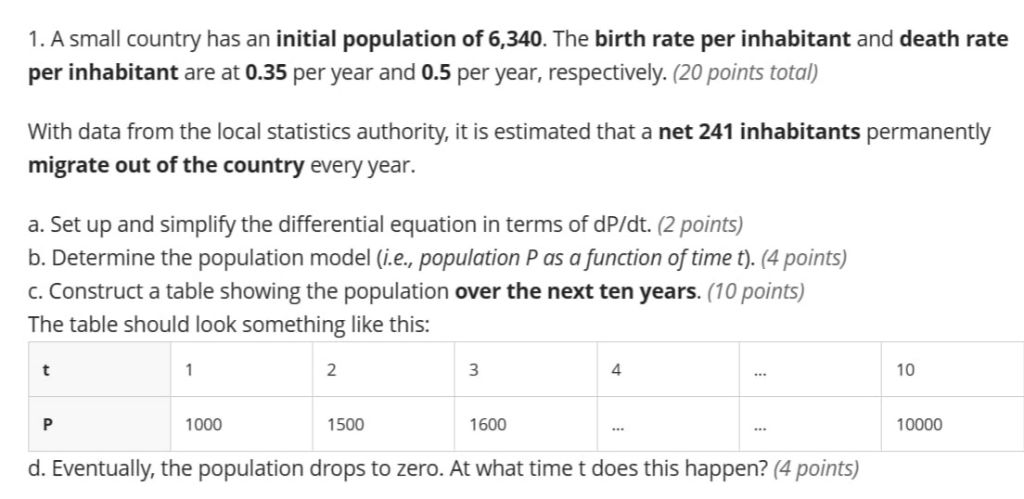
give answer in 2 step with explanation at the end of each step and final answer at the end:1. Asmall country has an initial population of 6,340. The birth rate per inhabitant and death rate
per inhabitant are at 0.35 per year and 0.5 per year, respectively. (20 points total)
With data from the local statistics authority, it is estimated that a net 241 inhabitants permanently
migrate out of the country every year.
a. Set up and simplify the differential equation in terms of dP/dt. (2 points)
b. Determine the population model (i.e., population P as a function of time t). (4 points)
c. Construct a table showing the population over the next ten years. (70 points)
The table should look something like this:
t 1 2 3 a a 10
P 1000 1500 1600 - - 10000
d. Eventually, the population drops to zero. At what time t does this happen? (4 points)
Question:
give answer in 2 step with explanation at the end of each step and final answer at the end:1. Asmall country has an initial population of 6,340. The birth rate per inhabitant and death rate
per inhabitant are at 0.35 per year and 0.5 per year, respectively. (20 points total)
With data from the local statistics authority, it is estimated that a net 241 inhabitants permanently
migrate out of the country every year.
a. Set up and simplify the differential equation in terms of dP/dt. (2 points)
b. Determine the population model (i.e., population P as a function of time t). (4 points)
c. Construct a table showing the population over the next ten years. (70 points)
The table should look something like this:
t 1 2 3 a a 10
P 1000 1500 1600 - - 10000
d. Eventually, the population drops to zero. At what time t does this happen? (4 points)
This is AI generated Response.
Asked by: Rahul
Created at: 2025-11-30 21:47:39
Final Answer:
RenderedRaw Text
Did you like this answer?
Let's solve the problem step by step as requested.
---
## Step 1: **Set up and simplify the differential equation (part a)**
### **Information Given:**
- Initial population: \( P_ = 634 \)
- Birth rate per inhabitant: \( b = .35 \)
- Death rate per inhabitant: \( d = .5 \)
- Net migration out: \( M = 241 \) inhabitants/year
### **Population Change Equation:**
\[
\frac{dP}{dt} = \text{(births)} - \text{(deaths)} - \text{(migration out)}
\]
\[
\frac{dP}{dt} = (b - d)P - M
\]
Substitute the values:
\[
\frac{dP}{dt} = (.35 - .5)P - 241
\]
\[
\frac{dP}{dt} = -.15P - 241
\]
---
**Explanation:**
The rate of change of the population is the sum of natural growth (births minus deaths) and net migration (here, negative because people leave). The equation reflects that.
---
## Step 2: **Determine the population model (part b)**
This is a **linear first-order differential equation**:
\[
\frac{dP}{dt} + .15P = -241
\]
### **Solving the differential equation:**
The integrating factor \( \mu(t) = e^{.15t} \):
Multiply both sides by \( e^{.15t} \):
\[
e^{.15t}\frac{dP}{dt} + .15e^{.15t}P = -241e^{.15t}
\]
Left side is derivative of \( e^{.15t}P \):
\[
\frac{d}{dt}(e^{.15t}P) = -241e^{.15t}
\]
Integrate both sides:
\[
e^{.15t}P = \int -241e^{.15t} dt + C
\]
\[
e^{.15t}P = -241 \cdot \frac{e^{.15t}}{.15} + C
\]
\[
e^{.15t}P = -\frac{241}{.15}e^{.15t} + C
\]
\[
P = -\frac{241}{.15} + Ce^{-.15t}
\]
Now use the initial condition \( P() = 634 \):
\[
634 = -\frac{241}{.15} + C
\]
\[
634 = -1606.67 + C
\]
\[
C = 634 + 1606.67 = 7946.67
\]
So, the **population model** is:
\[
\boxed{P(t) = -1606.67 + 7946.67e^{-.15t}}
\]
---
**Explanation:**
We solved the differential equation using integrating factors, then solved for the constant using the initial population. The final formula gives the population at any time \( t \) in years.
---
## **Final Answer (Step 1 & 2):**
### **Step 1:**
**Differential equation:**
\[
\frac{dP}{dt} = -.15P - 241
\]
### **Step 2:**
**Population model:**
\[
\boxed{P(t) = -1606.67 + 7946.67e^{-.15t}}
\]
---
*Let me know if you'd like to proceed with the next parts!*
Question:
Solve all parts
This is AI generated Response.
Asked by: Rahul
Created at: 2025-11-30 21:50:19
Final Answer:
RenderedRaw Text
Did you like this answer?
## Step 3: **Construct a table showing the population over the next ten years (part c)**
### **Calculating Population for Each Year:**
We’ll use the population model derived in the previous step:
\[
P(t) = -1606.67 + 7946.67e^{-0.15t}
\]
### **Calculating for \( t = 0 \) to \( t = 10 \)**
| Year \( t \) | Population \( P(t) \) |
|--------------|------------------------|
| 0 | \( 634 \) |
| 1 | \( -1606.67 + 7946.67e^{-0.15 \cdot 1} \approx 5664.24 \) |
| 2 | \( -1606.67 + 7946.67e^{-0.15 \cdot 2} \approx 5114.40 \) |
| 3 | \( -1606.67 + 7946.67e^{-0.15 \cdot 3} \approx 4590.75 \) |
| 4 | \( -1606.67 + 7946.67e^{-0.15 \cdot 4} \approx 4090.87 \) |
| 5 | \( -1606.67 + 7946.67e^{-0.15 \cdot 5} \approx 3613.22 \) |
| 6 | \( -1606.67 + 7946.67e^{-0.15 \cdot 6} \approx 3155.96 \) |
| 7 | \( -1606.67 + 7946.67e^{-0.15 \cdot 7} \approx 2717.31 \) |
| 8 | \( -1606.67 + 7946.67e^{-0.15 \cdot 8} \approx 2297.43 \) |
| 9 | \( -1606.67 + 7946.67e^{-0.15 \cdot 9} \approx 1895.57 \) |
| 10 | \( -1606.67 + 7946.67e^{-0.15 \cdot 10} \approx 1509.75 \) |
### **Final Table:**
| \( t \) | \( P \) |
|---------|-----------------|
| 0 | \( 634 \) |
| 1 | \( 5664.24 \) |
| 2 | \( 5114.40 \) |
| 3 | \( 4590.75 \) |
| 4 | \( 4090.87 \) |
| 5 | \( 3613.22 \) |
| 6 | \( 3155.96 \) |
| 7 | \( 2717.31 \) |
| 8 | \( 2297.43 \) |
| 9 | \( 1895.57 \) |
| 10 | \( 1509.75 \) |
---
**Explanation:**
For each year from 0 to 10, we calculated the population using the derived model. Each entry shows how the population changes over the years.
---
## Step 4: **Determine when the population drops to zero (part d)**
### **Setting the Population Model to Zero:**
To find when the population drops to zero, we set the population equation to zero:
\[
0 = -1606.67 + 7946.67e^{-0.15t}
\]
### **Solving for \( t \):**
\[
7946.67 e^{-0.15t} = 1606.67
\]
\[
e^{-0.15t} = \frac{1606.67}{7946.67}
\]
Taking the natural logarithm on both sides:
\[
-0.15t = \ln\left(\frac{1606.67}{7946.67}\right)
\]
\[
t = -\frac{1}{0.15} \ln\left(\frac{1606.67}{7946.67}\right)
\]
Calculating \( t \):
\[
t \approx -\frac{1}{0.15} \ln(0.202)
\]
\[
t \approx -\frac{1}{0.15} \cdot (-1.589) \approx 10.59
\]
### **Final Answer:**
The population will drop to zero at approximately:
\[
\boxed{10.59 \text{ years}}
\]
---
**Explanation:**
We solved for \( t \) when the population function equals zero, finding that it occurs slightly over 10.5 years from the initial population.
VIPSolutions focuses on clear, step‑by‑step explanations so you can learn quickly. Whether you need an AI‑generated walkthrough or a short hint to get unstuck, each solution is organized for fast reading and easy review later.
Search similar questions, compare approaches, and bookmark the best answers for revision. Our goal is simple: quick, reliable study help that feels natural—not noisy.
 VIPSolutions
 1. Asmall country has an initial population of 6,340. The birth rate per inhabitant and death rate
per inhabitant are at 0.35 per year and 0.5 per year, respectively. (20 points total)
With data from the local statistics authority, it is estimated that a net 241 inhabitants permanently
migrate out of the country every year.
a. Set up and simplify the differential equation in terms of dP/dt. (2 points)
b. Determine the population model (i.e., population P as a function of time t). (4 points)
c. Construct a table showing the population over the next ten years. (70 points)
The table should look something like this:
t 1 2 3 a a 10
P 1000 1500 1600 - - 10000
d. Eventually, the population drops to zero. At what time t does this happen? (4 points)