 VIPSolutions
solve allIwo PEC electrodes are attached to the ends of a furved bar. + The bar medium has conductivity, 6(F) =G, a and permittivity, &(F)=¢, B Y _ vy let ®,, £{(1.0.2)| A
Question:
solve all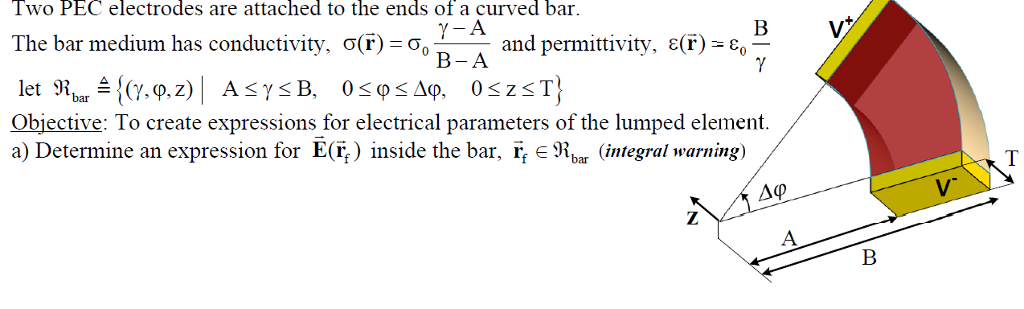 Iwo PEC electrodes are attached to the ends of a furved bar. +
The bar medium has conductivity, 6(F) =G, a and permittivity, &(F)=¢, B Y
_ vy
let ®,, £{(1.0.2)| A
This is AI generated Response.
Asked by: Adapaka Jagadeesh
Created at: 2025-07-29 20:15:43
Asked by: Adapaka Jagadeesh
Created at: 2025-07-29 20:15:43
Final Answer:
Rendered
Raw Text
Did you like this answer?
Let's break down what is given and requested:
### **Given:**
- **Bar Shape:** Curved bar (cylindrical segment), with length \(A \leq \gamma \leq B\), angle \(0 \leq \varphi \leq \Delta \varphi\), height \(0 \leq z \leq T\).
- **Conductivity:** \(\sigma(\vec{r}) = \sigma_0 \frac{\gamma - A}{B - A}\)
- **Permittivity:** \(\epsilon(\vec{r}) = \epsilon_0 \frac{B}{\gamma}\)
- **Region:** \(\mathbb{R}_{\text{bar}} = \{ (\gamma, \varphi, z) \mid A \leq \gamma \leq B,\, 0 \leq \varphi \leq \Delta\varphi,\, 0 \leq z \leq T \}\)
- **Boundary:** PEC electrodes at the ends (\(\gamma = A\), \(\gamma = B\)), held at potentials \(V^+\), \(V^-\).
---
### **To Find:**
**(a) Expression for \(\vec{E}(\vec{r}_f)\) inside the bar.**
---
## **1. Governing Equation**
Since the bar is between two electrodes, and assuming static or quasi-static conditions, the electric field \(\vec{E} = -\vec{\nabla} V\), where \(V\) is the potential.
#### **Laplace's Equation**
Because the electrodes are at fixed potentials and there are no free charges inside,
\[
\vec{\nabla} \cdot \left( \epsilon(\vec{r}) \vec{\nabla} V \right) = 0
\]
But for conductivity and DC, we use:
\[
\vec{\nabla} \cdot \left( \sigma(\vec{r}) \vec{\nabla} V \right) = 0
\]
#### **Symmetry**
The bar is symmetric in \(\varphi\) and \(z\), so the potential only varies with \(\gamma\):
\[
V = V(\gamma)
\]
---
## **2. Setting Up the Equation**
In cylindrical coordinates, for a function of \(\gamma\) only:
\[
\frac{1}{\gamma}\frac{d}{d\gamma} \left( \gamma \sigma(\gamma) \frac{dV}{d\gamma} \right) = 0
\]
Plug in \(\sigma(\gamma)\):
\[
\sigma(\gamma) = \sigma_0 \frac{\gamma - A}{B - A}
\]
So:
\[
\frac{1}{\gamma}\frac{d}{d\gamma} \left( \gamma \frac{\gamma - A}{B - A} \frac{dV}{d\gamma} \right) = 0
\]
---
## **3. Integrate**
Let’s introduce \(u(\gamma) = \gamma (\gamma - A)\):
\[
\frac{d}{d\gamma} \left( u(\gamma) \frac{dV}{d\gamma} \right) = 0
\implies
u(\gamma) \frac{dV}{d\gamma} = C_1
\implies
\frac{dV}{d\gamma} = \frac{C_1}{u(\gamma)}
\]
Integrate both sides:
\[
dV = \frac{C_1}{u(\gamma)} d\gamma
\implies
V(\gamma) = C_1 \int \frac{1}{\gamma (\gamma - A)} d\gamma + C_2
\]
Let’s compute the integral:
\[
\int \frac{1}{\gamma(\gamma - A)} d\gamma = \int \left[ \frac{1}{A} \left( \frac{1}{\gamma - A} - \frac{1}{\gamma} \right) \right] d\gamma
= \frac{1}{A} \ln \left| \frac{\gamma - A}{\gamma} \right|
\]
So:
\[
V(\gamma) = \frac{C_1}{A} \ln \left| \frac{\gamma - A}{\gamma} \right| + C_2
\]
---
## **4. Apply Boundary Conditions**
- At \(\gamma = A\): \(V = V^+\)
- At \(\gamma = B\): \(V = V^-\)
Plug in \(\gamma = A\):
\[
V^+ = \frac{C_1}{A} \ln 0 + C_2 \implies \ln 0 \to -\infty
\]
This suggests a singularity at \(\gamma = A\), which is expected with a perfect electrode.
Let’s check at \(\gamma = B\):
\[
V^- = \frac{C_1}{A} \ln \left( \frac{B - A}{B} \right) + C_2
\]
To avoid the singularity, sometimes the potential is set just inside the bar, or you can keep the form and use potential differences.
Let’s compute the potential difference:
\[
V^+ - V^- = \frac{C_1}{A} \left[ \ln 0 - \ln \left( \frac{B - A}{B} \right) \right]
\]
But \(\ln 0 \to -\infty\). In practice, the field just inside the bar is what is needed. Let's write the field:
---
## **5. **Electric Field**
\[
\vec{E}(\gamma) = -\frac{dV}{d\gamma} \hat{\gamma} = -\frac{C_1}{\gamma (\gamma - A)} \hat{\gamma}
\]
To find \(C_1\), integrate from \(A\) to \(B\):
\[
\int_A^B \vec{E}(\gamma) d\gamma = V^+ - V^-
\]
But with the singularity, usually the boundary is just outside the electrode, i.e., from \(A + \epsilon\) to \(B - \epsilon\), or the result is given with reference to the difference.
---
## **6. **Final Expression**
**The electric field inside the bar:**
\[
\boxed{
\vec{E}(\vec{r}_f) = -\frac{C_1}{\gamma_f (\gamma_f - A)} \hat{\gamma}
}
\]
where \(C_1\) is determined by the applied voltage:
\[
V^+ - V^- = \frac{C_1}{A} \ln \left( \frac{B - A}{B} \right)
\implies
C_1 = A \frac{V^+ - V^-}{\ln \left( \frac{B - A}{B} \right)}
\]
So,
\[
\boxed{
\vec{E}(\vec{r}_f) =
- \frac{A (V^+ - V^-)}{\ln\left( \frac{B - A}{B} \right)} \cdot \frac{1}{\gamma_f (\gamma_f - A)} \hat{\gamma}
}
\]
**where:**
- \(\gamma_f\) is the radial coordinate of the field point,
- \(\hat{\gamma}\) is the unit vector in the radial direction,
- \(A, B\) are the inner and outer radii.
---
### **Summary Table**
| **Parameter** | **Expression** |
|-----------------|---------------|
| \(\vec{E}(\vec{r}_f)\) | \(- \frac{A (V^+ - V^-)}{\ln\left( \frac{B - A}{B} \right)} \cdot \frac{1}{\gamma_f (\gamma_f - A)} \hat{\gamma}\) |
---
Let me know if you need the current, resistance, or capacitance as well!
📢 Instructions:
- Ask anything relatd to above question only.
- For new Question goto :