 VIPSolutions
Solve according to chegg guidelines in two step and add explanation in each step along with final answerIn Class Question 4.8 A 10-kg block is stationary on a horizontal surface. You apply a horizontal force of 30 N. If the maximum static frictional force is 50 N, what is the acceleration of the block? a om/s b. 2m/s? c 3m/e d. 5m/s? e. 8m/s?
Question:
Solve according to chegg guidelines in two step and add explanation in each step along with final answer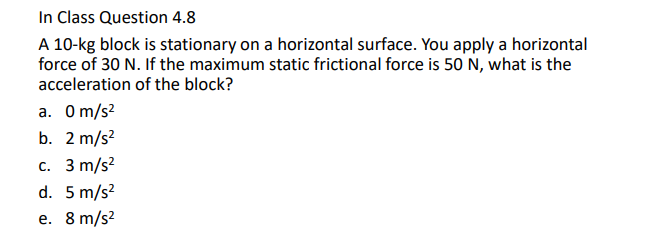 In Class Question 4.8
A 10-kg block is stationary on a horizontal surface. You apply a horizontal
force of 30 N. If the maximum static frictional force is 50 N, what is the
acceleration of the block?
a om/s
b. 2m/s?
c 3m/e
d. 5m/s?
e. 8m/s?
This is AI generated Response.
Asked by: July kumari
Created at: 2025-07-10 09:51:00
Asked by: July kumari
Created at: 2025-07-10 09:51:00
Final Answer:
Rendered
Raw Text
Did you like this answer?
Let's solve the problem step by step as per Chegg guidelines:
---
**Step 1: Compare the applied force with the maximum static frictional force.**
- Applied force \( F_{applied} = 30\) N
- Maximum static frictional force \( f_{s, max} = 50\) N
**Explanation:**
The block will only start moving if the applied force exceeds the maximum static frictional force. Here, the applied force (30 N) is **less than** the maximum static friction (50 N). Thus, the block does **not move**.
---
**Step 2: Calculate the acceleration.**
Since the block does not move, the net force is zero, so the acceleration \( a = 0 \text{ m/s}^2 \).
**Explanation:**
According to Newton's Second Law (\( F = ma \)), if the net force on the object is zero, the acceleration is also zero.
---
**Final Answer:**
**a. \( \boxed{0 \text{ m/s}^2} \)**
The block does not move because the applied force is less than the maximum static frictional force. Therefore, its acceleration is zero.
Question:
write about friction force
This is AI generated Response.
Asked by: July kumari
Created at: 2025-07-10 09:53:35
Asked by: July kumari
Created at: 2025-07-10 09:53:35
Final Answer:
Rendered
Raw Text
Did you like this answer?
Friction force is a resistive force that acts parallel to the surfaces in contact, opposing the relative motion or tendency of motion between those surfaces. It plays a crucial role in everyday life and physics by providing the necessary grip or traction to prevent slipping and enabling objects to move or stay stationary under various forces.
There are two main types of friction:
1. **Static Friction:**
- Acts when an object is at rest relative to the surface.
- It opposes the initiation of motion.
- Its magnitude can vary from zero up to a maximum value, given by \( f_s \leq \mu_s N \), where \( \mu_s \) is the coefficient of static friction and \( N \) is the normal force.
2. **Kinetic (Sliding) Friction:**
- Acts when an object is sliding over a surface.
- It opposes the motion of the moving object.
- Its magnitude is given by \( f_k = \mu_k N \), where \( \mu_k \) is the coefficient of kinetic friction.
**Key points about friction:**
- Frictional force depends on the nature of the surfaces in contact and the normal force pressing them together.
- It acts tangent to the contact surface, opposite to the direction of motion or impending motion.
- Friction is essential for walking, driving, and many mechanical operations but can also cause wear and energy loss.
**In summary:**
Friction force is a force that opposes motion, arising from the interactions at the microscopic level between surfaces in contact. Its magnitude is influenced by the properties of the surfaces and the normal force, and it can be static or kinetic depending on the situation.
📢 Instructions:
- Ask anything relatd to above question only.
- For new Question goto :