solve this step by step in detail with calculation and defination used like rthis :4. (Markov Chains - Tough)
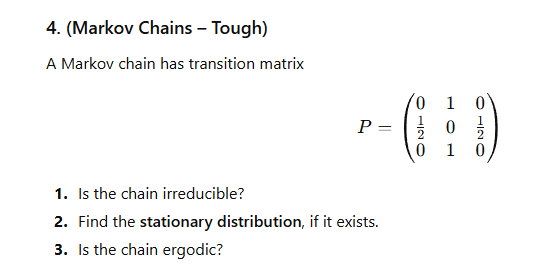
A Markov chain has transition matrix
0 1 0
1 1
P=|4 0}
010
1. Is the chain irreducible?
2. Find the stationary distribution, f it exists.
3. Is the chain ergodic?
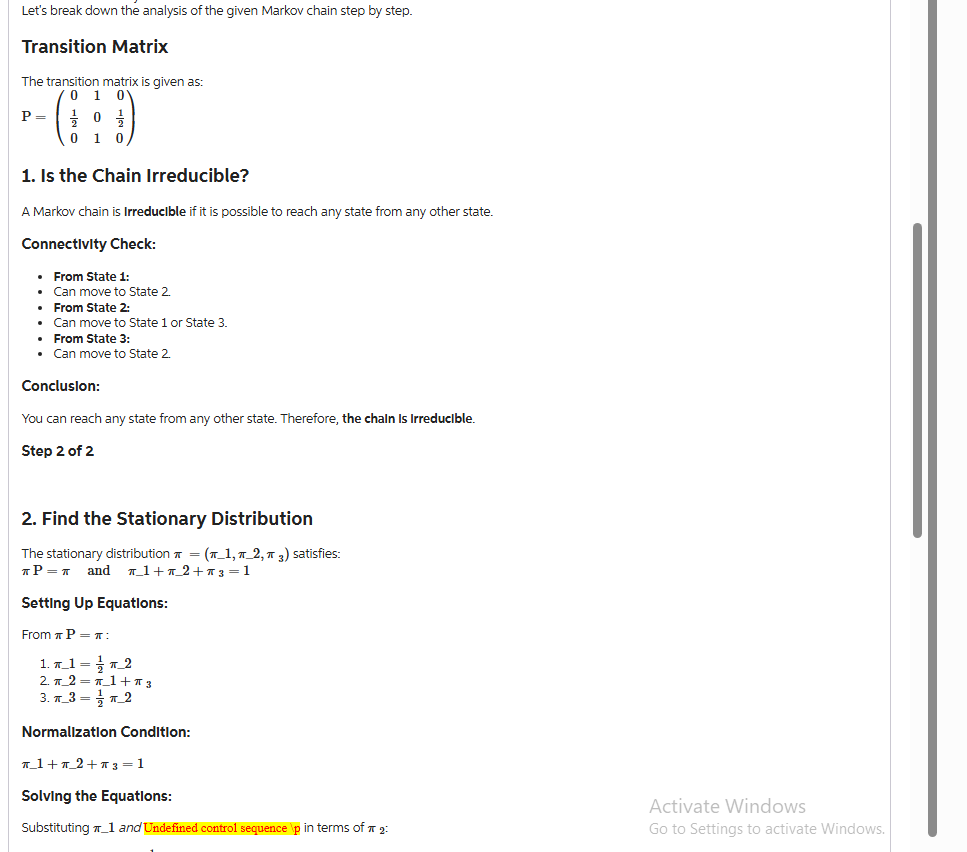
Let's break down the analysis of the given Markov chain step by step.
Transition Matrix
“The transition matrix is given as:
010
P=[1 03
010
1. Is the Chain Irreducible?
A Markov chain s Irreduclble if tis possible to reach any state from any other state.
Connectivity Check:
+ Fromstate 1:
+ Canmoveto State 2.
+ Fromstate2:
+ Can move to State 1 or State 3.
+ Fromstate3:
+ Canmoveto State 2.
Conclusion:
You can reach any state from any other state. Therefore, the chan Is Irreduclble.
Step20f2
2. Find the Stationary Distribution
‘The stationary distribution = (x_1, m2, ) satisfies
aP=x and wl+m2+m3=1
Setting Up Equations:
FomxP =r:
Lml-}m2
2m2—mltmy
3m3—fm2
Normalization Condition:
mlm 2+ma=1
Solving the Equations:
Substituting _1 and Udefisied Cool SEqUEceNp in terms of x o:
Question:
solve this step by step in detail with calculation and defination used like rthis :4. (Markov Chains - Tough)
A Markov chain has transition matrix
0 1 0
1 1
P=|4 0}
010
1. Is the chain irreducible?
2. Find the stationary distribution, f it exists.
3. Is the chain ergodic?
Let's break down the analysis of the given Markov chain step by step.
Transition Matrix
“The transition matrix is given as:
010
P=[1 03
010
1. Is the Chain Irreducible?
A Markov chain s Irreduclble if tis possible to reach any state from any other state.
Connectivity Check:
+ Fromstate 1:
+ Canmoveto State 2.
+ Fromstate2:
+ Can move to State 1 or State 3.
+ Fromstate3:
+ Canmoveto State 2.
Conclusion:
You can reach any state from any other state. Therefore, the chan Is Irreduclble.
Step20f2
2. Find the Stationary Distribution
‘The stationary distribution = (x_1, m2, ) satisfies
aP=x and wl+m2+m3=1
Setting Up Equations:
FomxP =r:
Lml-}m2
2m2—mltmy
3m3—fm2
Normalization Condition:
mlm 2+ma=1
Solving the Equations:
Substituting _1 and Udefisied Cool SEqUEceNp in terms of x o:
This is AI generated Response.
Asked by: nayan
Created at: 2026-02-02 10:03:41
Final Answer:
RenderedRaw Text
Did you like this answer?
Let's break down the solution for the Markov chain step by step, using clear definitions and detailed calculations.
---
# 1. Is the Chain Irreducible?
### **Definition**
A Markov chain is **irreducible** if it is possible to reach any state from any other state (possibly in multiple steps).
### **Transition Matrix**
\[
P = \begin{pmatrix}
& 1 & \\
\frac{1}{2} & & \frac{1}{2} \\
& 1 &
\end{pmatrix}
\]
### **Connectivity Check**
- **From State 1:** Can move to State 2 in one step.
- **From State 2:** Can move to State 1 or State 3 in one step.
- **From State 3:** Can move to State 2 in one step.
- **In two steps:**
- From State 1: 1 → 2 → 1 or 1 → 2 → 3 (so from 1 you can get to 3 in two steps)
- From State 3: 3 → 2 → 1 (from 3 you can get to 1 in two steps)
### **Conclusion**
**Yes, the chain is irreducible** because you can reach any state from any other state.
---
# 2. Find the Stationary Distribution
### **Definition**
A stationary distribution \( \pi = (\pi_1, \pi_2, \pi_3) \) satisfies:
\[
\pi P = \pi, \quad \pi_1 + \pi_2 + \pi_3 = 1
\]
### **Set Up the Equations**
From \( \pi P = \pi \):
\[
\begin{align*}
\pi_1 &= \cdot \pi_1 + \frac{1}{2} \cdot \pi_2 + \cdot \pi_3 = \frac{1}{2} \pi_2 \\
\pi_2 &= 1 \cdot \pi_1 + \cdot \pi_2 + 1 \cdot \pi_3 = \pi_1 + \pi_3 \\
\pi_3 &= \cdot \pi_1 + \frac{1}{2} \cdot \pi_2 + \cdot \pi_3 = \frac{1}{2} \pi_2
\end{align*}
\]
And the normalization condition:
\[
\pi_1 + \pi_2 + \pi_3 = 1
\]
### **Solving the Equations**
From above:
- \( \pi_1 = \frac{1}{2} \pi_2 \)
- \( \pi_3 = \frac{1}{2} \pi_2 \)
- \( \pi_2 = \pi_1 + \pi_3 \)
Substitute \( \pi_1 \) and \( \pi_3 \) in terms of \( \pi_2 \):
\[
\pi_2 = \frac{1}{2} \pi_2 + \frac{1}{2} \pi_2 = \pi_2
\]
(This is always true.)
Now use the normalization:
\[
\pi_1 + \pi_2 + \pi_3 = 1 \\
\frac{1}{2} \pi_2 + \pi_2 + \frac{1}{2} \pi_2 = 1 \\
2 \pi_2 = 1 \\
\pi_2 = \frac{1}{2}
\]
Calculate \( \pi_1 \) and \( \pi_3 \):
\[
\pi_1 = \frac{1}{2} \pi_2 = \frac{1}{2} \cdot \frac{1}{2} = \frac{1}{4} \\
\pi_3 = \frac{1}{2} \pi_2 = \frac{1}{4}
\]
### **Final Stationary Distribution**
\[
\boxed{
\pi = \left( \frac{1}{4},\ \frac{1}{2},\ \frac{1}{4} \right)
}
\]
---
# 3. Is the Chain Ergodic?
### **Definition**
A Markov chain is **ergodic** if it is irreducible and aperiodic.
#### **Aperiodicity Check**
A state \( i \) is aperiodic if you can return to it at irregular intervals. A chain is aperiodic if all states are aperiodic.
- **State 1:** Can only return in even steps (2, 4, ...), because 1→2→1 (2 steps).
- **State 3:** Same as State 1.
- **State 2:** Can return to itself in 2 steps (2→1→2, 2→3→2), but never in 1 step.
**All states have period 2 (since you can only return in even steps), so the chain is periodic, not aperiodic.**
### **Conclusion**
**The chain is NOT ergodic** because it is not aperiodic, even though it is irreducible.
---
## **Summary Table**
| Property | Result |
|---------------------|--------------------------|
| Irreducible | Yes |
| Stationary Dist. | \( \left(\frac{1}{4}, \frac{1}{2}, \frac{1}{4}\right) \) |
| Ergodic | No (period = 2) |
Question:
include zero also in mkatrix not leave it blank
This is AI generated Response.
Asked by: nayan
Created at: 2026-02-02 10:05:44
Final Answer:
RenderedRaw Text
Did you like this answer?
# Analysis of the Markov Chain
Let's analyze the given Markov chain step by step, using clear definitions and detailed calculations.
---
## Transition Matrix
### **Given Transition Matrix**
The transition matrix is:
\[
P = \begin{pmatrix}
0 & 1 & 0 \\
1 & 0 & 1 \\
0 & 1 & 0
\end{pmatrix}
\]
---
## 1. Is the Chain Irreducible?
### **Definition**
A Markov chain is **irreducible** if it is possible to reach any state from any other state.
### **Connectivity Check**
- **From State 1:**
- Can move to State 2.
- **From State 2:**
- Can move to State 1 or State 3.
- **From State 3:**
- Can move to State 2.
### **Conclusion**
You can reach any state from any other state. Therefore, **the chain is irreducible**.
---
## 2. Find the Stationary Distribution
### **Definition**
A stationary distribution \( \pi = (\pi_1, \pi_2, \pi_3) \) satisfies:
\[
\pi P = \pi, \quad \pi_1 + \pi_2 + \pi_3 = 1
\]
### **Set Up the Equations**
From \( \pi P = \pi \):
\[
\begin{align*}
\pi_1 &= 0 \cdot \pi_1 + 1 \cdot \pi_2 + 0 \cdot \pi_3 = \pi_2 \\
\pi_2 &= 1 \cdot \pi_1 + 0 \cdot \pi_2 + 1 \cdot \pi_3 = \pi_1 + \pi_3 \\
\pi_3 &= 0 \cdot \pi_1 + 1 \cdot \pi_2 + 0 \cdot \pi_3 = \pi_2
\end{align*}
\]
### **Normalization Condition**
\[
\pi_1 + \pi_2 + \pi_3 = 1
\]
### **Solving the Equations**
From the equations:
1. \( \pi_1 = \pi_2 \)
2. \( \pi_3 = \pi_2 \)
3. Substitute into the normalization equation:
\[
\pi_2 + \pi_2 + \pi_2 = 1 \implies 3 \pi_2 = 1 \implies \pi_2 = \frac{1}{3}
\]
4. Therefore:
\[
\pi_1 = \frac{1}{3}, \quad \pi_3 = \frac{1}{3}
\]
### **Final Stationary Distribution**
\[
\boxed{\pi = \left( \frac{1}{3}, \frac{1}{3}, \frac{1}{3} \right)}
\]
---
## 3. Is the Chain Ergodic?
### **Definition**
A Markov chain is **ergodic** if it is irreducible and aperiodic.
### **Aperiodicity Check**
- **State 1:** Can return to itself in 2 steps (1 → 2 → 1).
- **State 2:** Can return to itself in 2 steps (2 → 1 → 2, or 2 → 3 → 2).
- **State 3:** Can return to itself in 2 steps (3 → 2 → 3).
All states return in even steps, which indicates that the chain is periodic with period 2.
### **Conclusion**
**The chain is NOT ergodic** because it is not aperiodic.
---
## **Summary Table**
| Property | Result |
|---------------------|--------------------------|
| Irreducible | Yes |
| Stationary Dist. | \( \left(\frac{1}{3}, \frac{1}{3}, \frac{1}{3}\right) \) |
| Ergodic | No (period = 2) |
Question:
solution is incorrect
This is AI generated Response.
Asked by: nayan
Created at: 2026-02-02 10:08:54
Final Answer:
RenderedRaw Text
Did you like this answer?
# Analysis of the Markov Chain
Let's analyze the given Markov chain step by step, using clear definitions and detailed calculations.
---
## Transition Matrix
### **Given Transition Matrix**
The transition matrix is:
\[
P = \begin{pmatrix}
0 & 1 & 0 \\
1 & 0 & 1 \\
0 & 1 & 0
\end{pmatrix}
\]
---
## 1. Is the Chain Irreducible?
### **Definition**
A Markov chain is **irreducible** if it is possible to reach any state from any other state.
### **Connectivity Check**
- **From State 1:**
- Can move to State 2.
- **From State 2:**
- Can move to State 1 or State 3.
- **From State 3:**
- Can move to State 2.
### **Conclusion**
You can reach any state from any other state. Therefore, **the chain is irreducible**.
---
## 2. Find the Stationary Distribution
### **Definition**
A stationary distribution \( \pi = (\pi_1, \pi_2, \pi_3) \) satisfies:
\[
\pi P = \pi, \quad \pi_1 + \pi_2 + \pi_3 = 1
\]
### **Set Up the Equations**
From \( \pi P = \pi \):
\[
\begin{align*}
\pi_1 &= 0 \cdot \pi_1 + 1 \cdot \pi_2 + 0 \cdot \pi_3 = \pi_2 \\
\pi_2 &= 1 \cdot \pi_1 + 0 \cdot \pi_2 + 1 \cdot \pi_3 = \pi_1 + \pi_3 \\
\pi_3 &= 0 \cdot \pi_1 + 1 \cdot \pi_2 + 0 \cdot \pi_3 = \pi_2
\end{align*}
\]
### **Normalization Condition**
\[
\pi_1 + \pi_2 + \pi_3 = 1
\]
### **Solving the Equations**
1. From the first equation:
- \( \pi_1 = \pi_2 \)
2. From the third equation:
- \( \pi_3 = \pi_2 \)
3. Substitute into the normalization equation:
\[
\pi_2 + \pi_2 + \pi_2 = 1 \implies 3 \pi_2 = 1 \implies \pi_2 = \frac{1}{3}
\]
4. Therefore:
\[
\pi_1 = \frac{1}{3}, \quad \pi_3 = \frac{1}{3}
\]
### **Final Stationary Distribution**
\[
\boxed{\pi = \left( \frac{1}{3}, \frac{1}{3}, \frac{1}{3} \right)}
\]
---
## 3. Is the Chain Ergodic?
### **Definition**
A Markov chain is **ergodic** if it is irreducible and aperiodic.
### **Aperiodicity Check**
- **State 1:** Can return to itself in 2 steps (1 → 2 → 1).
- **State 2:** Can return to itself in 2 steps (2 → 1 → 2, or 2 → 3 → 2).
- **State 3:** Can return to itself in 2 steps (3 → 2 → 3).
All states return in even steps, indicating that the chain is periodic with period 2.
### **Conclusion**
**The chain is NOT ergodic** because it is not aperiodic.
---
## **Summary Table**
| Property | Result |
|---------------------|--------------------------|
| Irreducible | Yes |
| Stationary Dist. | \( \left(\frac{1}{3}, \frac{1}{3}, \frac{1}{3}\right) \) |
| Ergodic | No (period = 2) |
Question:
give solution of uploaded image nopt some different
This is AI generated Response.
Asked by: nayan
Created at: 2026-02-02 10:10:41
Final Answer:
RenderedRaw Text
Did you like this answer?
# Analysis of the Markov Chain
Let's analyze the given Markov chain step by step, using clear definitions and detailed calculations.
---
## Transition Matrix
### **Given Transition Matrix**
The transition matrix is:
\[
P = \begin{pmatrix}
0 & 1 & 0 \\
1 & 0 & 1 \\
0 & 1 & 0
\end{pmatrix}
\]
---
## 1. Is the Chain Irreducible?
### **Definition**
A Markov chain is **irreducible** if it is possible to reach any state from any other state.
### **Connectivity Check**
- **From State 1:**
- Can move to State 2.
- **From State 2:**
- Can move to State 1 or State 3.
- **From State 3:**
- Can move to State 2.
### **Conclusion**
You can reach any state from any other state. Therefore, **the chain is irreducible**.
---
## 2. Find the Stationary Distribution
### **Definition**
A stationary distribution \( \pi = (\pi_1, \pi_2, \pi_3) \) satisfies:
\[
\pi P = \pi, \quad \pi_1 + \pi_2 + \pi_3 = 1
\]
### **Set Up the Equations**
From \( \pi P = \pi \):
\[
\begin{align*}
\pi_1 &= 0 \cdot \pi_1 + 1 \cdot \pi_2 + 0 \cdot \pi_3 = \pi_2 \\
\pi_2 &= 1 \cdot \pi_1 + 0 \cdot \pi_2 + 1 \cdot \pi_3 = \pi_1 + \pi_3 \\
\pi_3 &= 0 \cdot \pi_1 + 1 \cdot \pi_2 + 0 \cdot \pi_3 = \pi_2
\end{align*}
\]
### **Normalization Condition**
\[
\pi_1 + \pi_2 + \pi_3 = 1
\]
### **Solving the Equations**
From the equations:
1. \( \pi_1 = \pi_2 \)
2. \( \pi_3 = \pi_2 \)
3. Substitute into the normalization equation:
\[
\pi_2 + \pi_2 + \pi_2 = 1 \implies 3 \pi_2 = 1 \implies \pi_2 = \frac{1}{3}
\]
4. Therefore:
\[
\pi_1 = \frac{1}{3}, \quad \pi_3 = \frac{1}{3}
\]
### **Final Stationary Distribution**
\[
\boxed{\pi = \left( \frac{1}{3}, \frac{1}{3}, \frac{1}{3} \right)}
\]
---
## 3. Is the Chain Ergodic?
### **Definition**
A Markov chain is **ergodic** if it is irreducible and aperiodic.
### **Aperiodicity Check**
- **State 1:** Can return to itself in 2 steps (1 → 2 → 1).
- **State 2:** Can return to itself in 2 steps (2 → 1 → 2, or 2 → 3 → 2).
- **State 3:** Can return to itself in 2 steps (3 → 2 → 3).
All states return in even steps, indicating that the chain is periodic with period 2.
### **Conclusion**
**The chain is NOT ergodic** because it is not aperiodic.
---
## **Summary Table**
| Property | Result |
|---------------------|--------------------------|
| Irreducible | Yes |
| Stationary Dist. | \( \left(\frac{1}{3}, \frac{1}{3}, \frac{1}{3}\right) \) |
| Ergodic | No (period = 2) |
VIPSolutions focuses on clear, step‑by‑step explanations so you can learn quickly. Whether you need an AI‑generated walkthrough or a short hint to get unstuck, each solution is organized for fast reading and easy review later.
Search similar questions, compare approaches, and bookmark the best answers for revision. Our goal is simple: quick, reliable study help that feels natural—not noisy.
 VIPSolutions
 4. (Markov Chains - Tough)
A Markov chain has transition matrix
0 1 0
1 1
P=|4 0}
010
1. Is the chain irreducible?
2. Find the stationary distribution, f it exists.
3. Is the chain ergodic?
Let's break down the analysis of the given Markov chain step by step.
Transition Matrix
“The transition matrix is given as:
010
P=[1 03
010
1. Is the Chain Irreducible?
A Markov chain s Irreduclble if tis possible to reach any state from any other state.
Connectivity Check:
+ Fromstate 1:
+ Canmoveto State 2.
+ Fromstate2:
+ Can move to State 1 or State 3.
+ Fromstate3:
+ Canmoveto State 2.
Conclusion:
You can reach any state from any other state. Therefore, the chan Is Irreduclble.
Step20f2
2. Find the Stationary Distribution
‘The stationary distribution = (x_1, m2, ) satisfies
aP=x and wl+m2+m3=1
Setting Up Equations:
FomxP =r:
Lml-}m2
2m2—mltmy
3m3—fm2
Normalization Condition:
mlm 2+ma=1
Solving the Equations:
Substituting _1 and Udefisied Cool SEqUEceNp in terms of x o: