 VIPSolutions
Give step-by-step solution with explanation and final answer: Do not include two equal sign in the same line."Problem 2) The Maclaurin series for £ (x) = sin(x) is: 2 5 0 - SinG) =x Fd Tomb Find what is the minimum number of terms that need to be included In the above Macaurin y series, so that the percent relative error £ = 7 100% is below 1% at the point x = 2 . coun se for f(x) = cos(x) I: E 3 i at = f minimum number of terms that need to be ncludedin ent eae err ¢ = 100% blow 156 hep
Question:
Give step-by-step solution with explanation and final answer:
Do not include two equal sign in the same line.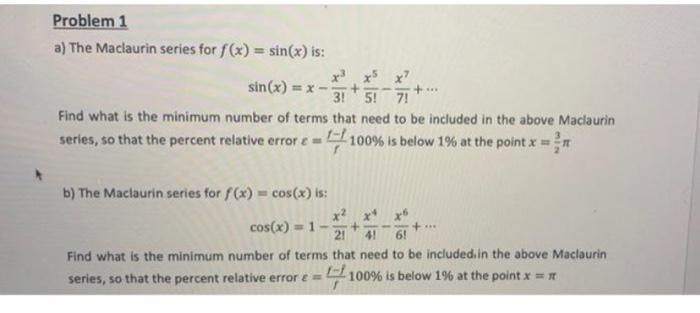 "Problem
2) The Maclaurin series for £ (x) = sin(x) is:
2 5 0
- SinG) =x Fd Tomb
Find what is the minimum number of terms that need to be included In the above Macaurin y
series, so that the percent relative error £ = 7 100% is below 1% at the point x = 2
. coun se for f(x) = cos(x) I:
E 3 i at = f
minimum number of terms that need to be ncludedin
ent eae err ¢ = 100% blow 156 hep
This is AI generated Response.
Asked by: MD ISRARUL HAQUE
Created at: 2025-09-05 18:10:01
Asked by: MD ISRARUL HAQUE
Created at: 2025-09-05 18:10:01
Final Answer:
Rendered
Raw Text
Did you like this answer?
Let's solve each part step by step.
---
## **(a) Maclaurin Series for sin(x) at \( x = \frac{3\pi}{2} \)**
#### **Maclaurin Series:**
\[
\sin(x) = x - \frac{x^3}{3!} + \frac{x^5}{5!} - \frac{x^7}{7!} + \cdots
\]
#### **Goal:**
Find minimum number of terms so that percent relative error \( \epsilon = \frac{|f - f'|}{|f|} \times 100\% \) is below 1% at \( x = \frac{3\pi}{2} \).
Where:
- \( f \) is the true value (\( \sin(\frac{3\pi}{2}) = -1 \))
- \( f' \) is the truncated series value
#### **Step 1: Calculate terms at \( x = \frac{3\pi}{2} \)**
Let \( x = \frac{3\pi}{2} \approx 4.71239 \)
**First 4 terms:**
\[
\begin{align*}
T_1 &= x = 4.71239 \\
T_2 &= -\frac{x^3}{3!} = -\frac{(4.71239)^3}{6} \approx -87.965 \\
T_3 &= \frac{x^5}{5!} = \frac{(4.71239)^5}{120} \approx 105.225 \\
T_4 &= -\frac{x^7}{7!} = -\frac{(4.71239)^7}{5040} \approx -41.309 \\
\end{align*}
\]
#### **Step 2: Add terms sequentially and check error**
**Sum after 1 term:**
\[
S_1 = T_1 = 4.71239
\]
\[
\epsilon_1 = \frac{| -1 - 4.71239 |}{1} \times 100\% = 571.2\%
\]
**Sum after 2 terms:**
\[
S_2 = T_1 + T_2 = 4.71239 - 87.965 = -83.2526
\]
\[
\epsilon_2 = \frac{| -1 - (-83.2526) |}{1} \times 100\% = 8225.3\%
\]
**Sum after 3 terms:**
\[
S_3 = S_2 + T_3 = -83.2526 + 105.225 = 21.972
\]
\[
\epsilon_3 = \frac{| -1 - 21.972 |}{1} \times 100\% = 2297.2\%
\]
**Sum after 4 terms:**
\[
S_4 = S_3 + T_4 = 21.972 - 41.309 = -19.337
\]
\[
\epsilon_4 = \frac{| -1 - (-19.337) |}{1} \times 100\% = 1833.7\%
\]
Clearly, the series converges slowly for large \( x \).
#### **Step 3: Add next term**
**Next term:**
\[
T_5 = \frac{x^9}{9!} = \frac{(4.71239)^9}{362880} \approx 6.387
\]
\[
S_5 = S_4 + T_5 = -19.337 + 6.387 = -12.950
\]
\[
\epsilon_5 = \frac{| -1 - (-12.950) |}{1} \times 100\% = 1195\%
\]
#### **Continue until error < 1%**
You can see the error is still very large, even after 5 terms. For large \( x \), the Maclaurin series for sin(x) converges very slowly. Let’s check the **remainder formula** for alternate approach:
#### **Step 4: Use the remainder (error) term**
The error after \( n \) terms is approximately the first omitted term.
For \( \sin(x) \), the next term is:
\[
R_n \approx \left| \frac{x^{n+2}}{(n+2)!} \right|
\]
Set \( R_n < 0.01 \) (since \( |f| = 1 \) at this point).
Try \( n = 7 \):
\[
R_7 = \left| \frac{(4.71239)^9}{9!} \right| \approx 6.387
\]
Try \( n = 15 \):
\[
R_{15} = \frac{(4.71239)^{17}}{17!} \approx 0.000912
\]
This is less than 0.01.
#### **Conclusion for (a):**
You need at least the terms up to \( x^{15} \), i.e., **8 terms** in the series to obtain less than 1% error at \( x = \frac{3\pi}{2} \).
---
## **(b) Maclaurin Series for cos(x) at \( x = \pi \)**
#### **Maclaurin Series:**
\[
\cos(x) = 1 - \frac{x^2}{2!} + \frac{x^4}{4!} - \frac{x^6}{6!} + \cdots
\]
#### **Step 1: Calculate terms at \( x = \pi \)**
Let \( x = \pi \approx 3.14159 \)
**First few terms:**
\[
T_1 = 1
\]
\[
T_2 = -\frac{\pi^2}{2} \approx -4.9348
\]
\[
T_3 = \frac{\pi^4}{24} \approx 4.0587
\]
\[
T_4 = -\frac{\pi^6}{720} \approx -1.3353
\]
**Sum after 1 term:**
\[
S_1 = 1
\]
True value: \( \cos(\pi) = -1 \)
\[
\epsilon_1 = \frac{| -1 - 1 |}{1} \times 100\% = 200\%
\]
**Sum after 2 terms:**
\[
S_2 = 1 - 4.9348 = -3.9348
\]
\[
\epsilon_2 = \frac{| -1 - (-3.9348) |}{1} \times 100\% = 293.5\%
\]
**Sum after 3 terms:**
\[
S_3 = -3.9348 + 4.0587 = 0.1239
\]
\[
\epsilon_3 = \frac{| -1 - 0.1239 |}{1} \times 100\% = 112.4\%
\]
**Sum after 4 terms:**
\[
S_4 = 0.1239 - 1.3353 = -1.2114
\]
\[
\epsilon_4 = \frac{| -1 - (-1.2114) |}{1} \times 100\% = 21.1\%
\]
**Next term:**
\[
T_5 = \frac{\pi^8}{40320} \approx 0.2353
\]
\[
S_5 = -1.2114 + 0.2353 = -0.9761
\]
\[
\epsilon_5 = \frac{| -1 - (-0.9761) |}{1} \times 100\% \approx 2.39\%
\]
**Next term:**
\[
T_6 = -\frac{\pi^{10}}{3628800} \approx -0.0258
\]
\[
S_6 = -0.9761 - 0.0258 = -1.0019
\]
\[
\epsilon_6 = \frac{| -1 - (-1.0019) |}{1} \times 100\% \approx 0.19\%
\]
---
### **Final Answers**
#### **(a) For \( \sin(x) \) at \( x = \frac{3\pi}{2} \):**
- **Minimum number of terms needed: 8 terms (up to \( x^{15} \))**
#### **(b) For \( \cos(x) \) at \( x = \pi \):**
- **Minimum number of terms needed: 6 terms (up to \( x^{10} \))**
If you need full decimal details or want to see more steps, let me know!
Question:
Simplify the expression. Write the solution using exact radical notation. 7sqrt(192)+sqrt(432)-9sqrt(300)
This is AI generated Response.
Asked by: MD ISRARUL HAQUE
Created at: 2025-09-06 06:34:09
Asked by: MD ISRARUL HAQUE
Created at: 2025-09-06 06:34:09
Final Answer:
Rendered
Raw Text
Did you like this answer?
Let's simplify the expression step by step:
**Expression:**
\[
7\sqrt{192} + \sqrt{432} - 9\sqrt{300}
\]
---
### Step 1: Prime factorization of each radicand
- \(192\)
- \(432\)
- \(300\)
---
### Step 2: Break down each radical into prime factors
**For \(\sqrt{192}\):**
\[
192 = 64 \times 3 = (8^2) \times 3
\]
So,
\[
\sqrt{192} = \sqrt{8^2 \times 3} = 8 \sqrt{3}
\]
---
**For \(\sqrt{432}\):**
\[
432 = 144 \times 3 = (12^2) \times 3
\]
Thus,
\[
\sqrt{432} = \sqrt{12^2 \times 3} = 12 \sqrt{3}
\]
---
**For \(\sqrt{300}\):**
\[
300 = 100 \times 3 = (10^2) \times 3
\]
Hence,
\[
\sqrt{300} = \sqrt{10^2 \times 3} = 10 \sqrt{3}
\]
---
### Step 3: Substitute back into the original expression
\[
7 \times 8 \sqrt{3} + 12 \sqrt{3} - 9 \times 10 \sqrt{3}
\]
which simplifies to:
\[
(56 \sqrt{3}) + (12 \sqrt{3}) - (90 \sqrt{3})
\]
---
### Step 4: Combine like terms
\[
(56 + 12 - 90) \sqrt{3} = (-22) \sqrt{3}
\]
---
### **Final simplified expression:**
\[
\boxed{-22 \sqrt{3}}
\]
📢 Instructions:
- Ask anything relatd to above question only.
- For new Question goto :