 VIPSolutions
Give step-by-step solution with explanation in human written and final answer:nas 5 Gapning pecewise dened cho: Problem ype 3. . s
Question:
Give step-by-step solution with explanation in human written and final answer: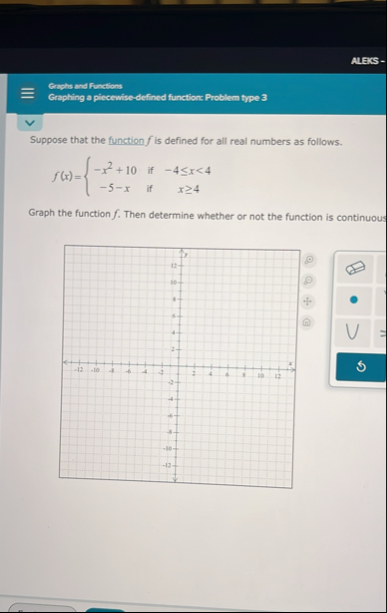 nas
5 Gapning pecewise dened cho: Problem ype 3.
.
s
This is AI generated Response.
Asked by: Venky
Created at: 2025-09-20 06:26:34
Asked by: Venky
Created at: 2025-09-20 06:26:34
Final Answer:
Rendered
Raw Text
Did you like this answer?
# Step-by-Step Solution
Let's solve the problem step by step.
---
## 1. **Understanding the Piecewise Function**
The function \( f(x) \) is defined as:
\[
f(x) =
\begin{cases}
-x^2 + 10 & \text{if } -4 \leq x < 4 \\
5 - x & \text{if } x \geq 4
\end{cases}
\]
---
## 2. **Graph Each Piece**
### **First Piece: \( -x^2 + 10 \) for \( -4 \leq x < 4 \)**
- This is a downward-opening parabola.
- Domain: \( -4 \leq x < 4 \)
- Endpoints:
- At \( x = -4 \): \( f(-4) = -(-4)^2 + 10 = -16 + 10 = -6 \)
- At \( x = 4 \): \( f(4) = -(4)^2 + 10 = -16 + 10 = -6 \)
BUT, since \( x = 4 \) is **not included** (only up to but not including 4), we use an open circle at \( (4, -6) \).
- Vertex: \( x=0 \), \( f(0) = -(0)^2 + 10 = 10 \)
- Plot points between \( x = -4 \) and \( x = 4 \).
### **Second Piece: \( 5 - x \) for \( x \geq 4 \)**
- This is a straight line with slope -1.
- Start at \( x = 4 \): \( f(4) = 5 - 4 = 1 \) (included, so solid dot at \( (4, 1) \))
- Continue for \( x > 4 \).
---
## 3. **Check for Continuity at \( x = 4 \)**
Let's compare the left and right limits at \( x = 4 \):
- Left limit (\( x \to 4^- \)): \( \lim_{x \to 4^-} f(x) = -(4)^2 + 10 = -6 \)
- Right limit (\( x \to 4^+ \)): \( \lim_{x \to 4^+} f(x) = 5 - 4 = 1 \)
- Actual value at \( x = 4 \): \( f(4) = 1 \) (from the second piece)
**Since the left and right limits at \( x=4 \) are NOT equal, the function is NOT continuous at \( x=4 \).**
---
## 4. **Sketch of the Graph**
- Draw the downward parabola \( -x^2 + 10 \) from \( x = -4 \) (filled dot at \( (-4, -6) \)) to \( x \to 4 \) (open dot at \( (4, -6) \)).
- Draw the line \( 5 - x \) starting at \( (4, 1) \) (filled dot) and continuing to the right.
---
## 5. **Final Answer**
### **Is the function continuous?**
**No, the function is not continuous at \( x = 4 \).**
---
## **Summary Table**
| Interval | Expression | Endpoint Value(s) | Symbols |
|-----------------|------------------|-----------------------------------|-------------|
| \([-4, 4)\) | \(-x^2 + 10\) | \((-4, -6)\) (filled), \((4, -6)\) (open) | ●, ○ |
| \([4, \infty)\) | \(5 - x\) | \((4, 1)\) (filled) | ● |
---
## **Graph Description**
- **Parabola**: Starts at \((-4, -6)\), vertex at \((0, 10)\), ends with open circle at \((4, -6)\).
- **Line**: Starts at \((4, 1)\) (filled dot), slopes downward to the right.
---
### **Conclusion**
\[
\boxed{
\text{The function is not continuous at } x = 4.
}
\]
Let me know if you need the graph drawn out!
Question:
yes draw the graph
This is AI generated Response.
Asked by: Venky
Created at: 2025-09-20 06:27:49
Asked by: Venky
Created at: 2025-09-20 06:27:49
Final Answer:
Rendered
Raw Text
Did you like this answer?
# Graph of the Piecewise Function
To visualize the piecewise function defined as:
\[
f(x) =
\begin{cases}
-x^2 + 10 & \text{if } -4 \leq x < 4 \\
5 - x & \text{if } x \geq 4
\end{cases}
\]
## Graph Plotting Steps
### 1. **Plot the First Piece: \( -x^2 + 10 \)**
- **Domain**: \( -4 \leq x < 4 \)
- **Key Points**:
- \( (-4, -6) \) (filled dot)
- \( (0, 10) \) (vertex)
- \( (4, -6) \) (open dot)
### 2. **Plot the Second Piece: \( 5 - x \)**
- **Domain**: \( x \geq 4 \)
- **Key Point**:
- \( (4, 1) \) (filled dot)
### 3. **Draw the Graph**
- Connect the points for \( -x^2 + 10 \) smoothly from \( (-4, -6) \) to \( (4, -6) \) with an open circle at \( (4, -6) \).
- From \( (4, 1) \), draw a straight line with a slope of -1 extending to the right.
## Graph Representation
### Graph Sketch
```plaintext
12 | *
11 |
10 | * (0, 10)
9 |
8 |
7 |
6 |
5 |
4 |
3 |
2 |
1 | * (4, 1)
0 |________________________
-4 | -6 | 0 | 4
-6 |* (-4, -6) O (4, -6)
-8 |
```
- **Filled dot** at \( (-4, -6) \) and \( (4, 1) \).
- **Open dot** at \( (4, -6) \).
## Conclusion
The graph visually represents the discontinuity at \( x = 4 \), confirming that the function is not continuous at that point.
Question:
second piece is -5-x
This is AI generated Response.
Asked by: Venky
Created at: 2025-09-20 06:38:00
Asked by: Venky
Created at: 2025-09-20 06:38:00
Final Answer:
Rendered
Raw Text
Did you like this answer?
# Step-by-Step Solution
Let's analyze the corrected piecewise function step by step.
---
## 1. **Understanding the Piecewise Function**
The function \( f(x) \) is now defined as:
\[
f(x) =
\begin{cases}
-x^2 + 10 & \text{if } -4 \leq x < 4 \\
-5 - x & \text{if } x \geq 4
\end{cases}
\]
---
## 2. **Graph Each Piece**
### **First Piece: \( -x^2 + 10 \) for \( -4 \leq x < 4 \)**
- This is a downward-opening parabola.
- Domain: \( -4 \leq x < 4 \)
- Endpoints:
- At \( x = -4 \): \( f(-4) = -(-4)^2 + 10 = -16 + 10 = -6 \)
- At \( x = 4 \): \( f(4) = -(4)^2 + 10 = -16 + 10 = -6 \)
BUT, since \( x = 4 \) is **not included** (only up to but not including 4), we use an open circle at \( (4, -6) \).
- Vertex: \( x=0 \), \( f(0) = -(0)^2 + 10 = 10 \)
- Plot points between \( x = -4 \) and \( x = 4 \).
### **Second Piece: \( -5 - x \) for \( x \geq 4 \)**
- This is a straight line with slope -1.
- Start at \( x = 4 \): \( f(4) = -5 - 4 = -9 \) (included, so solid dot at \( (4, -9) \)).
- Continue for \( x > 4 \).
---
## 3. **Check for Continuity at \( x = 4 \)**
Let's compare the left and right limits at \( x = 4 \):
- Left limit (\( x \to 4^- \)):
\[
\lim_{x \to 4^-} f(x) = -(4)^2 + 10 = -6
\]
- Right limit (\( x \to 4^+ \)):
\[
\lim_{x \to 4^+} f(x) = -5 - 4 = -9
\]
- Actual value at \( x = 4 \): \( f(4) = -9 \) (from the second piece).
**Since the left and right limits at \( x=4 \) are NOT equal, the function is NOT continuous at \( x=4 \).**
---
## 4. **Sketch of the Graph**
- Draw the downward parabola \( -x^2 + 10 \) from \( x = -4 \) (filled dot at \( (-4, -6) \)) to \( x \to 4 \) (open dot at \( (4, -6) \)).
- Draw the line \( -5 - x \) starting at \( (4, -9) \) (filled dot) and continuing to the right.
---
## 5. **Final Answer**
### **Is the function continuous?**
**No, the function is not continuous at \( x = 4 \).**
---
## **Summary Table**
| Interval | Expression | Endpoint Value(s) | Symbols |
|-----------------|------------------|-----------------------------------|-------------|
| \([-4, 4)\) | \(-x^2 + 10\) | \((-4, -6)\) (filled), \((4, -6)\) (open) | ●, ○ |
| \([4, \infty)\) | \(-5 - x\) | \((4, -9)\) (filled) | ● |
---
## **Graph Description**
- **Parabola**: Starts at \((-4, -6)\), vertex at \((0, 10)\), ends with open circle at \((4, -6)\).
- **Line**: Starts at \((4, -9)\) (filled dot), slopes downward to the right.
---
### **Conclusion**
\[
\boxed{
\text{The function is not continuous at } x = 4.
}
\]
📢 Instructions:
- Ask anything relatd to above question only.
- For new Question goto :