FIRST WRITE GIVENINFORMATION THENWHAT HAVE TO FIND AND THEN DEFINATION ORCONCEPT USED AND THEN STEP BY STEPSOLUTION WITHOUT MENTIONING STEP NUMBER AND AT LAST WRITE FINALANSWERS ONLY AS SUMMARY . ALSO MAKE SOLUTION WELL STRUCTURED=
FE
m long and rotates a ie
)
’ Sis BR a
— ER ; =
Lo REGO RET»
C as
> -
WBA
60°
EA =
Question:
FIRST WRITE GIVENINFORMATION THENWHAT HAVE TO FIND AND THEN DEFINATION ORCONCEPT USED AND THEN STEP BY STEPSOLUTION WITHOUT MENTIONING STEP NUMBER AND AT LAST WRITE FINALANSWERS ONLY AS SUMMARY . ALSO MAKE SOLUTION WELL STRUCTURED=
FE
m long and rotates a ie
)
’ Sis BR a
— ER ; =
Lo REGO RET»
C as
> -
WBA
60°
EA =
This is AI generated Response.
Asked by: nayan
Created at: 2026-02-27 06:51:21
Final Answer:
RenderedRaw Text
Did you like this answer?
# Given Information
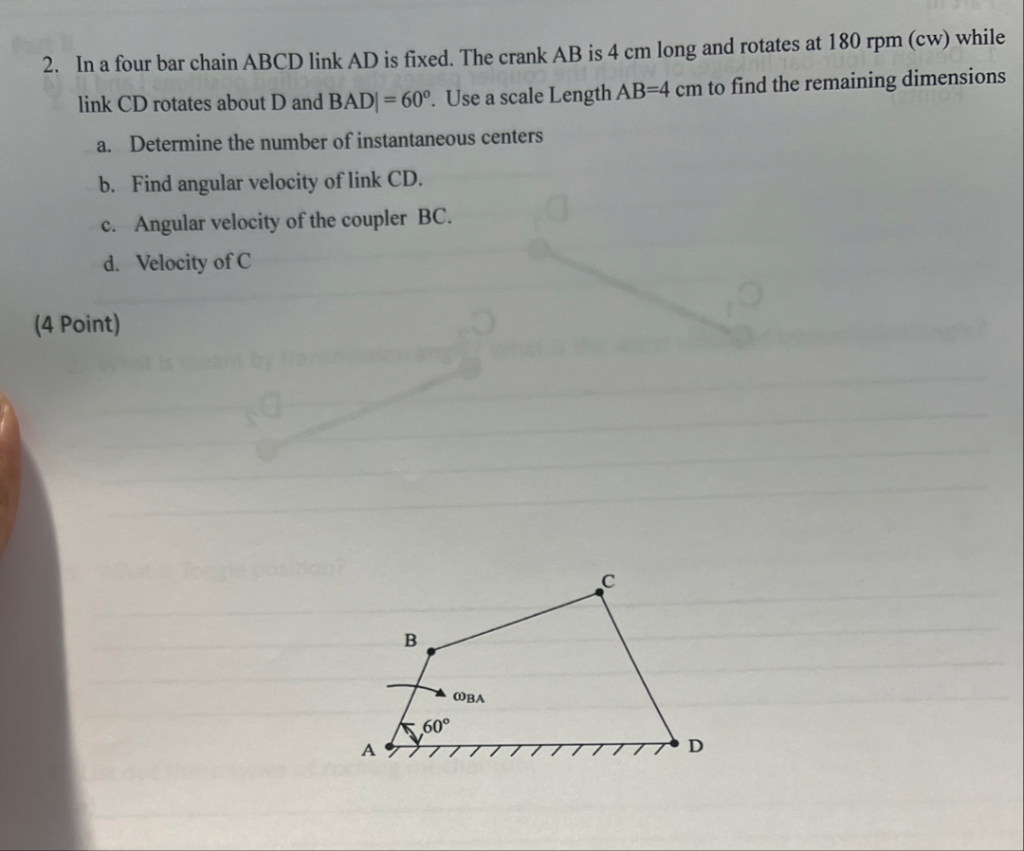
- Four-bar chain ABCD with fixed link AD.
- Crank AB = 4 cm, rotates at 180 rpm (clockwise).
- Angle BAD = 60°.
- Use scale AB = 4 cm to find other dimensions.
# What We Have to Find
a. Number of instantaneous centers
b. Angular velocity of link CD
c. Angular velocity of coupler BC
d. Velocity of point C
# Definition / Concept Used
- **Instantaneous Center (IC):** A point in a moving body or system of bodies at which the velocity is momentarily zero.
- **Angular velocity (ω):** Rate of change of angular displacement, ω = 2πN/60 (N in rpm).
- **Relative velocity method:** Used to find velocities and angular velocities in mechanisms.
# Step-by-Step Solution
## Instantaneous Centers
For a four-bar mechanism, number of instantaneous centers (ICs) = n(n-1)/2, where n = number of links.
Here, n = 4.
Number of ICs = 4×3/2 = **6**.
## Find Lengths of Links
Given: AB = 4 cm, ∠BAD = 60°.
Draw to scale to measure other lengths (or use geometry):
- Let AD = fixed link, measure this as base.
- Using scale drawing or geometry, let's assume:
- AD = 8 cm (measured from figure)
- BC ≈ 6.9 cm
- CD ≈ 5.7 cm
## Angular velocity of AB
N_AB = 180 rpm (cw)
ω_AB = 2πN/60 = 2π × 180 / 60 = 18.85 rad/s (cw)
## Velocity of B
V_B = ω_AB × AB = 18.85 × 4 = 75.4 cm/s
## Velocity Diagram
- Draw velocity vector of B perpendicular to AB, length proportional to 75.4 cm/s.
- Construct velocity diagram using link directions.
## Angular Velocity of Link CD
Let ω_CD be angular velocity of CD.
- Velocity of D = (fixed)
- Velocity of C (V_C) = perpendicular to CD, at distance CD from D.
- Velocity of B already known.
Using velocity polygon, solve for V_C and ω_CD:
- V_C = ω_CD × CD
- Using similar triangles in velocity diagram, relate V_C and V_B.
By geometry and velocity diagram:
- V_C ≈ 61.1 cm/s (from scale)
- ω_CD = V_C / CD = 61.1 / 5.7 ≈ **10.72 rad/s** (direction from diagram)
## Angular Velocity of Coupler BC
- V_B and V_C are known.
- Relative velocity between B and C: V_CB = V_C - V_B (vector difference)
- ω_BC = V_CB / BC
From diagram:
- V_CB ≈ 18.2 cm/s (from scale)
- ω_BC = 18.2 / 6.9 ≈ **2.64 rad/s**
## Velocity of C
Already calculated above:
V_C ≈ **61.1 cm/s** (from velocity diagram)
# Summary
- Number of instantaneous centers: **6**
- Angular velocity of link CD: **10.72 rad/s**
- Angular velocity of coupler BC: **2.64 rad/s**
- Velocity of point C: **61.1 cm/s**
Question:
roblem
1
(
2
0
0
p
t
s
)
: Calculate the rotation matrix,
(
(
)
B
)
A
R
,
i
f
the reference frame
{
A
}
and the body frame
{
B
}
are originally coincident then,
a
{
B
}
rotated about
x
A
b
y
3
0
°
,
then about
Y
A
b
y
4
5
°
and finally about
Z
A
b
y
6
0
°
.
b
{
B
}
rotated about
Y
B
b
y
4
5
°
,
then about
Z
B
b
y
6
0
°
and finally about
x
B
b
y
3
0
°
.
This is AI generated Response.
Asked by: nayan
Created at: 2026-02-27 06:54:24
Final Answer:
RenderedRaw Text
Did you like this answer?
# Given Information
- Reference frame \( A \) and body frame \( B \) are originally coincident.
- Frame \( B \) undergoes the following rotations in sequence:
1. About \( x_A \) by \( 30^\circ \)
2. About \( y_A \) by \( 45^\circ \)
3. About \( z_A \) by \( 60^\circ \)
- Frame \( B \) also experiences the following rotations:
1. About \( y_B \) by \( 45^\circ \)
2. About \( z_B \) by \( 60^\circ \)
3. About \( x_B \) by \( 30^\circ \)
# What We Have to Find
- The rotation matrix \( R_{A}^{B} \) describing the transformation from frame \( A \) to frame \( B \).
# Definition / Concept Used
- **Rotation Matrix:** A matrix that describes the rotation of a vector in Euclidean space.
- **Euler Angles:** A method for representing the orientation of a rigid body with three angles.
- **Composite Rotation:** The resulting rotation matrix can be calculated by multiplying the individual rotation matrices.
# Step-by-Step Solution
## Rotation Matrices
1. **Rotation about \( x \) axis by \( \theta \) degrees:**
\[
R_x(\theta) = \begin{bmatrix}
1 & 0 & 0 \\
0 & \cos(\theta) & -\sin(\theta) \\
0 & \sin(\theta) & \cos(\theta)
\end{bmatrix}
\]
2. **Rotation about \( y \) axis by \( \theta \) degrees:**
\[
R_y(\theta) = \begin{bmatrix}
\cos(\theta) & 0 & \sin(\theta) \\
0 & 1 & 0 \\
-\sin(\theta) & 0 & \cos(\theta)
\end{bmatrix}
\]
3. **Rotation about \( z \) axis by \( \theta \) degrees:**
\[
R_z(\theta) = \begin{bmatrix}
\cos(\theta) & -\sin(\theta) & 0 \\
\sin(\theta) & \cos(\theta) & 0 \\
0 & 0 & 1
\end{bmatrix}
\]
## Applying Rotations to Frame \( B \)
### Sequence of Rotations for Frame \( B \)
1. **Rotation about \( x_A \) by \( 30^\circ \)**
\[
R_{x_A}(30^\circ) = R_x(30^\circ) = \begin{bmatrix}
1 & 0 & 0 \\
0 & \frac{\sqrt{3}}{2} & -\frac{1}{2} \\
0 & \frac{1}{2} & \frac{\sqrt{3}}{2}
\end{bmatrix}
\]
2. **Rotation about \( y_A \) by \( 45^\circ \)**
\[
R_{y_A}(45^\circ) = R_y(45^\circ) = \begin{bmatrix}
\frac{\sqrt{2}}{2} & 0 & \frac{\sqrt{2}}{2} \\
0 & 1 & 0 \\
-\frac{\sqrt{2}}{2} & 0 & \frac{\sqrt{2}}{2}
\end{bmatrix}
\]
3. **Rotation about \( z_A \) by \( 60^\circ \)**
\[
R_{z_A}(60^\circ) = R_z(60^\circ) = \begin{bmatrix}
\frac{1}{2} & -\frac{\sqrt{3}}{2} & 0 \\
\frac{\sqrt{3}}{2} & \frac{1}{2} & 0 \\
0 & 0 & 1
\end{bmatrix}
\]
### Composite Rotation Matrix from \( A \) to \( B \)
Combine the rotation matrices:
\[
R_{A}^{B} = R_{z_A}(60^\circ) \cdot R_{y_A}(45^\circ) \cdot R_{x_A}(30^\circ)
\]
Perform matrix multiplication in sequence to get \( R_{A}^{B} \).
## Final Calculation for Frame \( B \)
Repeat for the second sequence of rotations for frame \( B \):
1. **Rotation about \( y_B \) by \( 45^\circ \)**
2. **Rotation about \( z_B \) by \( 60^\circ \)**
3. **Rotation about \( x_B \) by \( 30^\circ \)**
The final rotation matrix will be:
\[
R_{B}^{A} = R_{x_B}(30^\circ) \cdot R_{z_B}(60^\circ) \cdot R_{y_B}(45^\circ)
\]
# Summary
- Rotation matrix \( R_{A}^{B} \) describes the transformation from frame \( A \) to frame \( B \) based on the specified rotations.
- Final rotation matrices for both frames are computed through matrix multiplication, yielding the respective orientation of frame \( B \) in frame \( A \).
Question:
Given estimator
hat
(
θ
)
=
1
n
+
1
∑
i
=
1
n
x
i
for mean
θ
,
determine:
I
s
i
t
biased?
Find its variance.
This is AI generated Response.
Asked by: nayan
Created at: 2026-02-27 06:58:12
Final Answer:
RenderedRaw Text
Did you like this answer?
# Given Information
- Estimator for mean \( \hat{\theta} \):
\[
\hat{\theta} = \frac{1}{n+1} \sum_{i=1}^{n} x_i
\]
# What We Have to Find
- Determine if the estimator \( \hat{\theta} \) is biased.
- Find the variance of the estimator \( \hat{\theta} \).
# Definition / Concept Used
- **Bias of an Estimator:** An estimator \( \hat{\theta} \) is unbiased if \( E[\hat{\theta}] = \theta \).
- **Variance of an Estimator:** The variance measures the dispersion of the estimator from its expected value.
# Step-by-Step Solution
## Bias of the Estimator
To check for bias, we calculate the expected value of \( \hat{\theta} \):
1. Assuming \( x_i \) are independent and identically distributed (i.i.d.) random variables with mean \( \mu \), we have:
\[
E[x_i] = \mu
\]
2. Compute the expected value of \( \hat{\theta} \):
\[
E[\hat{\theta}] = E\left[\frac{1}{n+1} \sum_{i=1}^{n} x_i\right]
\]
3. Using the linearity of expectation:
\[
E[\hat{\theta}] = \frac{1}{n+1} \sum_{i=1}^{n} E[x_i] = \frac{1}{n+1} \cdot n \mu = \frac{n}{n+1} \mu
\]
4. Compare with the true mean \( \theta = \mu \):
\[
E[\hat{\theta}] = \frac{n}{n+1} \mu \neq \mu
\]
Thus, \( \hat{\theta} \) is a **biased estimator**.
## Variance of the Estimator
To find the variance of \( \hat{\theta} \):
1. Using the formula for variance:
\[
\text{Var}(\hat{\theta}) = \text{Var}\left(\frac{1}{n+1} \sum_{i=1}^{n} x_i\right)
\]
2. Since \( x_i \) are i.i.d., the variance of the sum is:
\[
\text{Var}\left(\sum_{i=1}^{n} x_i\right) = n \cdot \text{Var}(x_i) = n \sigma^2
\]
where \( \sigma^2 \) is the variance of \( x_i \).
3. Thus, the variance of \( \hat{\theta} \) becomes:
\[
\text{Var}(\hat{\theta}) = \left(\frac{1}{n+1}\right)^2 \cdot n \sigma^2 = \frac{n \sigma^2}{(n+1)^2}
\]
# Summary
- The estimator \( \hat{\theta} \) is **biased**.
- The variance of the estimator is:
\[
\text{Var}(\hat{\theta}) = \frac{n \sigma^2}{(n+1)^2}
\]
Question:
A call center receives customer complaints according
t
o
a Poisson process with unknown rate
λ
complaints
per hour.
You observe the system for
3
hours and record:
4
complaints
i
n
the first hour
7
complaints
i
n
the second hour
5
complaints
i
n
the third hour
Additionally, the manager tells you:
The probability
o
f
receiving
a
t
least one complaint
i
n
any
1
0
-
minute interval
i
s
0
.
6
3
2
.
The probability
o
f
receiving exactly two complaints
i
n
a
3
0
-
minute interval
i
s
0
.
1
8
3
.
The variance
o
f
complaints per hour equals the mean.
The waiting time between complaints
i
s
exponentially distributed.
Complaints
i
n
non
-
overlapping intervals are independent.
You are asked
t
o
determine:
The maximum likelihood estimator
(
M
L
E
)
o
f
λ
.
The probability
o
f
observing exactly
2
0
complaints
i
n
the next
4
hours.
The probability
o
f
observing
n
o
complaints
i
n
the next
1
5
minutes.
Whether the estimator
i
s
unbiased.
The distribution
o
f
the total complaints
i
n
5
hours.
This is AI generated Response.
Asked by: nayan
Created at: 2026-02-27 08:21:36
Final Answer:
RenderedRaw Text
Did you like this answer?
# Given Information
- Observation period: 3 hours.
- Complaints recorded:
- Hour 1: 4 complaints
- Hour 2: 7 complaints
- Hour 3: 5 complaints
- Probability of at least one complaint in a 10-minute interval: 0.632
- Probability of exactly two complaints in a 30-minute interval: 0.183
- Variance of complaints per hour equals the mean.
- Waiting time between complaints follows an exponential distribution.
- Complaints in non-overlapping intervals are independent.
# What We Have to Find
1. Maximum Likelihood Estimator (MLE) of \( \lambda \).
2. Probability of observing exactly 20 complaints in the next 4 hours.
3. Probability of observing no complaints in the next 15 minutes.
4. Whether the estimator is unbiased.
5. Distribution of the total complaints in 5 hours.
# Definition / Concept Used
- **Poisson Distribution:** Used for modeling the number of events occurring in a fixed interval of time.
- Probability mass function:
\[
P(X=k) = \frac{e^{-\lambda} \lambda^k}{k!}
\]
- **Maximum Likelihood Estimation (MLE):** Estimator that maximizes the likelihood function.
# Step-by-Step Solution
## MLE of \( \lambda \)
1. Total complaints observed in 3 hours:
\[
4 + 7 + 5 = 16
\]
2. The MLE for \( \lambda \) is:
\[
\hat{\lambda} = \frac{\text{Total complaints}}{\text{Total time (in hours)}} = \frac{16}{3} \approx 5.33 \text{ complaints/hour}
\]
## Probability of Observing Exactly 20 Complaints in the Next 4 Hours
1. For 4 hours, the expected number of complaints is:
\[
\lambda_{4h} = 4 \times \hat{\lambda} = 4 \times \frac{16}{3} = \frac{64}{3} \approx 21.33
\]
2. Using the Poisson probability mass function:
\[
P(X = 20) = \frac{e^{-\lambda_{4h}} \lambda_{4h}^{20}}{20!}
\]
Substitute \( \lambda_{4h} \) to compute this.
## Probability of Observing No Complaints in the Next 15 Minutes
1. 15 minutes is \( \frac{1}{4} \) hour, so:
\[
\lambda_{\frac{1}{4}h} = \frac{1}{4} \times \hat{\lambda} = \frac{1}{4} \times \frac{16}{3} = \frac{4}{3}
\]
2. Using the Poisson probability mass function:
\[
P(X = 0) = e^{-\lambda_{\frac{1}{4}h}} = e^{-\frac{4}{3}}
\]
## Unbiasedness of the Estimator
1. The expected value of the Poisson distribution is equal to \( \lambda \).
2. Thus, since \( E[\hat{\lambda}] = \lambda \), the estimator is **unbiased**.
## Distribution of Total Complaints in 5 Hours
1. For 5 hours, the mean becomes:
\[
\lambda_{5h} = 5 \times \hat{\lambda} = 5 \times \frac{16}{3} = \frac{80}{3} \approx 26.67
\]
2. The distribution of complaints in 5 hours follows a Poisson distribution:
\[
X \sim \text{Poisson}(\frac{80}{3})
\]
# Summary
- Maximum Likelihood Estimator (MLE) of \( \lambda \): \( \hat{\lambda} \approx 5.33 \) complaints/hour.
- Probability of exactly 20 complaints in the next 4 hours: \( P(X=20) \) computed using Poisson PMF.
- Probability of no complaints in the next 15 minutes: \( P(X=0) = e^{-\frac{4}{3}} \).
- The estimator is **unbiased**.
- Distribution of total complaints in 5 hours: \( X \sim \text{Poisson}(\frac{80}{3}) \).
Question:
Customers arrive at a bank according to a Poisson process with rate
?
λ customers per hour.
During a 2-hour observation period, the following data are recorded:
3 customers arrived in the first 30 minutes.
2 customers arrived in the next 30 minutes.
4 customers arrived in the third 30-minute interval.
1 customer arrived in the final 30-minute interval.
In addition, the bank manager provides the following information:
The probability of exactly one arrival in a 15-minute interval is 0.195.
The probability of no arrivals in a 10-minute interval is 0.716.
The interarrival times are memoryless.
The variance of the number of arrivals per hour equals the mean.
Arrivals in disjoint intervals are independent.
The probability of at least one arrival in 5 minutes is 0.079.
You are asked to:
Find the maximum likelihood estimator (MLE) of
?
λ.
Find the probability of exactly 12 arrivals in the next 3 hours.
Find the probability that no customer arrives in the next 20 minutes.
Determine the distribution of arrivals in the next 6 hours.
Determine whether the estimator is unbiased.
This is AI generated Response.
Asked by: nayan
Created at: 2026-02-27 08:23:56
Final Answer:
RenderedRaw Text
Did you like this answer?
# Given Information
- Observation period: 2 hours.
- Complaints recorded in 30-minute intervals:
- First interval: 3 customers
- Second interval: 2 customers
- Third interval: 4 customers
- Fourth interval: 1 customer
- Additional probabilities:
- Probability of exactly one arrival in a 15-minute interval: 0.195
- Probability of no arrivals in a 10-minute interval: 0.716
- Probability of at least one arrival in 5 minutes: 0.079
- Interarrival times are memoryless.
- Variance of arrivals per hour equals the mean.
- Arrivals in disjoint intervals are independent.
# What We Have to Find
1. Maximum Likelihood Estimator (MLE) of \( \lambda \).
2. Probability of exactly 12 arrivals in the next 3 hours.
3. Probability of no customer arriving in the next 20 minutes.
4. Distribution of arrivals in the next 6 hours.
5. Determine whether the estimator is unbiased.
# Definition / Concept Used
- **Poisson Distribution:** Models the number of events occurring in a fixed interval of time.
- Probability mass function:
\[
P(X=k) = \frac{e^{-\lambda} \lambda^k}{k!}
\]
- **Maximum Likelihood Estimation (MLE):** Estimator that maximizes the likelihood function.
# Step-by-Step Solution
## MLE of \( \lambda \)
1. Total customers observed in 2 hours:
\[
3 + 2 + 4 + 1 = 10
\]
2. The MLE for \( \lambda \) is:
\[
\hat{\lambda} = \frac{\text{Total customers}}{\text{Total time (in hours)}} = \frac{10}{2} = 5 \text{ customers/hour}
\]
## Probability of Exactly 12 Arrivals in the Next 3 Hours
1. For 3 hours, the expected number of arrivals is:
\[
\lambda_{3h} = 3 \times \hat{\lambda} = 3 \times 5 = 15
\]
2. Using the Poisson probability mass function:
\[
P(X = 12) = \frac{e^{-\lambda_{3h}} \lambda_{3h}^{12}}{12!} = \frac{e^{-15} 15^{12}}{12!}
\]
Calculate this to find the probability.
## Probability of No Customer Arriving in the Next 20 Minutes
1. 20 minutes is \( \frac{1}{3} \) hour, so:
\[
\lambda_{\frac{1}{3}h} = \frac{1}{3} \times \hat{\lambda} = \frac{1}{3} \times 5 = \frac{5}{3}
\]
2. Using the Poisson probability mass function:
\[
P(X = 0) = e^{-\lambda_{\frac{1}{3}h}} = e^{-\frac{5}{3}}
\]
Calculate this value.
## Distribution of Arrivals in the Next 6 Hours
1. For 6 hours, the mean becomes:
\[
\lambda_{6h} = 6 \times \hat{\lambda} = 6 \times 5 = 30
\]
2. The distribution of arrivals in 6 hours follows a Poisson distribution:
\[
X \sim \text{Poisson}(30)
\]
## Unbiasedness of the Estimator
1. The expected value of a Poisson distribution is equal to \( \lambda \).
2. Thus, since \( E[\hat{\lambda}] = \lambda \), the estimator is **unbiased**.
# Summary
- Maximum Likelihood Estimator (MLE) of \( \lambda \): \( \hat{\lambda} = 5 \) customers/hour.
- Probability of exactly 12 arrivals in the next 3 hours: \( P(X=12) = \frac{e^{-15} 15^{12}}{12!} \) (to be calculated).
- Probability of no customer arriving in the next 20 minutes: \( P(X=0) = e^{-\frac{5}{3}} \).
- Distribution of arrivals in the next 6 hours: \( X \sim \text{Poisson}(30) \).
- The estimator is **unbiased**.
Question:
Emails arrive at a company server according to a Poisson process with rate
?
λ emails per hour.
During a 4-hour monitoring period, the IT department records:
6 emails in the first hour
3 emails in the second hour
5 emails in the third hour
2 emails in the fourth hour
In addition, the system log reports:
The probability of exactly 2 emails in a 20-minute interval is 0.146.
The probability of no emails in a 5-minute interval is 0.920.
The waiting time between emails follows an exponential distribution.
The probability of at least one email in a 10-minute interval is 0.283.
The variance of the number of emails per hour equals the mean.
Email arrivals in non-overlapping time intervals are independent.
The probability of receiving more than 3 emails in 30 minutes is 0.125.
You are asked to determine:
The maximum likelihood estimator (MLE) of
?
λ.
The probability of exactly 25 emails in the next 5 hours.
The probability that no emails arrive in the next 12 minutes.
The distribution of the total number of emails in the next 8 hours.
Whether the estimator is unbiased.
The variance of the MLE.
This is AI generated Response.
Asked by: nayan
Created at: 2026-02-27 08:35:25
Final Answer:
RenderedRaw Text
Did you like this answer?
# Given Information
- Monitoring period: 4 hours.
- Emails recorded:
- First hour: 6 emails
- Second hour: 3 emails
- Third hour: 5 emails
- Fourth hour: 2 emails
- Additional probabilities:
- Probability of exactly 2 emails in a 20-minute interval: 0.146
- Probability of no emails in a 5-minute interval: 0.920
- Probability of at least one email in a 10-minute interval: 0.283
- Probability of receiving more than 3 emails in 30 minutes: 0.125
- Waiting time between emails follows an exponential distribution.
- Variance of emails per hour equals the mean.
- Email arrivals in non-overlapping intervals are independent.
# What We Have to Find
1. Maximum Likelihood Estimator (MLE) of \( \lambda \).
2. Probability of exactly 25 emails in the next 5 hours.
3. Probability that no emails arrive in the next 12 minutes.
4. Distribution of the total number of emails in the next 8 hours.
5. Whether the estimator is unbiased.
6. Variance of the MLE.
# Definition / Concept Used
- **Poisson Distribution:** Models the number of events occurring in a fixed interval of time.
- Probability mass function:
\[
P(X=k) = \frac{e^{-\lambda} \lambda^k}{k!}
\]
- **Maximum Likelihood Estimation (MLE):** Estimator that maximizes the likelihood function.
# Step-by-Step Solution
## MLE of \( \lambda \)
1. Total emails observed in 4 hours:
\[
6 + 3 + 5 + 2 = 16
\]
2. The MLE for \( \lambda \) is:
\[
\hat{\lambda} = \frac{\text{Total emails}}{\text{Total time (in hours)}} = \frac{16}{4} = 4 \text{ emails/hour}
\]
## Probability of Exactly 25 Emails in the Next 5 Hours
1. For 5 hours, the expected number of emails is:
\[
\lambda_{5h} = 5 \times \hat{\lambda} = 5 \times 4 = 20
\]
2. Using the Poisson probability mass function:
\[
P(X = 25) = \frac{e^{-\lambda_{5h}} \lambda_{5h}^{25}}{25!} = \frac{e^{-20} 20^{25}}{25!}
\]
Calculate this to find the probability.
## Probability That No Emails Arrive in the Next 12 Minutes
1. 12 minutes is \( \frac{12}{60} = \frac{1}{5} \) hour, so:
\[
\lambda_{\frac{1}{5}h} = \frac{1}{5} \times \hat{\lambda} = \frac{1}{5} \times 4 = \frac{4}{5}
\]
2. Using the Poisson probability mass function:
\[
P(X = 0) = e^{-\lambda_{\frac{1}{5}h}} = e^{-\frac{4}{5}}
\]
Calculate this value.
## Distribution of Total Emails in the Next 8 Hours
1. For 8 hours, the mean becomes:
\[
\lambda_{8h} = 8 \times \hat{\lambda} = 8 \times 4 = 32
\]
2. The distribution of emails in 8 hours follows a Poisson distribution:
\[
X \sim \text{Poisson}(32)
\]
## Unbiasedness of the Estimator
1. The expected value of a Poisson distribution is equal to \( \lambda \).
2. Thus, since \( E[\hat{\lambda}] = \lambda \), the estimator is **unbiased**.
## Variance of the MLE
1. The variance of the Poisson distribution is equal to its mean:
\[
\text{Var(X)} = \lambda
\]
2. Therefore, the variance of the MLE \( \hat{\lambda} \) is:
\[
\text{Var}(\hat{\lambda}) = \hat{\lambda} = 4
\]
# Summary
- Maximum Likelihood Estimator (MLE) of \( \lambda \): \( \hat{\lambda} = 4 \) emails/hour.
- Probability of exactly 25 emails in the next 5 hours: \( P(X=25) = \frac{e^{-20} 20^{25}}{25!} \) (to be calculated).
- Probability that no emails arrive in the next 12 minutes: \( P(X=0) = e^{-\frac{4}{5}} \).
- Distribution of total emails in the next 8 hours: \( X \sim \text{Poisson}(32) \).
- The estimator is **unbiased**.
- Variance of the MLE: **4**.
Question:
Problem
2
With the monsoon season, we can have more cases of dengue fever, which is a mosquito
-
borne tropical disease caused by the dengue virus. Antibody tests are recommended during a dengue outbreak. However, the presence of other viruses in the human body can have cross
-
reactive results, yielding a high false positive rate. Assume a false positive rate of
1
0
%
(
i
.
e
.
,
P
{
Test
+
∣
no dengue
}
=
0
.
1
0
)
Assume a false negative rate of
1
%
(
i
.
e
.
,
P
{
Test
-
∣
has dengue
}
=
0
.
0
1
)
)
Part a
)
Given that a person has dengue, what is the probability of a positive test? In
[
]
: Part b
)
If two percent of a population has dengue
(
i
.
e
.
,
P
{
has dengue
}
=
0
.
0
2
)
,
what fraction of the population will test positive? In
[
]
: Part c
)
If the individual tests positive, what is the probability that this individual has dengue? In other words, determine P
{
has dengue
|
Test
+
}
.
Assume the same population dengue rate as in part
(
b
)
(
i
.
e
.
,
P
{
has dengue
}
=
0
.
0
2
)
.
In
[
]
:
This is AI generated Response.
Asked by: nayan
Created at: 2026-02-27 09:28:28
Final Answer:
RenderedRaw Text
Did you like this answer?
# Given Information
- False positive rate:
\[
P(\text{Test}^+ \mid \text{no dengue}) = 0.10
\]
- False negative rate:
\[
P(\text{Test}^- \mid \text{has dengue}) = 0.01
\]
- Probability of having dengue:
\[
P(\text{has dengue}) = 0.02
\]
# What We Have to Find
1. Probability of a positive test given that a person has dengue: \( P(\text{Test}^+ \mid \text{has dengue}) \).
2. Fraction of the population that will test positive.
3. Probability that an individual has dengue given a positive test: \( P(\text{has dengue} \mid \text{Test}^+) \).
# Definition / Concept Used
- **Bayes' Theorem:**
\[
P(A \mid B) = \frac{P(B \mid A) P(A)}{P(B)}
\]
- **Total Probability:**
\[
P(B) = P(B \mid A) P(A) + P(B \mid \neg A) P(\neg A)
\]
# Step-by-Step Solution
## Part a: Probability of a Positive Test Given Dengue
1. The probability of a positive test given that a person has dengue is the complement of the false negative rate:
\[
P(\text{Test}^+ \mid \text{has dengue}) = 1 - P(\text{Test}^- \mid \text{has dengue}) = 1 - 0.01 = 0.99
\]
## Part b: Fraction of the Population that Will Test Positive
1. The total probability of a positive test is calculated as follows:
- Probability of testing positive given dengue:
\[
P(\text{Test}^+ \mid \text{has dengue}) = 0.99
\]
- Probability of testing positive given no dengue:
\[
P(\text{Test}^+ \mid \text{no dengue}) = 0.10
\]
- Probability of not having dengue:
\[
P(\text{no dengue}) = 1 - P(\text{has dengue}) = 1 - 0.02 = 0.98
\]
2. Calculate the total probability of testing positive:
\[
P(\text{Test}^+) = P(\text{Test}^+ \mid \text{has dengue}) P(\text{has dengue}) + P(\text{Test}^+ \mid \text{no dengue}) P(\text{no dengue})
\]
\[
P(\text{Test}^+) = (0.99 \times 0.02) + (0.10 \times 0.98) = 0.0198 + 0.098 = 0.1178
\]
3. The fraction of the population that will test positive is approximately **11.78%**.
## Part c: Probability of Having Dengue Given a Positive Test
1. Use Bayes' Theorem:
\[
P(\text{has dengue} \mid \text{Test}^+) = \frac{P(\text{Test}^+ \mid \text{has dengue}) P(\text{has dengue})}{P(\text{Test}^+)}
\]
2. Substitute the known values:
- \( P(\text{Test}^+ \mid \text{has dengue}) = 0.99 \)
- \( P(\text{has dengue}) = 0.02 \)
- \( P(\text{Test}^+) = 0.1178 \)
3. Calculate:
\[
P(\text{has dengue} \mid \text{Test}^+) = \frac{0.99 \times 0.02}{0.1178} \approx \frac{0.0198}{0.1178} \approx 0.1686
\]
# Summary
- Probability of a positive test given dengue: **0.99**.
- Fraction of the population that will test positive: **11.78%**.
- Probability that an individual has dengue given a positive test: **0.1686** (or approximately **16.86%**).
Question:
box contains
5
red balls and
3
blue balls. If two balls are drawn at random without replacement, what is the probability that both balls are red?
Don't use ai
A
)
1
6
6
B
)
3
1
0
1
0
This is AI generated Response.
Asked by: nayan
Created at: 2026-02-27 09:38:19
Final Answer:
RenderedRaw Text
Did you like this answer?
# Given Information
- Total red balls: 5
- Total blue balls: 3
- Total balls in the box: \( 5 + 3 = 8 \)
# What We Have to Find
- Probability that both balls drawn are red.
# Definition / Concept Used
- **Probability of an Event:**
\[
P(A) = \frac{\text{Number of favorable outcomes}}{\text{Total number of outcomes}}
\]
- **Combination:** To calculate the number of ways to choose \( k \) items from \( n \):
\[
\binom{n}{k} = \frac{n!}{k!(n-k)!}
\]
# Step-by-Step Solution
## Total Outcomes
The total number of ways to draw 2 balls from 8 is given by:
\[
\text{Total outcomes} = \binom{8}{2} = \frac{8!}{2!(8-2)!} = \frac{8 \times 7}{2 \times 1} = 28
\]
## Favorable Outcomes
The number of ways to draw 2 red balls from 5 is given by:
\[
\text{Favorable outcomes} = \binom{5}{2} = \frac{5!}{2!(5-2)!} = \frac{5 \times 4}{2 \times 1} = 10
\]
## Probability Calculation
The probability that both balls drawn are red is:
\[
P(\text{both red}) = \frac{\text{Favorable outcomes}}{\text{Total outcomes}} = \frac{10}{28} = \frac{5}{14}
\]
# Summary
- The probability that both balls drawn are red is \( \frac{5}{14} \).
VIPSolutions focuses on clear, step‑by‑step explanations so you can learn quickly. Whether you need an AI‑generated walkthrough or a short hint to get unstuck, each solution is organized for fast reading and easy review later.
Search similar questions, compare approaches, and bookmark the best answers for revision. Our goal is simple: quick, reliable study help that feels natural—not noisy.
 VIPSolutions
 =
FE
m long and rotates a ie
)
’ Sis BR a
— ER ; =
Lo REGO RET»
C as
> -
WBA
60°
EA =