 VIPSolutions
rewrite same given in image in structed wayGiven: * EMFg(t)=60V * Inductance L=40H * Resistance R=120 « Initial Condition: i(0) =0 The KVL equation for the RL circuit is: jy dit e=1i(t)R+ LED Substitute the given values: di) 60 = 12i(t) + 440 Divide the equation by 4. dit; . 40 1 3i(t) = 15 Step 2: This is a linear differential equation. The integrating factor is: u(t) = ef 3d — g3t Multiply both sides of the differential equation by e3% ed + 3ei = 15e% This can be written as: 2 (i(t)e™) = 15e™ Integrate both sides: i(t)e* = [15e™dt = 5e* + C i(t) =5+ Ce Apply the initial condition: 0=5+C=>C=-5 it) =5(1—e) A
Question:
rewrite same given in image in structed way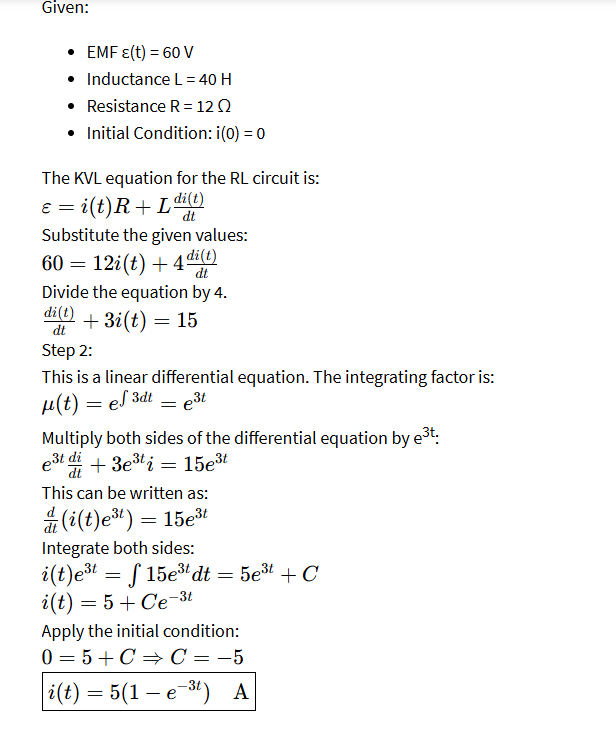 Given:
* EMFg(t)=60V
* Inductance L=40H
* Resistance R=120
« Initial Condition: i(0) =0
The KVL equation for the RL circuit is:
jy dit
e=1i(t)R+ LED
Substitute the given values:
di)
60 = 12i(t) + 440
Divide the equation by 4.
dit; .
40 1 3i(t) = 15
Step 2:
This is a linear differential equation. The integrating factor is:
u(t) = ef 3d — g3t
Multiply both sides of the differential equation by e3%
ed + 3ei = 15e%
This can be written as:
2 (i(t)e™) = 15e™
Integrate both sides:
i(t)e* = [15e™dt = 5e* + C
i(t) =5+ Ce
Apply the initial condition:
0=5+C=>C=-5
it) =5(1—e) A
This is AI generated Response.
Asked by: mayank
Created at: 2025-09-09 01:18:03
Asked by: mayank
Created at: 2025-09-09 01:18:03
Final Answer:
Rendered
Raw Text
Did you like this answer?
Certainly! Here is the solution from the image rewritten in a structured and organized way:
---
### **Given:**
- **EMF:** \( \varepsilon(t) = 60\,V \)
- **Inductance:** \( L = 40\,H \)
- **Resistance:** \( R = 12\,\Omega \)
- **Initial Condition:** \( i(0) = 0 \)
---
### **Step 1: Write the KVL Equation for the RL Circuit**
\[
\varepsilon = i(t)R + L\frac{di(t)}{dt}
\]
Substitute the given values:
\[
60 = 12i(t) + 40\frac{di(t)}{dt}
\]
Divide the equation by 4:
\[
\frac{di(t)}{dt} + 3i(t) = 15
\]
---
### **Step 2: Solve the Differential Equation**
This is a first-order linear differential equation.
The integrating factor (\(\mu(t)\)) is:
\[
\mu(t) = e^{\int 3 dt} = e^{3t}
\]
Multiply both sides by the integrating factor:
\[
e^{3t}\frac{di}{dt} + 3e^{3t}i = 15e^{3t}
\]
This simplifies to:
\[
\frac{d}{dt}(i(t)e^{3t}) = 15e^{3t}
\]
---
### **Step 3: Integrate Both Sides**
\[
i(t)e^{3t} = \int 15e^{3t}dt
\]
\[
i(t)e^{3t} = 5e^{3t} + C
\]
\[
i(t) = 5 + Ce^{-3t}
\]
---
### **Step 4: Apply Initial Condition**
Given \(i(0) = 0\):
\[
0 = 5 + C \implies C = -5
\]
So,
\[
\boxed{i(t) = 5\left(1 - e^{-3t}\right) \ \text{A}}
\]
---
**Final Answer:**
\[
\boxed{i(t) = 5\left(1 - e^{-3t}\right) \ \text{A}}
\]
---
📢 Instructions:
- Ask anything relatd to above question only.
- For new Question goto :