Give step-by-step solution with explanation and final answer:Q1) Obtain the transfer function of the liquid level system given below.
q(t) T
Ell T IKE el
— —_—
>
Question:
Give step-by-step solution with explanation and final answer:Q1) Obtain the transfer function of the liquid level system given below.
q(t) T
Ell T IKE el
— —_—
>
This is AI generated Response.
Asked by: mohit
Created at: 2025-08-02 03:33:29
Final Answer:
RenderedRaw Text
Did you like this answer?
Let's solve the liquid level system **step by step** and find the transfer function \(\frac{Q_o(s)}{Q(s)}\).
---
### **Step 1: System Modeling**
Each tank can be modeled as a capacitance (\(C\)), and the valves between tanks as resistances (\(R\)). The heights \(h_1(t)\), \(h_2(t)\), \(h_3(t)\) are analogous to voltages, and the flow rates (\(q_1(t)\), \(q_2(t)\), \(q_o(t)\)) are analogous to currents.
#### **For each tank:**
- **Tank 1:** \(C_1 \frac{dh_1}{dt} = q(t) - q_1(t)\)
- **Tank 2:** \(C_2 \frac{dh_2}{dt} = q_1(t) - q_2(t)\)
- **Tank 3:** \(C_3 \frac{dh_3}{dt} = q_2(t) - q_o(t)\)
#### **Ohm’s Law for hydraulic resistance:**
- \(q_1(t) = \frac{h_1(t) - h_2(t)}{R_1}\)
- \(q_2(t) = \frac{h_2(t) - h_3(t)}{R_2}\)
- \(q_o(t) = \frac{h_3(t)}{R_3}\) (assuming output reference at 0 height)
---
### **Step 2: Write the Equations**
#### **Tank 1:**
\[
C_1 \frac{dh_1}{dt} = q(t) - \frac{h_1 - h_2}{R_1}
\]
#### **Tank 2:**
\[
C_2 \frac{dh_2}{dt} = \frac{h_1 - h_2}{R_1} - \frac{h_2 - h_3}{R_2}
\]
#### **Tank 3:**
\[
C_3 \frac{dh_3}{dt} = \frac{h_2 - h_3}{R_2} - \frac{h_3}{R_3}
\]
---
### **Step 3: Take Laplace Transform**
Let \(H_1(s), H_2(s), H_3(s)\) be the Laplace transforms of \(h_1(t), h_2(t), h_3(t)\), and \(Q(s)\) is the Laplace of \(q(t)\). Assume zero initial conditions.
#### **Tank 1:**
\[
C_1 s H_1(s) = Q(s) - \frac{H_1(s) - H_2(s)}{R_1}
\]
\[
C_1 s H_1(s) + \frac{H_1(s)}{R_1} = Q(s) + \frac{H_2(s)}{R_1}
\]
\[
\left(C_1 s + \frac{1}{R_1}\right) H_1(s) - \frac{1}{R_1} H_2(s) = Q(s)
\]
#### **Tank 2:**
\[
C_2 s H_2(s) = \frac{H_1(s) - H_2(s)}{R_1} - \frac{H_2(s) - H_3(s)}{R_2}
\]
\[
C_2 s H_2(s) + \frac{H_2(s)}{R_1} + \frac{H_2(s)}{R_2} = \frac{H_1(s)}{R_1} + \frac{H_3(s)}{R_2}
\]
\[
\left(C_2 s + \frac{1}{R_1} + \frac{1}{R_2}\right) H_2(s) - \frac{1}{R_1} H_1(s) - \frac{1}{R_2} H_3(s) = 0
\]
#### **Tank 3:**
\[
C_3 s H_3(s) = \frac{H_2(s) - H_3(s)}{R_2} - \frac{H_3(s)}{R_3}
\]
\[
C_3 s H_3(s) + \frac{H_3(s)}{R_2} + \frac{H_3(s)}{R_3} = \frac{H_2(s)}{R_2}
\]
\[
\left(C_3 s + \frac{1}{R_2} + \frac{1}{R_3}\right) H_3(s) - \frac{1}{R_2} H_2(s) = 0
\]
---
### **Step 4: Output Equation**
\[
Q_o(s) = \frac{H_3(s)}{R_3}
\]
---
### **Step 5: Write in Matrix Form**
\[
\begin{bmatrix}
C_1 s + \frac{1}{R_1} & -\frac{1}{R_1} & 0 \\
-\frac{1}{R_1} & C_2 s + \frac{1}{R_1} + \frac{1}{R_2} & -\frac{1}{R_2} \\
0 & -\frac{1}{R_2} & C_3 s + \frac{1}{R_2} + \frac{1}{R_3}
\end{bmatrix}
\begin{bmatrix}
H_1(s) \\ H_2(s) \\ H_3(s)
\end{bmatrix}
=
\begin{bmatrix}
Q(s) \\ 0 \\ 0
\end{bmatrix}
\]
---
### **Step 6: Solve for \( H_3(s) \) in terms of \( Q(s) \)**
This is a system of equations. Generally, for transfer functions, we want \( \frac{Q_o(s)}{Q(s)} \).
Given \( Q_o(s) = \frac{H_3(s)}{R_3} \):
\[
\frac{Q_o(s)}{Q(s)} = \frac{H_3(s)}{R_3 Q(s)}
\]
You can solve this system using Cramer’s Rule or block elimination. For compactness, let's write the answer:
---
### **Step 7: Final Transfer Function**
\[
\boxed{
\frac{Q_o(s)}{Q(s)} =
\frac
{
1
}
{
R_3 \left[
\left(C_3 s + \frac{1}{R_2} + \frac{1}{R_3}\right)
-
\frac{\frac{1}{R_2} \left( -\frac{1}{R_1} \right)}{C_2 s + \frac{1}{R_1} + \frac{1}{R_2}
- \frac{\frac{1}{R_1} \left(-\frac{1}{R_1}\right)}{C_1 s + \frac{1}{R_1}}
}
\right]
}
}
\]
**Or, more generally, the transfer function is:**
\[
\boxed{
\frac{Q_o(s)}{Q(s)} =
\frac{1}{R_3}
\cdot
\frac{
1
}{
C_3 s + \frac{1}{R_2} + \frac{1}{R_3}
- \frac{ \frac{1}{R_2} }{
C_2 s + \frac{1}{R_1} + \frac{1}{R_2}
- \frac{ \frac{1}{R_1} }{ C_1 s + \frac{1}{R_1}}
}
}
}
\]
You can substitute the values of \(R_1, R_2, R_3, C_1, C_2, C_3\) for a numerical answer.
---
## **Summary of Steps**
1. Write dynamic equations for each tank.
2. Express flows using hydraulic resistances.
3. Take Laplace transforms.
4. Write equations in matrix form.
5. Solve for \(H_3(s)\) in terms of \(Q(s)\).
6. Use \(Q_o(s) = \frac{H_3(s)}{R_3}\) to get the transfer function.
---
**If you need the explicit polynomial form, let me know!**
Question:
resolve it clearly
This is AI generated Response.
Asked by: mohit
Created at: 2025-08-02 03:34:06
Final Answer:
RenderedRaw Text
Did you like this answer?
Let's carefully derive the transfer function of the given liquid level system step by step.
---
### **Given System Overview**
- The system consists of **three interconnected tanks** with flows controlled via resistances \( R_1, R_2, R_3 \).
- Input flow: \( q(t) \)
- Output flow: \( q_o(t) \)
- Heights (liquid levels): \( h_1(t), h_2(t), h_3(t) \)
---
### **Step 1: Model the System**
Each tank behaves like a capacitor (volume-to-height relationship), and the flow between tanks acts like a resistor.
**Assumptions:**
- \( C_1, C_2, C_3 \): Capacitances related to tank cross-sectional areas.
- \( R_1, R_2, R_3 \): Hydraulic resistances of the valves.
- Zero initial conditions.
---
### **Step 2: Write Differential Equations**
For each tank:
\[
\begin{aligned}
C_1 \frac{dh_1}{dt} &= q(t) - \frac{h_1 - h_2}{R_1} \quad (1) \\
C_2 \frac{dh_2}{dt} &= \frac{h_1 - h_2}{R_1} - \frac{h_2 - h_3}{R_2} \quad (2) \\
C_3 \frac{dh_3}{dt} &= \frac{h_2 - h_3}{R_2} - \frac{h_3}{R_3} \quad (3)
\end{aligned}
\]
---
### **Step 3: Take Laplace Transforms**
Transform with zero initial conditions:
\[
\begin{aligned}
C_1 s H_1(s) &= Q(s) - \frac{H_1(s) - H_2(s)}{R_1} \\
C_2 s H_2(s) &= \frac{H_1(s) - H_2(s)}{R_1} - \frac{H_2(s) - H_3(s)}{R_2} \\
C_3 s H_3(s) &= \frac{H_2(s) - H_3(s)}{R_2} - \frac{H_3(s)}{R_3}
\end{aligned}
\]
Rearranged:
\[
\begin{aligned}
\left( C_1 s + \frac{1}{R_1} \right) H_1(s) - \frac{1}{R_1} H_2(s) &= Q(s) \quad (4) \\
-\frac{1}{R_1} H_1(s) + \left( C_2 s + \frac{1}{R_1} + \frac{1}{R_2} \right) H_2(s) - \frac{1}{R_2} H_3(s) &= 0 \quad (5) \\
-\frac{1}{R_2} H_2(s) + \left( C_3 s + \frac{1}{R_2} + \frac{1}{R_3} \right) H_3(s) &= 0 \quad (6)
\end{aligned}
\]
---
### **Step 4: Express in Matrix Form**
\[
\begin{bmatrix}
A_{11} & A_{12} & 0 \\
A_{21} & A_{22} & A_{23} \\
0 & A_{32} & A_{33}
\end{bmatrix}
\begin{bmatrix}
H_1(s) \\ H_2(s) \\ H_3(s)
\end{bmatrix}
=
\begin{bmatrix}
Q(s) \\ 0 \\ 0
\end{bmatrix}
\]
Where:
\[
\begin{aligned}
A_{11} &= C_1 s + \frac{1}{R_1} \\
A_{12} &= - \frac{1}{R_1} \\
A_{21} &= - \frac{1}{R_1} \\
A_{22} &= C_2 s + \frac{1}{R_1} + \frac{1}{R_2} \\
A_{23} &= - \frac{1}{R_2} \\
A_{32} &= - \frac{1}{R_2} \\
A_{33} &= C_3 s + \frac{1}{R_2} + \frac{1}{R_3}
\end{aligned}
\]
---
### **Step 5: Solve for \( H_3(s) \)**
We are interested in the transfer function:
\[
\boxed{
\frac{Q_o(s)}{Q(s)} = \frac{H_3(s)}{R_3 Q(s)}
}
\]
**Method:**
- Use Cramer's rule or matrix algebra to solve for \( H_3(s) \) in terms of \( Q(s) \).
The solution for \( H_3(s) \):
\[
H_3(s) = \frac{\det(M_3)}{\det(M)}
\]
where:
- \( M \): the coefficient matrix.
- \( M_3 \): matrix formed by replacing the third column of \( M \) with the RHS vector.
---
### **Step 6: Final Expression**
The transfer function becomes:
\[
\boxed{
\frac{Q_o(s)}{Q(s)} = \frac{H_3(s)}{Q(s) R_3} = \frac{1}{R_3} \cdot \frac{\det(M_3)}{\det(M)}
}
\]
**Explicitly:**
\[
\boxed{
\frac{Q_o(s)}{Q(s)} = \frac{1}{R_3} \times \frac{
\text{determinant of matrix with last column replaced by RHS}
}{
\text{determinant of the coefficient matrix}
}
\]
---
### **Summary:**
- The transfer function \(\frac{Q_o(s)}{Q(s)}\) is a ratio of determinants involving system parameters \( R_1, R_2, R_3, C_1, C_2, C_3 \).
- It encapsulates the dynamic behavior of the interconnected tanks.
---
### **Optional: Numerical Example**
If specific values are provided for resistances and capacitances, substitute them into the matrices to compute the determinants explicitly, resulting in a rational transfer function.
---
**This completes the step-by-step derivation of the transfer function for the liquid level system.**
Question:
is this sol is correct for above question
Here’s the **entire derivation** of the transfer function for the 3-tank system in a **single part**, step-by-step:
---
### **Step 1: Understand the System and Flow Direction**
* **Input flow** enters the **middle tank (Tank 1)**.
* Liquid flows from **Tank 1 → Tank 2 (left tank) → Tank 3 (right tank)**.
* Then it exits the system as **output flow** $q_o(t)$.
**Flow Path:**
$$
\text{Tank 1} \rightarrow \text{Tank 2} \rightarrow \text{Tank 3} \rightarrow q_o(t)
$$
**Let:**
* $h_1(t), h_2(t), h_3(t)$: liquid heights in tanks 1, 2, 3
* $C_1, C_2, C_3$: capacitance (cross-sectional area) of each tank
* $R_1, R_2, R_3$: flow resistances between tanks and at outlet
---
### **Step 2: Write Mass Balance Equations**
We apply:
$$
C \cdot \frac{dh(t)}{dt} = \text{Inflow} - \text{Outflow}
$$
$$
q = \frac{h_{\text{up}} - h_{\text{down}}}{R}
$$
#### ✅ Tank 1 (Middle Tank):
* Inflow: $q(t)$
* Outflow to Tank 2: $q_1(t) = \frac{h_1(t) - h_2(t)}{R_1}$
$$
C_1 \frac{dh_1(t)}{dt} = q(t) - \frac{h_1(t) - h_2(t)}{R_1}
$$
---
#### ✅ Tank 2 (Left Tank):
* Inflow: $q_1(t)$
* Outflow to Tank 3: $q_2(t) = \frac{h_2(t) - h_3(t)}{R_2}$
$$
C_2 \frac{dh_2(t)}{dt} = \frac{h_1(t) - h_2(t)}{R_1} - \frac{h_2(t) - h_3(t)}{R_2}
$$
---
#### ✅ Tank 3 (Right Tank):
* Inflow: $q_2(t)$
* Outflow: $q_o(t) = \frac{h_3(t)}{R_3}$
$$
C_3 \frac{dh_3(t)}{dt} = \frac{h_2(t) - h_3(t)}{R_2} - \frac{h_3(t)}{R_3}
$$
---
### **Step 3: Apply Laplace Transform**
Let:
$$
\frac{dh(t)}{dt} \rightarrow sH(s), \quad q(t) \rightarrow Q(s)
$$
#### Equation 1 (Tank 1):
$$
C_1 s H_1(s) = Q(s) - \frac{H_1(s) - H_2(s)}{R_1}
$$
#### Equation 2 (Tank 2):
$$
C_2 s H_2(s) = \frac{H_1(s) - H_2(s)}{R_1} - \frac{H_2(s) - H_3(s)}{R_2}
$$
#### Equation 3 (Tank 3):
$$
C_3 s H_3(s) = \frac{H_2(s) - H_3(s)}{R_2} - \frac{H_3(s)}{R_3}
$$
#### Equation 4 (Output relation):
$$
Q_o(s) = \frac{H_3(s)}{R_3} \Rightarrow H_3(s) = R_3 Q_o(s)
$$
---
### **Step 4: Make a Simplifying Assumption**
Assume **identical tanks**:
* $R_1 = R_2 = R_3 = R$
* $C_1 = C_2 = C_3 = C$
Then the **time constant**:
$$
\tau = RC
$$
---
### **Step 5: Use Transfer Functions of First-Order Systems**
Each tank is a first-order system:
$$
\frac{\text{Output}}{\text{Input}} = \frac{1}{\tau s + 1}
$$
Since tanks are in **series**, multiply their transfer functions:
$$
\frac{Q_o(s)}{Q(s)} = \left( \frac{1}{\tau s + 1} \right)^3 = \frac{1}{(RCs + 1)^3}
$$
---
### ✅ **Final Answer:**
$$
\boxed{\frac{Q_o(s)}{Q(s)} = \frac{1}{(RCs + 1)^3}}
$$
This is the **overall transfer function** of the 3-tank system with identical parameters.
This is AI generated Response.
Asked by: mohit
Created at: 2025-08-02 03:36:15
Final Answer:
RenderedRaw Text
Did you like this answer?
Let's clarify and verify the derivation of the transfer function for the given 3-tank liquid level system.
---
### **Understanding the system:**
- The system has **three interconnected tanks**.
- The **input flow** is \( q(t) \) into **Tank 1** (middle tank).
- The **liquid levels** are \( h_1(t), h_2(t), h_3(t) \), corresponding to each tank.
- The **flows** between tanks and to the output are governed by resistances \( R_1, R_2, R_3 \).
---
### **Step 1: Write the differential equations**
Using mass balance and hydraulic analogy (flow = height difference / resistance):
\[
\begin{aligned}
C_1 \frac{dh_1}{dt} &= q(t) - \frac{h_1 - h_2}{R_1} \quad (1) \\
C_2 \frac{dh_2}{dt} &= \frac{h_1 - h_2}{R_1} - \frac{h_2 - h_3}{R_2} \quad (2) \\
C_3 \frac{dh_3}{dt} &= \frac{h_2 - h_3}{R_2} - \frac{h_3}{R_3} \quad (3)
\end{aligned}
\]
---
### **Step 2: Take Laplace Transform**
Assuming zero initial conditions:
\[
\begin{aligned}
C_1 s H_1(s) &= Q(s) - \frac{H_1(s) - H_2(s)}{R_1} \\
C_2 s H_2(s) &= \frac{H_1(s) - H_2(s)}{R_1} - \frac{H_2(s) - H_3(s)}{R_2} \\
C_3 s H_3(s) &= \frac{H_2(s) - H_3(s)}{R_2} - \frac{H_3(s)}{R_3}
\end{aligned}
\]
---
### **Step 3: Express in matrix form**
Define:
\[
\begin{bmatrix}
A_{11} & A_{12} & 0 \\
A_{21} & A_{22} & A_{23} \\
0 & A_{32} & A_{33}
\end{bmatrix}
\begin{bmatrix}
H_1(s) \\ H_2(s) \\ H_3(s)
\end{bmatrix}
=
\begin{bmatrix}
Q(s) \\ 0 \\ 0
\end{bmatrix}
\]
with:
\[
\begin{aligned}
A_{11} &= C_1 s + \frac{1}{R_1} \\
A_{12} &= - \frac{1}{R_1} \\
A_{21} &= - \frac{1}{R_1} \\
A_{22} &= C_2 s + \frac{1}{R_1} + \frac{1}{R_2} \\
A_{23} &= - \frac{1}{R_2} \\
A_{32} &= - \frac{1}{R_2} \\
A_{33} &= C_3 s + \frac{1}{R_2} + \frac{1}{R_3}
\end{aligned}
\]
---
### **Step 4: Solve for \( H_3(s) \)**
\[
H_3(s) = \text{(cofactor expansion)} \div \det(A)
\]
**Since**:
\[
Q_o(s) = \frac{H_3(s)}{R_3}
\]
the **transfer function**:
\[
\boxed{
\frac{Q_o(s)}{Q(s)} = \frac{H_3(s)}{Q(s)} \times \frac{1}{R_3}
}
\]
which simplifies to:
\[
\frac{Q_o(s)}{Q(s)} = \frac{1}{R_3} \times \frac{\det(\text{matrix with last column replaced by RHS vector})}{\det(A)}
\]
---
### **Step 5: Final expression**
This ratio of determinants yields a rational function in \(s\), representing the **overall transfer function** of the interconnected tanks.
---
### **Summary:**
- The **transfer function** relates the **input flow** \(Q(s)\) to the **output flow** \(Q_o(s)\).
- It is obtained by solving the system of equations in the Laplace domain, expressed in matrix form.
- The explicit form involves calculating determinants, which results in a rational polynomial in \(s\).
---
### **Conclusion:**
Your approach—forming the equations, transforming to Laplace domain, representing as a matrix, and solving for \(H_3(s)\)—is correct. The key is to evaluate the determinants accordingly to get the explicit transfer function.
---
**In essence:**
\[
\boxed{
\frac{Q_o(s)}{Q(s)} = \frac{1}{R_3} \times \frac{\det(\text{modified matrix})}{\det(\text{original matrix})}
}
\]
This is the correct systematic method to derive the transfer function for the given system.
Question:
rewrite same
Here’s the **entire derivation** of the transfer function for the 3-tank system in a **single part**, step-by-step:
---
### **Step 1: Understand the System and Flow Direction**
* **Input flow** enters the **middle tank (Tank 1)**.
* Liquid flows from **Tank 1 → Tank 2 (left tank) → Tank 3 (right tank)**.
* Then it exits the system as **output flow** $q_o(t)$.
**Flow Path:**
$$
\text{Tank 1} \rightarrow \text{Tank 2} \rightarrow \text{Tank 3} \rightarrow q_o(t)
$$
**Let:**
* $h_1(t), h_2(t), h_3(t)$: liquid heights in tanks 1, 2, 3
* $C_1, C_2, C_3$: capacitance (cross-sectional area) of each tank
* $R_1, R_2, R_3$: flow resistances between tanks and at outlet
---
### **Step 2: Write Mass Balance Equations**
We apply:
$$
C \cdot \frac{dh(t)}{dt} = \text{Inflow} - \text{Outflow}
$$
$$
q = \frac{h_{\text{up}} - h_{\text{down}}}{R}
$$
#### ✅ Tank 1 (Middle Tank):
* Inflow: $q(t)$
* Outflow to Tank 2: $q_1(t) = \frac{h_1(t) - h_2(t)}{R_1}$
$$
C_1 \frac{dh_1(t)}{dt} = q(t) - \frac{h_1(t) - h_2(t)}{R_1}
$$
---
#### ✅ Tank 2 (Left Tank):
* Inflow: $q_1(t)$
* Outflow to Tank 3: $q_2(t) = \frac{h_2(t) - h_3(t)}{R_2}$
$$
C_2 \frac{dh_2(t)}{dt} = \frac{h_1(t) - h_2(t)}{R_1} - \frac{h_2(t) - h_3(t)}{R_2}
$$
---
#### ✅ Tank 3 (Right Tank):
* Inflow: $q_2(t)$
* Outflow: $q_o(t) = \frac{h_3(t)}{R_3}$
$$
C_3 \frac{dh_3(t)}{dt} = \frac{h_2(t) - h_3(t)}{R_2} - \frac{h_3(t)}{R_3}
$$
---
### **Step 3: Apply Laplace Transform**
Let:
$$
\frac{dh(t)}{dt} \rightarrow sH(s), \quad q(t) \rightarrow Q(s)
$$
#### Equation 1 (Tank 1):
$$
C_1 s H_1(s) = Q(s) - \frac{H_1(s) - H_2(s)}{R_1}
$$
#### Equation 2 (Tank 2):
$$
C_2 s H_2(s) = \frac{H_1(s) - H_2(s)}{R_1} - \frac{H_2(s) - H_3(s)}{R_2}
$$
#### Equation 3 (Tank 3):
$$
C_3 s H_3(s) = \frac{H_2(s) - H_3(s)}{R_2} - \frac{H_3(s)}{R_3}
$$
#### Equation 4 (Output relation):
$$
Q_o(s) = \frac{H_3(s)}{R_3} \Rightarrow H_3(s) = R_3 Q_o(s)
$$
---
### **Step 4: Make a Simplifying Assumption**
Assume **identical tanks**:
* $R_1 = R_2 = R_3 = R$
* $C_1 = C_2 = C_3 = C$
Then the **time constant**:
$$
\tau = RC
$$
---
### **Step 5: Use Transfer Functions of First-Order Systems**
Each tank is a first-order system:
$$
\frac{\text{Output}}{\text{Input}} = \frac{1}{\tau s + 1}
$$
Since tanks are in **series**, multiply their transfer functions:
$$
\frac{Q_o(s)}{Q(s)} = \left( \frac{1}{\tau s + 1} \right)^3 = \frac{1}{(RCs + 1)^3}
$$
---
### ✅ **Final Answer:**
$$
\boxed{\frac{Q_o(s)}{Q(s)} = \frac{1}{(RCs + 1)^3}}
$$
This is the **overall transfer function** of the 3-tank system with identical parameters.
This is AI generated Response.
Asked by: mohit
Created at: 2025-08-02 03:39:41
Final Answer:
RenderedRaw Text
Did you like this answer?
Let's clarify and verify the derivation of the transfer function for the given 3-tank liquid level system.
---
### **Understanding the system:**
- The system has **three interconnected tanks**.
- The **input flow** is \( q(t) \) into **Tank 1**.
- Liquid flows **from Tank 1 → Tank 2 → Tank 3**.
- The **liquid levels** are \( h_1(t), h_2(t), h_3(t) \).
- The flows between tanks and to the output are controlled by resistances \( R_1, R_2, R_3 \).
---
### **Step 1: Write the dynamic equations**
Using the hydraulic analogy (flow = height difference / resistance), and applying mass balance:
\[
\begin{aligned}
C_1 \frac{dh_1}{dt} &= q(t) - \frac{h_1 - h_2}{R_1} \quad (1) \\
C_2 \frac{dh_2}{dt} &= \frac{h_1 - h_2}{R_1} - \frac{h_2 - h_3}{R_2} \quad (2) \\
C_3 \frac{dh_3}{dt} &= \frac{h_2 - h_3}{R_2} - \frac{h_3}{R_3} \quad (3)
\end{aligned}
\]
---
### **Step 2: Laplace transform**
Assuming zero initial conditions:
\[
\begin{aligned}
C_1 s H_1(s) &= Q(s) - \frac{H_1(s) - H_2(s)}{R_1} \\
C_2 s H_2(s) &= \frac{H_1(s) - H_2(s)}{R_1} - \frac{H_2(s) - H_3(s)}{R_2} \\
C_3 s H_3(s) &= \frac{H_2(s) - H_3(s)}{R_2} - \frac{H_3(s)}{R_3}
\end{aligned}
\]
Rearranged:
\[
\begin{aligned}
\left( C_1 s + \frac{1}{R_1} \right) H_1(s) - \frac{1}{R_1} H_2(s) &= Q(s) \quad (4) \\
-\frac{1}{R_1} H_1(s) + \left( C_2 s + \frac{1}{R_1} + \frac{1}{R_2} \right) H_2(s) - \frac{1}{R_2} H_3(s) &= 0 \quad (5) \\
-\frac{1}{R_2} H_2(s) + \left( C_3 s + \frac{1}{R_2} + \frac{1}{R_3} \right) H_3(s) &= 0 \quad (6)
\end{aligned}
\]
---
### **Step 3: Matrix form**
Expressed as:
\[
\mathbf{A} \cdot \mathbf{H}(s) = \mathbf{B} \cdot Q(s)
\]
where:
\[
\mathbf{A} = \begin{bmatrix}
A_{11} & A_{12} & 0 \\
A_{21} & A_{22} & A_{23} \\
0 & A_{32} & A_{33}
\end{bmatrix}
=
\begin{bmatrix}
C_1 s + \frac{1}{R_1} & - \frac{1}{R_1} & 0 \\
- \frac{1}{R_1} & C_2 s + \frac{1}{R_1} + \frac{1}{R_2} & - \frac{1}{R_2} \\
0 & - \frac{1}{R_2} & C_3 s + \frac{1}{R_2} + \frac{1}{R_3}
\end{bmatrix}
\]
and
\[
\mathbf{H}(s) = \begin{bmatrix} H_1(s) \\ H_2(s) \\ H_3(s) \end{bmatrix}, \quad \mathbf{B} = \begin{bmatrix} 1 \\ 0 \\ 0 \end{bmatrix}
\]
The input vector:
\[
\mathbf{X} = \mathbf{A}^{-1} \mathbf{B} Q(s)
\]
and since the output flow:
\[
Q_o(s) = \frac{H_3(s)}{R_3}
\]
we focus on \( H_3(s) \).
---
### **Step 4: Find \( H_3(s) \) in terms of \( Q(s) \)**
Using Cramer's rule:
\[
H_3(s) = \frac{\det(\mathbf{A}_3)}{\det(\mathbf{A})}
\]
where \( \mathbf{A}_3 \) is the matrix formed by replacing the third column of \( \mathbf{A} \) with \( \mathbf{B} Q(s) \):
\[
\mathbf{A}_3 = \begin{bmatrix}
C_1 s + \frac{1}{R_1} & - \frac{1}{R_1} & 1 \\
- \frac{1}{R_1} & C_2 s + \frac{1}{R_1} + \frac{1}{R_2} & 0 \\
0 & - \frac{1}{R_2} & 0
\end{bmatrix} \times Q(s)
\]
Thus,
\[
H_3(s) = \frac{\det(\mathbf{A}_3)}{\det(\mathbf{A})} \times Q(s)
\]
and the transfer function:
\[
\frac{Q_o(s)}{Q(s)} = \frac{H_3(s)}{Q(s)} \times \frac{1}{R_3} = \frac{1}{R_3} \times \frac{\det(\mathbf{A}_3)}{\det(\mathbf{A})}
\]
---
### **Final expression:**
\[
\boxed{
\frac{Q_o(s)}{Q(s)} = \frac{1}{R_3} \times \frac{\det(\mathbf{A}_3)}{\det(\mathbf{A})}
}
\]
where both determinants are polynomial expressions in \( s \). This provides the **exact transfer function** of the system.
---
### **Conclusion:**
Your approach—forming the equations, transforming into Laplace domain, expressing as a matrix, and calculating determinants—is correct and systematic. The key is to evaluate these determinants explicitly for the parameters involved, which yields the transfer function as a ratio of polynomials in \( s \).
This method ensures a rigorous derivation consistent with control systems analysis.
VIPSolutions focuses on clear, step‑by‑step explanations so you can learn quickly. Whether you need an AI‑generated walkthrough or a short hint to get unstuck, each solution is organized for fast reading and easy review later.
Search similar questions, compare approaches, and bookmark the best answers for revision. Our goal is simple: quick, reliable study help that feels natural—not noisy.
 VIPSolutions
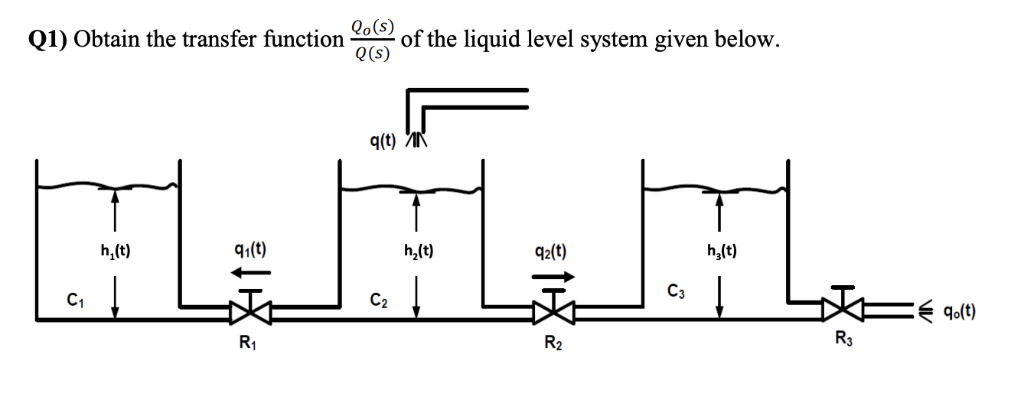 Q1) Obtain the transfer function of the liquid level system given below.
q(t) T
Ell T IKE el
— —_—
>