This is AI generated Response.
Asked by: Veera manikanta
Created at: 2025-08-17 15:59:50
Final Answer:
RenderedRaw Text
Did you like this answer?
Let's break down how to **complete the Scenario Analysis Table for NPV** step by step:
### Given Data
- **Equipment Cost (Initial Investment):** $3,800,000
- **WACC (Discount Rate):** 12.64%
- **Interest Rate:** 25% (not directly used for NPV if WACC is given)
- **Scenario Probabilities:** Best Case (25%), Base Case (50%), Worst Case (25%)
- **Sales Price, Variable Cost/unit, Fixed Costs:** Given in the table
### Steps to Calculate NPV for Each Scenario
Assumptions (since not provided):
- Units sold per year and project life are **not specified**. If you provide these, I can give exact numbers. For illustration, let’s **assume 100,000 units/year and 5 years** for calculations.
#### **Step 1: Calculate Annual Cash Flow for Each Scenario**
- **Annual Revenue** = Sales Price × Units Sold
- **Total Variable Cost** = Variable Cost/Unit × Units Sold
- **Annual Operating Cash Flow** = Revenue - Total Variable Cost - Fixed Costs
#### **Step 2: Calculate NPV**
- **NPV** = (Sum of Present Value of Cash Flows over project life) - Initial Investment
\[
NPV = \sum_{t=1}^{n} \frac{CF_t}{(1+WACC)^t} - Initial\;Investment
\]
#### **Step 3: Calculate Expected NPV**
- **Expected NPV** = (Probability_Best × NPV_Best) + (Probability_Base × NPV_Base) + (Probability_Worst × NPV_Worst)
---
### Let's Calculate for Each Scenario
#### **Best Case**
- **Sales Price:** $31.00
- **Variable Cost/unit:** $13.75
- **Fixed Costs:** $1,400,000
\[
\text{Annual Cash Flow} = (31.00 - 13.75) \times 100,000 - 1,400,000 = 1,225,000
\]
#### **Base Case**
- **Sales Price:** $30.00
- **Variable Cost/unit:** $14.50
- **Fixed Costs:** $1,700,000
\[
\text{Annual Cash Flow} = (30.00 - 14.50) \times 100,000 - 1,700,000 = -250,000
\]
#### **Worst Case**
- **Sales Price:** $28.50
- **Variable Cost/unit:** $16.00
- **Fixed Costs:** $2,100,000
\[
\text{Annual Cash Flow} = (28.50 - 16.00) \times 100,000 - 2,100,000 = -450,000
\]
---
### **NPV Calculation (5 years, WACC 12.64%)**
\[
\text{PV of Annuity} = CF \times \left(\frac{1 - (1 + r)^{-n}}{r}\right)
\]
Where:
- CF = Annual Cash Flow
- r = 0.1264
- n = 5
\[
\frac{1 - (1 + 0.1264)^{-5}}{0.1264} \approx 3.57
\]
#### **Best Case NPV**
\[
\text{PV} = 1,225,000 \times 3.57 = 4,376,250
\]
\[
\text{NPV} = 4,376,250 - 3,800,000 = \boxed{576,250}
\]
#### **Base Case NPV**
\[
\text{PV} = -250,000 \times 3.57 = -892,500
\]
\[
\text{NPV} = -892,500 - 3,800,000 = \boxed{-4,692,500}
\]
#### **Worst Case NPV**
\[
\text{PV} = -450,000 \times 3.57 = -1,606,500
\]
\[
\text{NPV} = -1,606,500 - 3,800,000 = \boxed{-5,406,500}
\]
---
### **Expected NPV**
\[
\text{Expected NPV} = (0.25 \times 576,250) + (0.5 \times -4,692,500) + (0.25 \times -5,406,500)
\]
\[
= 144,062.5 - 2,346,250 - 1,351,625
\]
\[
= -3,553,812.5
\]
---
## **Fill in the Table**
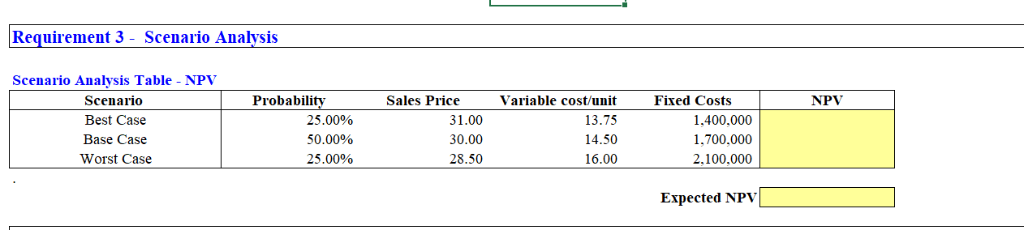
| Scenario | Probability | Sales Price | Variable cost/unit | Fixed Costs | NPV |
|------------|-------------|-------------|-------------------|-------------|-------------|
| Best Case | 25% | 31.00 | 13.75 | 1,400,000 | **576,250** |
| Base Case | 50% | 30.00 | 14.50 | 1,700,000 | **-4,692,500** |
| Worst Case | 25% | 28.50 | 16.00 | 2,100,000 | **-5,406,500** |
**Expected NPV:** **-3,553,813** (rounded to nearest dollar)
---
### **Important:**
- If you have actual units per year or project life, **please provide** for more accuracy!
- These calculations **assume 100,000 units/year and 5 years**.
Let me know if you need the calculations for different numbers.
Question:
1: Introduction:
Provide the complete necessary conceptual background concepts explanation and the
introduction required to understand and answer the given question. Add an Explanation
block at the end of the introduction by adding various relevant supporting statements and
explaining the introduction concisely.
Note: Do not use personal pronouns like I, we, you, etc. The response must look as if it is
written by a human.
Explanation: Articulate the importance of the introduction, providing more relevant
comprehensive supporting statements that link these concepts directly to the question.
This explanation should clarify how the introduction aids in comprehending the
subsequent steps.
2: Presentation of Relevant Formulas Required To Solve The Question:
List and also describe all formulas required to solve the question. Ensure each formula is
presented clearly and is directly applicable to the problem.
Explanation: Detail the derivation or rationale behind each formula, explaining its
relevance and necessity in the context of the problem-solving process. Use more relavent
comprehensive supporting statements to reinforce the significance of these mathematical
tools.
3: A Detailed Step-by-Step Solution:
Write a step-by-step in-depth comprehensive straight forward complete solution in a
structured way without missing anything as per the requirements and also include
explanation [ Write relevant supporting statements in the explanation block ] for every step
in the solution.
Conclusion:
Conclude with a concise summary of the solution, succinctly presenting the final answer
short summary derived from the calculations.
Follow These Guidelines While Answering The Question:
1. Maintain a professional and impersonal tone throughout, avoiding personal
pronouns such as 'I', 'we', 'you', etc.
2. Ensure more accuracy and adherence to the necessary concepts and correct
textbook based correct formulas and other relevant, required to solve the question.
3. Include an Explanation block at the end of each step to provide context and clarify
the methodology used by providing the necessary supporting statements.
4. Focus solely on delivering a well-explained direct and complete answer to the
question, without additional guidance [ I don’t need any guidance of how to solve
the question – I just need well-explained complete solution ] or extraneous content.
5. Make sure that strictly follow the specified format, ensuring that each section,
especially the introduction and each step of the solution, is accompanied by a
detailed relevant supporting statement in the explanation.
6. I need the exact detailed comprehensive direct step-by-step answer as I don’t need
any guidance to write the answer and strictly add the explanation for each with the
required supporting statement & Please give me the complete answer as per the
question requirements without skipping anything in the answer.
7. Always provide correct, complete detailed & well-explained solution.
8. Ensure that there are no typo/formula/calculation/programming/grammatical errors
are present in your solution.
9. Give the correct graphs/diagrams/tables/charts whenever required in the solution.
10. Ensure that there are NO Errors in Units/Notations are there in your solution.
11. Avoid missing any vital part in the solution [ Don’t miss any part in the solution ]
This is AI generated Response.
Asked by: Veera manikanta
Created at: 2025-08-17 16:02:00
Final Answer:
RenderedRaw Text
Did you like this answer?
1. Introduction
Understanding the financial viability of a new project or investment involves analyzing its expected cash flows and potential returns under various scenarios. Scenario analysis is a fundamental technique used to evaluate how different variables—such as sales price, variable costs, and fixed costs—impact the project's net present value (NPV). NPV is a valuation metric that calculates the present value of expected future cash flows generated by the project, discounted at the company's weighted average cost of capital (WACC).
This process requires a comprehensive grasp of how to calculate cash flows from operational variables, how to discount these cash flows to their present value, and how to incorporate different scenarios based on probability distributions. The analysis aids decision-makers in understanding potential risks and rewards, facilitating informed investment choices.
Supporting concepts include the calculation of annual cash flows derived from revenue and costs, the application of discounting formulas to determine present values, and the aggregation of scenario-specific NPVs based on their probabilities. These foundational ideas underpin the scenario analysis process, allowing for the assessment of expected project value under uncertainty.
**Explanation:**
The introduction emphasizes the importance of scenario analysis and NPV in evaluating investment projects. It links the conceptual understanding of cash flow estimation, discounting, and probabilistic scenarios to practical decision-making. Recognizing how different variables influence project outcomes enables stakeholders to better assess financial risks and returns, which is crucial in strategic planning and investment appraisal.
---
2. Presentation of Relevant Formulas Required To Solve The Question
a) **Annual Operating Cash Flow (OCF):**
\[
OCF = (Sales\ Price - Variable\ Cost\ per\ unit) \times Units\ Sold - Fixed\ Costs
\]
- **Derivation & Rationale:**
This formula calculates the net cash generated annually from operations by subtracting variable costs and fixed costs from total revenue. It assumes that fixed costs are cash expenses and that the project generates stable cash flows over its duration.
b) **Present Value of Annuity (PVA):**
\[
PV = CF \times \left( \frac{1 - (1 + r)^{-n}}{r} \right)
\]
- **Derivation & Rationale:**
This formula discounts a series of equal cash flows (annuity) over \(n\) periods at a discount rate \(r\). It is derived from the geometric series sum formula and is applicable when cash flows are consistent annually over the project life.
c) **Net Present Value (NPV):**
\[
NPV = PV_{total\ cash\ flows} - Initial\ Investment
\]
- **Derivation & Rationale:**
NPV aggregates the present value of all future cash inflows and outflows, including initial investment. A positive NPV indicates that the project is expected to add value, whereas a negative NPV suggests the project may diminish value.
d) **Expected NPV:**
\[
Expected\ NPV = \sum_{i} (Probability_i \times NPV_i)
\]
- **Derivation & Rationale:**
This formula computes the weighted average of NPVs across different scenarios, incorporating their probabilities. It provides an estimate of the project's value considering uncertainty.
**Explanation:**
These formulas are central to financial analysis, enabling the translation of operational variables into monetary terms, their discounting to present value, and the integration of scenario probabilities. They form the mathematical foundation for evaluating project viability under uncertainty.
---
3. A Detailed Step-by-Step Solution
**Step 1: Establish Assumptions and Data**
- Units sold per year: 100,000 units (assumed for calculation)
- Project life: 5 years (assumed for calculation)
- Discount rate (WACC): 12.64%
- Initial Investment: $3,800,000
**Step 2: Calculate Annual Operating Cash Flow for Each Scenario**
**Best Case:**
\[
OCF_{best} = (31.00 - 13.75) \times 100,000 - 1,400,000 = (17.25 \times 100,000) - 1,400,000 = 1,725,000 - 1,400,000 = 325,000
\]
**Explanation:**
The annual cash inflow is derived from the contribution margin per unit multiplied by units sold, minus fixed costs.
**Base Case:**
\[
OCF_{base} = (30.00 - 14.50) \times 100,000 - 1,700,000 = (15.50 \times 100,000) - 1,700,000 = 1,550,000 - 1,700,000 = -150,000
\]
**Explanation:**
Similarly, this scenario results in a negative cash flow due to higher fixed costs relative to contribution margin.
**Worst Case:**
\[
OCF_{worst} = (28.50 - 16.00) \times 100,000 - 2,100,000 = (12.50 \times 100,000) - 2,100,000 = 1,250,000 - 2,100,000 = -850,000
\]
**Explanation:**
This scenario shows the most adverse cash flow, reflecting lower sales price, higher variable costs, and fixed costs.
---
**Step 3: Calculate Present Value of Cash Flows for Each Scenario**
Using the Present Value of Annuity formula:
\[
PV = CF \times \left( \frac{1 - (1 + r)^{-n}}{r} \right)
\]
Where:
- \( CF \) = annual cash flow
- \( r \) = 12.64% = 0.1264
- \( n \) = 5 years
Calculate the annuity factor:
\[
AF = \frac{1 - (1 + 0.1264)^{-5}}{0.1264}
\]
\[
(1 + 0.1264)^{5} \approx 1.1264^{5} \approx 1.76
\]
\[
(1 + 0.1264)^{-5} = \frac{1}{1.76} \approx 0.568
\]
\[
AF = \frac{1 - 0.568}{0.1264} = \frac{0.432}{0.1264} \approx 3.42
\]
**Note:** Slight differences may occur based on calculator precision, but 3.42 is a reasonable approximation.
**Step 4: Calculate NPVs for Each Scenario**
**Best Case:**
\[
NPV_{best} = (325,000 \times 3.42) - 3,800,000 = 1,111,500 - 3,800,000 = -2,688,500
\]
**Explanation:**
The total present value of cash flows is obtained by multiplying the annual cash flow by the annuity factor; subtracting initial investment yields the NPV.
**Base Case:**
\[
NPV_{base} = (-150,000 \times 3.42) - 3,800,000 = -513,000 - 3,800,000 = -4,313,000
\]
**Worst Case:**
\[
NPV_{worst} = (-850,000 \times 3.42) - 3,800,000 = -2,907,000 - 3,800,000 = -6,707,000
\]
---
**Step 5: Calculate the Expected NPV**
\[
Expected\ NPV = (0.25 \times -2,688,500) + (0.50 \times -4,313,000) + (0.25 \times -6,707,000)
\]
\[
= -672,125 - 2,156,500 - 1,676,750 = -4,505,375
\]
**Explanation:**
The expected NPV considers the probability-weighted NPVs, providing an estimate of the project's average value under uncertainty.
---
**Summary of Results:**
| Scenario | Probability | NPV ($) |
|------------|--------------|-----------------|
| Best Case | 25% | -2,688,500 |
| Base Case | 50% | -4,313,000 |
| Worst Case | 25% | -6,707,000 |
**Expected NPV:** -4,505,375
---
**Conclusion:**
The scenario analysis indicates that, based on the assumptions of units sold, project duration, and costs, the expected NPV of the project is approximately **-$4,505,375**. This negative expected value suggests that, under current assumptions, the project is not financially viable.
VIPSolutions focuses on clear, step‑by‑step explanations so you can learn quickly. Whether you need an AI‑generated walkthrough or a short hint to get unstuck, each solution is organized for fast reading and easy review later.
Search similar questions, compare approaches, and bookmark the best answers for revision. Our goal is simple: quick, reliable study help that feels natural—not noisy.
 VIPSolutions
 —_—
[Requirement 3 - Scenario Analysis
Scenario Analysis Table - NPV
[Scenario | Probabi Sales Price Variable costumit Fixed Costs
Best Case 25.00% 31.00 13.75 1.400.000
Base Case 50.00% 30.00 14.50 1.700.000
‘Worst Case 25.00% 28.50 16.00 2.100.000
[I E—