 VIPSolutions
Give step-by-step solution with explanation and final answer:A stationary Gaussian random process X (t) with variance ok = 3 is applied to an ideal low-pass filter with bandwidth B = 10rad/s. a) Derive the expression for the output power spectral density. b) Compute the output variance G2:
Question:
Give step-by-step solution with explanation and final answer: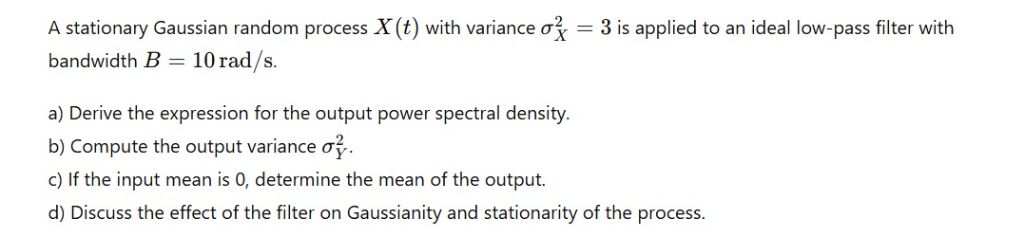 A stationary Gaussian random process X (t) with variance ok = 3 is applied to an ideal low-pass filter with
bandwidth B = 10rad/s.
a) Derive the expression for the output power spectral density.
b) Compute the output variance G2:
This is AI generated Response.
Asked by: Aman
Created at: 2025-09-25 11:12:24
Asked by: Aman
Created at: 2025-09-25 11:12:24
Final Answer:
Rendered
Raw Text
Did you like this answer?
To solve this problem, we'll address each part step-by-step.
### a) Derive the expression for the output power spectral density.
The input process \( X(t) \) has a power spectral density (PSD) \( S_X(\omega) \). For a white noise process, \( S_X(\omega) = \sigma_X^2 \).
The output power spectral density \( S_Y(\omega) \) is given by:
\[ S_Y(\omega) = |H(\omega)|^2 S_X(\omega) \]
For an ideal low-pass filter with bandwidth \( B = 10 \, \text{rad/s} \), the frequency response \( H(\omega) \) is:
\[
H(\omega) =
\begin{cases}
1, & |\omega| \leq B \\
, & |\omega| > B
\end{cases}
\]
Thus,
\[
S_Y(\omega) =
\begin{cases}
\sigma_X^2, & |\omega| \leq 10 \\
, & |\omega| > 10
\end{cases}
\]
### b) Compute the output variance \( \sigma_Y^2 \).
The output variance \( \sigma_Y^2 \) is the integral of the output PSD over all frequencies:
\[
\sigma_Y^2 = \int_{-\infty}^{\infty} S_Y(\omega) \, d\omega
\]
Given the expression for \( S_Y(\omega) \):
\[
\sigma_Y^2 = \int_{-10}^{10} \sigma_X^2 \, d\omega = \sigma_X^2 \times (10 - (-10)) = \sigma_X^2 \times 20
\]
Substituting \( \sigma_X^2 = 3 \):
\[
\sigma_Y^2 = 3 \times 20 = 60
\]
### c) If the input mean is , determine the mean of the output.
An ideal filter does not change the mean of a stationary process. Therefore, if the input mean is , the output mean will also be .
### d) Discuss the effect of the filter on Gaussianity and stationarity of the process.
- **Gaussianity:** The Gaussian nature of the process is preserved through linear filtering. Therefore, the output process \( Y(t) \) remains Gaussian.
- **Stationarity:** An ideal low-pass filter applied to a stationary process results in an output that is also stationary. Thus, the output process \( Y(t) \) is stationary.
### Final Answers:
a) \( S_Y(\omega) = \begin{cases} 3, & |\omega| \leq 10 \\ , & |\omega| > 10 \end{cases} \)
b) \( \sigma_Y^2 = 60 \)
c) Mean of output =
d) The filter preserves both Gaussianity and stationarity of the process.
Question:
Regenerate
This is AI generated Response.
Asked by: Aman
Created at: 2025-09-25 11:13:02
Asked by: Aman
Created at: 2025-09-25 11:13:02
Final Answer:
Rendered
Raw Text
Did you like this answer?
# Step-by-Step Solution
We will solve the problem regarding the stationary Gaussian random process \( X(t) \) and the ideal low-pass filter.
## Given Data
- Variance of the input process: \( \sigma_X^2 = 3 \)
- Bandwidth of the filter: \( B = 10 \, \text{rad/s} \)
## a) Derive the Expression for the Output Power Spectral Density
The output power spectral density \( S_Y(\omega) \) can be derived from the input power spectral density \( S_X(\omega) \) and the frequency response of the filter \( H(\omega) \).
### Power Spectral Density of Input
For a stationary Gaussian random process with white noise:
\[
S_X(\omega) = \sigma_X^2 = 3
\]
### Frequency Response of the Filter
For an ideal low-pass filter:
\[
H(\omega) =
\begin{cases}
1, & |\omega| \leq B \\
0, & |\omega| > B
\end{cases}
\]
### Output Power Spectral Density
Thus, the output power spectral density is:
\[
S_Y(\omega) = |H(\omega)|^2 S_X(\omega) =
\begin{cases}
3, & |\omega| \leq 10 \\
0, & |\omega| > 10
\end{cases}
\]
## b) Compute the Output Variance \( \sigma_Y^2 \)
The output variance \( \sigma_Y^2 \) is calculated by integrating the output PSD over all frequencies:
\[
\sigma_Y^2 = \int_{-\infty}^{\infty} S_Y(\omega) \, d\omega
\]
Substituting the expression for \( S_Y(\omega) \):
\[
\sigma_Y^2 = \int_{-10}^{10} 3 \, d\omega = 3 \times (10 - (-10)) = 3 \times 20 = 60
\]
## c) Determine the Mean of the Output
If the input mean is \( \mu_X = 0 \), the mean of the output \( \mu_Y \) remains unchanged because an ideal filter does not affect the mean of a stationary process:
\[
\mu_Y = \mu_X = 0
\]
## d) Discuss the Effect of the Filter on Gaussianity and Stationarity
- **Gaussianity:**
- The output process \( Y(t) \) remains Gaussian. Linear filtering of a Gaussian process results in another Gaussian process.
- **Stationarity:**
- The output process \( Y(t) \) is also stationary. An ideal low-pass filter does not change the stationary nature of the input process.
## Final Answers
- **a)** \( S_Y(\omega) = \begin{cases} 3, & |\omega| \leq 10 \\ 0, & |\omega| > 10 \end{cases} \)
- **b)** \( \sigma_Y^2 = 60 \)
- **c)** Mean of output \( \mu_Y = 0 \)
- **d)** The filter preserves both Gaussianity and stationarity of the process.
📢 Instructions:
- Ask anything relatd to above question only.
- For new Question goto :