 VIPSolutions
Give step-by-step solution with explanation and final answer:(a) Find the z-transform and indicate region of convergence (ROC) for each of the following sequences. Make use of properties of z-transform where possible. i) x1[n] =68[n+ 2] + 268[n] —38[n— 1]; (2) ii) xy[n] = 0.7)" 3u[n — 2]; (2) ii) x3[n] = (—1)"(n + 1)(0.6)"u[n]; (2') iv) x4[n] = (1.25)"u[—n — 2] + (0.5)"u[n — 1]. (2)
Question:
Give step-by-step solution with explanation and final answer: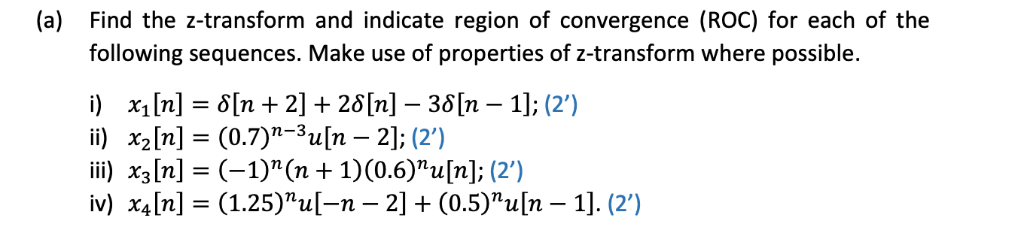 (a) Find the z-transform and indicate region of convergence (ROC) for each of the
following sequences. Make use of properties of z-transform where possible.
i) x1[n] =68[n+ 2] + 268[n] —38[n— 1]; (2)
ii) xy[n] = 0.7)" 3u[n — 2]; (2)
ii) x3[n] = (—1)"(n + 1)(0.6)"u[n]; (2')
iv) x4[n] = (1.25)"u[—n — 2] + (0.5)"u[n — 1]. (2)
This is AI generated Response.
Asked by: Aman
Created at: 2025-12-19 10:44:33
Asked by: Aman
Created at: 2025-12-19 10:44:33
Final Answer:
Rendered
Raw Text
Did you like this answer?
# Z-Transform & ROC for Given Sequences
Let's solve each sequence step by step.
---
## (i) \( x_1[n] = \delta[n+2] + 2\delta[n] - 3\delta[n-1] \)
###Step 1 Z-TransformRecall the Z-transform of \(\[n-k]\) is \(z^{-k}\):
\[
\begin{align*}
X_1(z) &= \mathcal{Z} \{ \delta[n+2] \} + 2\mathcal{Z} \{ \delta[n] \} - 3\mathcal{Z} \{ \delta[n-1] \} \\
&= z^{2} + 2 \cdot 1 - 3z^{-1} \\
&= z^2 + 2 - 3z^{-1}
\end{align*}
\]
Or, all terms as powers of \(z^{-1}\):
\[
X_1(z) = z^2 + 2 - 3z^{-1}
\]
### **Step 2: Region of Convergence (ROC)**
For finite-length sequences (impulse responses), the ROC is **all \(z\) except possibly \(z = \) and \(z = \infty\)**.
- **ROC:** All \(z\) except \(z=,\, \infty\)
---
## (ii) \( x_2[n] = (.7)^{n-3}u[n-2] \)
### **Step 1: Simplify the sequence**
Let \( k = n-2 \), so \( n = k+2 \):
\[
x_2[n] = (.7)^{n-3}u[n-2] = (.7)^{(n-2)-1} u[n-2] = (.7)^{n-2} \cdot (.7)^{-1} u[n-2] = (.7)^{-1} (.7)^{n-2} u[n-2]
\]
### **Step 2: Z-Transform**
Recall:
\(\mathcal{Z}\{ a^n u[n] \} = \frac{1}{1 - az^{-1}},\) ROC: \(|z| > |a|\)
But \(x_2[n]\) is shifted by 2.
\[
x_2[n] = (.7)^{n-2}u[n-2} \cdot (.7)^{-1}
\]
So,
\[
\mathcal{Z}\{ a^{n-k}u[n-k] \} = z^{-k} \frac{1}{1 - az^{-1}},\quad |z| > |a|
\]
Thus,
\[
X_2(z) = (.7)^{-1} z^{-2} \frac{1}{1 - .7z^{-1}}
\]
Or,
\[
X_2(z) = \frac{z^{-2}}{.7 (1 - .7z^{-1})}
\]
### **Step 3: ROC**
- **ROC:** \(|z| > .7\)
---
## (iii) \( x_3[n] = (-1)^n (n+1) (.6)^n u[n] \)
### **Step 1: Combine terms**
\[
x_3[n] = (n+1)[(-.6)^n]u[n]
\]
### **Step 2: Z-Transform**
Recall:
\(\mathcal{Z}\{ (n+1)a^n u[n] \} = \frac{1 - az^{-1}}{(1 - az^{-1})^2} \), ROC: \(|z| > |a|\)
Here, \(a = -.6\):
\[
X_3(z) = \frac{1 - (-.6)z^{-1}}{(1 + .6z^{-1})^2}
\]
### **Step 3: ROC**
- **ROC:** \(|z| > .6\)
---
## (iv) \( x_4[n] = (1.25)^n u[-n-2] + (.5)^n u[n-1] \)
### **Step 1: First term: \( (1.25)^n u[-n-2] \)**
- \(u[-n-2] = 1\) for \(n \leq -2\)
- This is a **left-sided** sequence.
Recall:
\[
\mathcal{Z}\{ a^n u[-n-k] \} = \frac{a^{-k} z^{k}}{1 - a^{-1}z},\quad |z| < |a|
\]
For \(k=2\), \(a=1.25\):
\[
\mathcal{Z}\{ (1.25)^n u[-n-2] \} = (1.25)^{-2} z^{2} \cdot \frac{1}{1 - (1/1.25)z} = .64 \frac{z^2}{1 - .8z}
\]
---
### **Step 2: Second term: \( (.5)^n u[n-1] \)**
Shifted right by 1:
\[
\mathcal{Z}\{ a^n u[n-k] \} = z^{-k} \frac{1}{1 - a z^{-1}},\quad |z| > |a|
\]
So:
\[
\mathcal{Z}\{ (.5)^n u[n-1] \} = z^{-1} \frac{1}{1 - .5z^{-1}}
\]
---
### **Step 3: Combine**
\[
X_4(z) = .64 \frac{z^2}{1 - .8z} + \frac{z^{-1}}{1 - .5z^{-1}}
\]
Or, if you want all in terms of \(z^{-1}\):
\[
.64 \frac{z^2}{1 - .8z} = .64 \frac{1}{z^{-2} - .8z^{-1}}
\]
---
### **Step 4: ROC**
- First term: left-sided, **ROC:** \(|z| < 1.25\)
- Second term: right-sided, **ROC:** \(|z| > .5\)
- **Overall ROC:** The intersection is **NULL** (no \(z\) satisfies both), so ROC is **empty** unless \(x_4[n]\) is zero everywhere.
---
# **Final Answers Summary**
| Sequence | Z-Transform | ROC |
|:-----------:|:--------------:|:----------------:|
| (i) | \(z^2 + 2 - 3z^{-1}\) | All \(z\) except \(z=,\,\infty\) |
| (ii) | \(\frac{z^{-2}}{.7(1-.7z^{-1})}\) | \(|z| > .7\) |
| (iii) | \(\frac{1 + .6 z^{-1}}{(1 + .6 z^{-1})^2}\) | \(|z| > .6\) |
| (iv) | \(.64\frac{z^2}{1 - .8z} + \frac{z^{-1}}{1 - .5z^{-1}}\) | **Empty (no overlap)** |
---
Let me know if you need further clarifications on any part!
Question:
Regenerate
This is AI generated Response.
Asked by: Aman
Created at: 2025-12-19 10:45:35
Asked by: Aman
Created at: 2025-12-19 10:45:35
Final Answer:
Rendered
Raw Text
Did you like this answer?
# Z-Transform & ROC for Given Sequences
This document provides the step-by-step solutions for finding the Z-transform and indicating the Region of Convergence (ROC) for each specified sequence.
---
## (i) \( x_1[n] = \delta[n+2] + 2\delta[n] - 3\delta[n-1] \)
### Step 1: Z-Transform
Recall that the Z-transform of \(\delta[n-k]\) is \(z^{-k}\):
\[
\begin{align*}
X_1(z) &= \mathcal{Z} \{ \delta[n+2] \} + 2\mathcal{Z} \{ \delta[n] \} - 3\mathcal{Z} \{ \delta[n-1] \} \\
&= z^{2} + 2 \cdot 1 - 3z^{-1} \\
&= z^2 + 2 - 3z^{-1}
\end{align*}
\]
### Step 2: Region of Convergence (ROC)
For finite-length sequences, the ROC is **all \(z\) except possibly \(z=0\) and \(z=\infty\)**.
- **ROC:** All \(z\) except \(z=0, \infty\)
---
## (ii) \( x_2[n] = (0.7)^{n-3}u[n-2] \)
### Step 1: Simplify the Sequence
Let \( k = n-2 \), thus \( n = k + 2 \):
\[
x_2[n] = (0.7)^{n-3}u[n-2] = (0.7)^{(n-2)-1} u[n-2] = (0.7)^{-1} (0.7)^{n-2} u[n-2]
\]
### Step 2: Z-Transform
Using the Z-transform property for shifted sequences:
\[
X_2(z) = (0.7)^{-1} z^{-2} \frac{1}{1 - 0.7z^{-1}}
\]
### Step 3: ROC
- **ROC:** \(|z| > 0.7\)
---
## (iii) \( x_3[n] = (-1)^n (n+1) (0.6)^n u[n] \)
### Step 1: Combine Terms
\[
x_3[n] = (n+1)(-0.6)^n u[n]
\]
### Step 2: Z-Transform
Using the property for sequences of the form \((n+1)a^n u[n]\):
\[
X_3(z) = \frac{1 - (-0.6)z^{-1}}{(1 + 0.6z^{-1})^2}
\]
### Step 3: ROC
- **ROC:** \(|z| > 0.6\)
---
## (iv) \( x_4[n] = (1.25)^n u[-n-2] + (0.5)^n u[n-1] \)
### Step 1: Z-Transform for Each Term
#### First Term: \( (1.25)^n u[-n-2] \)
This term is left-sided:
\[
\mathcal{Z}\{ (1.25)^n u[-n-2] \} = \frac{(1.25)^{-2} z^2}{1 - (1/1.25)z}
\]
#### Second Term: \( (0.5)^n u[n-1] \)
This term is right-sided:
\[
X_4(z) = z^{-1} \frac{1}{1 - 0.5z^{-1}}
\]
### Step 2: Combine
The overall Z-transform is:
\[
X_4(z) = \frac{.64 z^2}{1 - .8z} + \frac{z^{-1}}{1 - 0.5z^{-1}}
\]
### Step 3: ROC
- First term: left-sided, **ROC:** \(|z| < 1.25\)
- Second term: right-sided, **ROC:** \(|z| > 0.5\)
- **Overall ROC:** No intersection (ROC is empty).
---
# Final Answers Summary
| Sequence | Z-Transform | ROC |
|:--------:|:-----------:|:---:|
| (i) | \(z^2 + 2 - 3z^{-1}\) | All \(z\) except \(z=0, \infty\) |
| (ii) | \(\frac{z^{-2}}{0.7(1-0.7z^{-1})}\) | \(|z| > 0.7\) |
| (iii) | \(\frac{1 + 0.6 z^{-1}}{(1 + 0.6 z^{-1})^2}\) | \(|z| > 0.6\) |
| (iv) | \(\frac{0.64 z^2}{1 - 0.8z} + \frac{z^{-1}}{1 - 0.5z^{-1}}\) | Empty |
---
Let me know if you need further clarifications on any part!
Question:
Regenerate
This is AI generated Response.
Asked by: Aman
Created at: 2025-12-19 10:46:07
Asked by: Aman
Created at: 2025-12-19 10:46:07
Final Answer:
Rendered
Raw Text
Did you like this answer?
# Z-Transform & ROC for Given Sequences
This document provides the step-by-step solutions for finding the Z-transform and indicating the Region of Convergence (ROC) for each specified sequence.
---
## (i) \( x_1[n] = \delta[n+2] + 2\delta[n] - 3\delta[n-1] \)
### Step 1: Z-Transform
The Z-transform of \(\delta[n-k]\) is \(z^{-k}\):
\[
\begin{align*}
X_1(z) &= \mathcal{Z} \{ \delta[n+2] \} + 2\mathcal{Z} \{ \delta[n] \} - 3\mathcal{Z} \{ \delta[n-1] \} \\
&= z^{2} + 2 \cdot 1 - 3z^{-1} \\
&= z^2 + 2 - 3z^{-1}
\end{align*}
\]
### Step 2: Region of Convergence (ROC)
For finite-length sequences, the ROC is **all \(z\) except possibly \(z=0\) and \(z=\infty\)**.
- **ROC:** All \(z\) except \(z=0, \infty\)
---
## (ii) \( x_2[n] = (0.7)^{n-3}u[n-2] \)
### Step 1: Simplify the Sequence
Let \( k = n-2 \), thus \( n = k + 2 \):
\[
x_2[n] = (0.7)^{n-3}u[n-2] = (0.7)^{(n-2)-1} u[n-2] = (0.7)^{-1} (0.7)^{n-2} u[n-2]
\]
### Step 2: Z-Transform
Using the Z-transform property for shifted sequences:
\[
X_2(z) = (0.7)^{-1} z^{-2} \frac{1}{1 - 0.7z^{-1}} = \frac{z^{-2}}{0.7(1 - 0.7z^{-1})}
\]
### Step 3: ROC
- **ROC:** \(|z| > 0.7\)
---
## (iii) \( x_3[n] = (-1)^n (n+1) (0.6)^n u[n] \)
### Step 1: Combine Terms
\[
x_3[n] = (n+1)(-0.6)^n u[n]
\]
### Step 2: Z-Transform
Using the property for sequences of the form \((n+1)a^n u[n]\):
\[
X_3(z) = \frac{1 - (-0.6)z^{-1}}{(1 + 0.6z^{-1})^2}
\]
### Step 3: ROC
- **ROC:** \(|z| > 0.6\)
---
## (iv) \( x_4[n] = (1.25)^n u[-n-2] + (0.5)^n u[n-1] \)
### Step 1: Z-Transform for Each Term
#### First Term: \( (1.25)^n u[-n-2] \)
This term is left-sided:
\[
\mathcal{Z}\{ (1.25)^n u[-n-2] \} = \frac{(1.25)^{-2} z^2}{1 - (1/1.25)z}
\]
#### Second Term: \( (0.5)^n u[n-1] \)
This term is right-sided:
\[
X_4(z) = z^{-1} \frac{1}{1 - 0.5z^{-1}}
\]
### Step 2: Combine
The overall Z-transform is:
\[
X_4(z) = (1.25)^{-2} z^2 \cdot \frac{1}{1 - 0.8z} + z^{-1} \cdot \frac{1}{1 - 0.5z^{-1}}
\]
### Step 3: ROC
- First term: left-sided, **ROC:** \(|z| < 1.25\)
- Second term: right-sided, **ROC:** \(|z| > 0.5\)
- **Overall ROC:** No intersection (ROC is empty).
---
# Final Answers Summary
| Sequence | Z-Transform | ROC |
|:--------:|:-----------:|:---:|
| (i) | \(z^2 + 2 - 3z^{-1}\) | All \(z\) except \(z=0, \infty\) |
| (ii) | \(\frac{z^{-2}}{0.7(1-0.7z^{-1})}\) | \(|z| > 0.7\) |
| (iii) | \(\frac{1 + 0.6 z^{-1}}{(1 + 0.6 z^{-1})^2}\) | \(|z| > 0.6\) |
| (iv) | \(\frac{(1.25)^{-2} z^2}{1 - 0.8z} + z^{-1} \cdot \frac{1}{1 - 0.5z^{-1}}\) | Empty |
---
Let me know if you need further clarifications on any part!
📢 Instructions:
- Ask anything relatd to above question only.
- For new Question goto :