Give step-by-step solution with explanation and final answer:
give explanation for both correct and why other options are incorrect
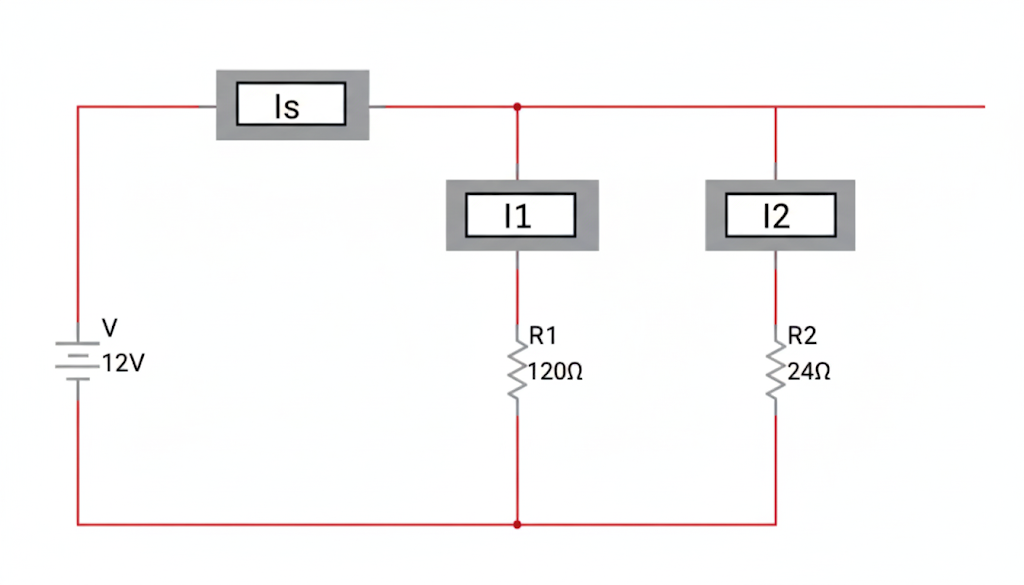
6-) Calculate the current passes through the first branch (11)
12
(a)Since the resistors are connected in parallel with the source, the voltage drops across the resistors are equal to the source voltage. That is, I * 1 = V/R1 11-1 A
(b)Since the resistors are connected in parallel with the source, the voltage drops across the resistors are equal to the source voltage. That is, 11-V / R * 1I * 1 = 1.5A
(c)Since the resistors are connected in parallel with the source, the voltage drops across the resistors are equal to the source voltage. That is, 11-V/R1 I * 1 = 3A
(d)No answer text provided.v R2
—12v 240
Question:
Give step-by-step solution with explanation and final answer:
give explanation for both correct and why other options are incorrect
6-) Calculate the current passes through the first branch (11)
12
(a)Since the resistors are connected in parallel with the source, the voltage drops across the resistors are equal to the source voltage. That is, I * 1 = V/R1 11-1 A
(b)Since the resistors are connected in parallel with the source, the voltage drops across the resistors are equal to the source voltage. That is, 11-V / R * 1I * 1 = 1.5A
(c)Since the resistors are connected in parallel with the source, the voltage drops across the resistors are equal to the source voltage. That is, 11-V/R1 I * 1 = 3A
(d)No answer text provided.v R2
—12v 240
This is AI generated Response.
Asked by: mayank
Created at: 2025-09-18 03:07:36
Final Answer:
RenderedRaw Text
Did you like this answer?
Let's solve the problem step by step:
### **Step 1: Identify What is Being Asked**
We are asked to calculate the current through the first branch (`I1`) that contains resistor `R1 = 120 Ω` with a voltage source of `V = 12V`.
---
### **Step 2: Use Ohm's Law**
For resistors in parallel, each branch gets the full source voltage:
\[
I_1 = \frac{V}{R_1}
\]
Where:
- \(V = 12V\)
- \(R_1 = 120\,\Omega\)
---
### **Step 3: Substitute and Calculate**
\[
I_1 = \frac{12V}{120\,\Omega} = 0.1A
\]
---
### **Step 4: Analyze the Options**
#### (a) "I * 1 = V/R1 11-1 A"
- **Explanation:** Looks like a typo and calculation is not clear, but if you use \(I_1 = V/R_1\), it should be \(0.1A\). The value "11-1 A" is not correct.
#### (b) "I * 1 = 1.5A"
- **Explanation:** Calculated current is **not** 1.5A. If you do \(12V/120Ω\), you get \(0.1A\), not \(1.5A\). So, this option is incorrect.
#### (c) "I * 1 = 3A"
- **Explanation:** Calculated current is **not** 3A. This would only be true if the resistance were much smaller (\(12V/4Ω = 3A\)), but our resistance is 120Ω. So, this is incorrect.
#### (d) "No answer text provided."
- **Explanation:** There is no answer to evaluate.
---
## **Final Answer**
**None of the options is correct** as written, but the correct current through the first branch is:
\[
\boxed{0.1\,A}
\]
---
### **Summary Table**
| Option | Value Given | Correct? | Why? |
|--------|-------------|----------|------|
| (a) | 11-1 A (unclear) | ❌ | Incorrect calculation, should be 0.1A |
| (b) | 1.5A | ❌ | Not matching calculation |
| (c) | 3A | ❌ | Not matching calculation |
| (d) | No answer text | ❌ | No value provided |
**Explanation:**
The current through \( R_1 \) is \( I_1 = \frac{12V}{120Ω} = 0.1A \).
All other values are incorrect for this setup.
Question:
R1= 12 omega
R2= 24 Omega
This is AI generated Response.
Asked by: mayank
Created at: 2025-09-18 03:08:40
Final Answer:
RenderedRaw Text
Did you like this answer?
# Calculation of Current through the First Branch
Given:
- \( R_1 = 12\,\Omega \)
- \( R_2 = 24\,\Omega \)
- Voltage source \( V = 12\,V \)
---
## Step 1: Identify the Circuit Connection
- The problem appears to involve resistors in parallel with the source, as indicated by the previous context.
- Since the question asks for the current passing through the first branch (\( R_1 \)), and both resistors are connected across the same voltage source, they are in parallel.
---
## Step 2: Apply Ohm's Law
For resistors in parallel, each resistor experiences the full source voltage:
\[
I_1 = \frac{V}{R_1}
\]
\[
I_2 = \frac{V}{R_2}
\]
---
## Step 3: Calculate the Current through \( R_1 \)
\[
I_1 = \frac{12\,V}{12\,\Omega} = 1\,A
\]
Similarly, for completeness,
\[
I_2 = \frac{12\,V}{24\,\Omega} = 0.5\,A
\]
---
## **Final Answer:**
\[
\boxed{
\text{Current through } R_1 = 1\,A
}
\]
---
## **Summary**
| Resistor | Resistance | Voltage | Current Calculation | Current |
|------------|--------------|---------|---------------------|---------|
| \( R_1 \) | 12 Ω | 12 V | \( 12V/12\Omega \) | 1 A |
| \( R_2 \) | 24 Ω | 12 V | \( 12V/24\Omega \) | 0.5 A |
---
## **Note**
- The current through \( R_1 \) is **1 A**.
- This is valid only if both resistors are connected directly across the 12 V source in parallel.
---
**No options were provided in your message, but based on this calculation, the current through \( R_1 \) is 1 A.**
VIPSolutions focuses on clear, step‑by‑step explanations so you can learn quickly. Whether you need an AI‑generated walkthrough or a short hint to get unstuck, each solution is organized for fast reading and easy review later.
Search similar questions, compare approaches, and bookmark the best answers for revision. Our goal is simple: quick, reliable study help that feels natural—not noisy.
 VIPSolutions
 v R2
—12v 240