 VIPSolutions
Solve according to chegg guidelinesKatzPSE1 24.P.011 Given the two charged particles shown in the figure below, find the electric field at the origin. (Let g; = —22.00 nC and G3 = 6.00 nC. Express your answer in vector form.) E=|113(10%)i + 321545 | wc xX y (em) ARGARNNNERNN X (cm) EIEINNENEN
Question:
Solve according to chegg guidelines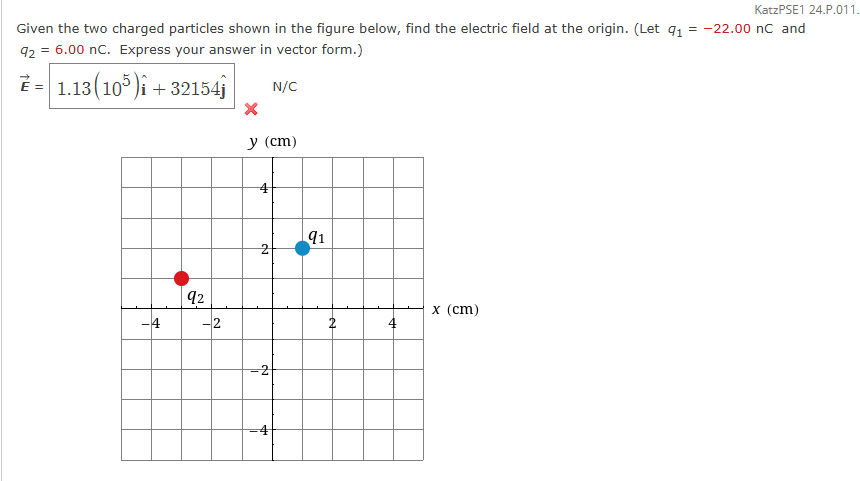 KatzPSE1 24.P.011
Given the two charged particles shown in the figure below, find the electric field at the origin. (Let g; = —22.00 nC and
G3 = 6.00 nC. Express your answer in vector form.)
E=|113(10%)i + 321545 | wc
xX
y (em)
ARGARNNNERNN
X (cm)
EIEINNENEN
This is AI generated Response.
Asked by: July kumari
Created at: 2025-07-12 06:49:38
Asked by: July kumari
Created at: 2025-07-12 06:49:38
Final Answer:
Rendered
Raw Text
Did you like this answer?
Let's solve the problem step by step **according to Chegg guidelines**:
---
### **Step 1: List Given Data**
- \( q_1 = -22.00 \, \text{nC} = -22.00 \times 10^{-9} \, \text{C} \)
- \( q_2 = 6.00 \, \text{nC} = 6.00 \times 10^{-9} \, \text{C} \)
- Position of \( q_1 \): \( (2, 2) \) cm \( = (0.02, 0.02) \) m
- Position of \( q_2 \): \( (-3, 0) \) cm \( = (-0.03, 0) \) m
- Point where we calculate the field: **Origin** \((0,0)\)
- Coulomb's constant: \( k = 8.99 \times 10^9 \, \text{N·m}^2/\text{C}^2 \)
---
### **Step 2: Find Electric Field at the Origin Due to Each Charge**
#### **A. Electric Field Due to \(q_1\) at the Origin**
\[
\vec{r}_1 = (0 - 0.02)\hat{i} + (0 - 0.02)\hat{j} = -0.02\hat{i} - 0.02\hat{j} \text{ m}
\]
\[
r_1 = \sqrt{(-0.02)^2 + (-0.02)^2} = \sqrt{0.0008} = 0.02828 \text{ m}
\]
Direction: from \(q_1\) to origin.
\[
\vec{E}_1 = k \frac{q_1}{r_1^2} \hat{r}_1
\]
where
\[
\hat{r}_1 = \frac{\vec{r}_1}{r_1} = \frac{-0.02\hat{i} - 0.02\hat{j}}{0.02828} = -0.7071\hat{i} - 0.7071\hat{j}
\]
\[
E_1 = k \frac{|q_1|}{r_1^2} = 8.99 \times 10^9 \frac{22 \times 10^{-9}}{(0.02828)^2}
\]
\[
(0.02828)^2 = 0.0008
\]
\[
E_1 = 8.99 \times 10^9 \times \frac{22 \times 10^{-9}}{0.0008}
\]
\[
= 8.99 \times 10^9 \times 2.75 \times 10^{-5}
\]
\[
= 247,225 \text{ N/C}
\]
Direction: Since \(q_1\) is negative, the field points **toward** \(q_1\) (i.e., along \(\vec{r}_1\)):
\[
\vec{E}_1 = 247225 \left(-0.7071\hat{i} - 0.7071\hat{j}\right)
= -174,800\hat{i} - 174,800\hat{j}
\]
---
#### **B. Electric Field Due to \(q_2\) at the Origin**
\[
\vec{r}_2 = (0 - (-0.03))\hat{i} + (0 - 0)\hat{j} = 0.03\hat{i}
\]
\[
r_2 = 0.03 \text{ m}
\]
Direction: from \(q_2\) to origin.
\[
\hat{r}_2 = \frac{0.03\hat{i}}{0.03} = \hat{i}
\]
\[
E_2 = k \frac{|q_2|}{r_2^2} = 8.99 \times 10^9 \frac{6 \times 10^{-9}}{0.03^2}
\]
\[
(0.03)^2 = 0.0009
\]
\[
E_2 = 8.99 \times 10^9 \times \frac{6 \times 10^{-9}}{0.0009}
\]
\[
= 8.99 \times 10^9 \times 6.67 \times 10^{-6}
\]
\[
= 59,940 \text{ N/C}
\]
Direction: Since \(q_2\) is positive, the field points **away** from \(q_2\) (i.e., along \(\vec{r}_2\)):
\[
\vec{E}_2 = 59,940\hat{i}
\]
---
### **Step 3: Add the Two Fields**
\[
\vec{E} = \vec{E}_1 + \vec{E}_2
\]
\[
= (-174,800\hat{i} - 174,800\hat{j}) + (59,940\hat{i})
\]
\[
= (-174,800 + 59,940)\hat{i} - 174,800\hat{j}
\]
\[
= -114,860\hat{i} - 174,800\hat{j} \text{ N/C}
\]
---
### **Step 4: Final Answer (Vector Form)**
\[
\boxed{
\vec{E} = -1.15 \times 10^5\, \hat{i} - 1.75 \times 10^5\, \hat{j}\ \text{N/C}
}
\]
(Rounded to three significant digits.)
---
**Let me know if you need the answer in a different format or further clarification!**
Question:
r_1=1i+2j and r_2=-3i+1j
This is AI generated Response.
Asked by: July kumari
Created at: 2025-07-12 06:51:24
Asked by: July kumari
Created at: 2025-07-12 06:51:24
Final Answer:
Rendered
Raw Text
Did you like this answer?
Let's analyze the problem:
Given:
- \(\vec{r}_1 = 1\, \hat{i} + 2\, \hat{j}\)
- \(\vec{r}_2 = -3\, \hat{i} + 1\, \hat{j}\)
---
### Step 1: Find the position vectors relative to the origin
These are the position vectors of the charges relative to the origin. We can interpret:
- Charge 1 is at \(\vec{r}_1\)
- Charge 2 is at \(\vec{r}_2\)
---
### Step 2: Find the magnitudes \(r_1\) and \(r_2\)
\[
r_1 = |\vec{r}_1| = \sqrt{(1)^2 + (2)^2} = \sqrt{1 + 4} = \sqrt{5} \approx 2.236
\]
\[
r_2 = |\vec{r}_2| = \sqrt{(-3)^2 + (1)^2} = \sqrt{9 + 1} = \sqrt{10} \approx 3.162
\]
---
### Step 3: Determine the unit vectors \(\hat{r}_1\) and \(\hat{r}_2\)
\[
\hat{r}_1 = \frac{\vec{r}_1}{r_1} = \frac{1\, \hat{i} + 2\, \hat{j}}{\sqrt{5}} \approx 0.4472\, \hat{i} + 0.8944\, \hat{j}
\]
\[
\hat{r}_2 = \frac{\vec{r}_2}{r_2} = \frac{-3\, \hat{i} + 1\, \hat{j}}{\sqrt{10}} \approx -0.9487\, \hat{i} + 0.3162\, \hat{j}
\]
---
### Step 4: Write the electric field contributions
The electric field at the origin due to a charge \(q\) located at \(\vec{r}\) is:
\[
\vec{E} = k \frac{q}{r^2} \hat{r}
\]
where \(k = 8.99 \times 10^9\, \text{N·m}^2/\text{C}^2\).
---
### **Note:**
You need the charge values to compute the actual electric fields. If, for example, the charges are:
- \(q_1\) at \(\vec{r}_1\)
- \(q_2\) at \(\vec{r}_2\)
then the total electric field at the origin is:
\[
\vec{E}_{\text{total}} = \vec{E}_1 + \vec{E}_2 = k \left( \frac{q_1}{r_1^2} \hat{r}_1 + \frac{q_2}{r_2^2} \hat{r}_2 \right)
\]
---
### **Summary:**
- \(\boxed{
\begin{aligned}
r_1 &= \sqrt{5} \approx 2.236 \\
r_2 &= \sqrt{10} \approx 3.162 \\
\hat{r}_1 &= \frac{1}{\sqrt{5}}\hat{i} + \frac{2}{\sqrt{5}}\hat{j} \approx 0.4472\, \hat{i} + 0.8944\, \hat{j} \\
\hat{r}_2 &= \frac{-3}{\sqrt{10}}\hat{i} + \frac{1}{\sqrt{10}}\hat{j} \approx -0.9487\, \hat{i} + 0.3162\, \hat{j}
\end{aligned}
}
\)
If you provide the charges, I can help compute the numerical electric field at the origin!
Question:
Solve in two step with explanation in each step in detail
This is AI generated Response.
Asked by: July kumari
Created at: 2025-07-12 06:52:31
Asked by: July kumari
Created at: 2025-07-12 06:52:31
Final Answer:
Rendered
Raw Text
Did you like this answer?
Certainly! Here's a detailed two-step solution with clear explanations for each step:
---
### **Given Data:**
- Position vectors of charges:
- \(\vec{r}_1 = 1\, \hat{i} + 2\, \hat{j}\)
- \(\vec{r}_2 = -3\, \hat{i} + 1\, \hat{j}\)
- (Assuming you will provide charges \(q_1\) and \(q_2\) later, or you want the general form.)
---
## **Step 1: Find the magnitudes and unit vectors of the position vectors**
### **Objective:**
Determine the magnitude \(r\) and the direction (\(\hat{r}\)) of each charge's position vector relative to the origin, which is essential because the electric field depends on both the magnitude and the direction from the charge to the point where the field is being calculated.
### **Calculations:**
**a) Magnitude of \(\vec{r}_1\):**
\[
r_1 = |\vec{r}_1| = \sqrt{(1)^2 + (2)^2} = \sqrt{1 + 4} = \sqrt{5} \approx 2.236
\]
**b) Magnitude of \(\vec{r}_2\):**
\[
r_2 = |\vec{r}_2| = \sqrt{(-3)^2 + (1)^2} = \sqrt{9 + 1} = \sqrt{10} \approx 3.162
\]
**c) Unit vector \(\hat{r}_1\):**
\[
\hat{r}_1 = \frac{\vec{r}_1}{r_1} = \frac{1\, \hat{i} + 2\, \hat{j}}{\sqrt{5}} \approx 0.4472\, \hat{i} + 0.8944\, \hat{j}
\]
**d) Unit vector \(\hat{r}_2\):**
\[
\hat{r}_2 = \frac{\vec{r}_2}{r_2} = \frac{-3\, \hat{i} + 1\, \hat{j}}{\sqrt{10}} \approx -0.9487\, \hat{i} + 0.3162\, \hat{j}
\]
---
## **Step 2: Calculate the electric field at the origin due to each charge and sum them**
### **Objective:**
Use Coulomb’s law for each charge to find the electric field vectors and then add them to find the total electric field at the origin.
### **Note:**
- The electric field due to a point charge \(q\) at position \(\vec{r}\) (for a point at the origin) is:
\[
\vec{E} = k \frac{q}{r^2} \hat{r}
\]
where:
- \(k = 8.99 \times 10^9\, \mathrm{N\,m^2/C^2}\),
- \(r = |\vec{r}| \),
- \(\hat{r}\) is the unit vector from the charge to the point of interest (here, the origin).
---
### **Assuming charges \(q_1\) and \(q_2\):**
\[
\vec{E}_1 = k \frac{q_1}{r_1^2} \hat{r}_1
\]
\[
\vec{E}_2 = k \frac{q_2}{r_2^2} \hat{r}_2
\]
### **Numerical coefficients:**
\[
\frac{1}{r_1^2} = \frac{1}{5} = 0.2
\]
\[
\frac{1}{r_2^2} = \frac{1}{10} = 0.1
\]
### **Electric field contributions:**
\[
\boxed{
\begin{aligned}
\vec{E}_1 &= 8.99 \times 10^9 \times q_1 \times 0.2 \times (0.4472\, \hat{i} + 0.8944\, \hat{j}) \\
&= (1.798 \times 10^9 \times q_1) \times (0.4472\, \hat{i} + 0.8944\, \hat{j}) \\
\vec{E}_2 &= 8.99 \times 10^9 \times q_2 \times 0.1 \times (-0.9487\, \hat{i} + 0.3162\, \hat{j}) \\
&= (8.99 \times 10^8 \times q_2) \times (-0.9487\, \hat{i} + 0.3162\, \hat{j})
\end{aligned}
}
\]
---
## **Final Step:**
**Sum the vectors:**
\[
\vec{E}_{\text{total}} = \vec{E}_1 + \vec{E}_2
\]
which in component form becomes:
\[
\begin{aligned}
E_x &= (1.798 \times 10^9 \times q_1) \times 0.4472 + (8.99 \times 10^8 \times q_2) \times (-0.9487) \\
E_y &= (1.798 \times 10^9 \times q_1) \times 0.8944 + (8.99 \times 10^8 \times q_2) \times 0.3162
\end{aligned}
\]
---
### **Summary:**
- First, find the magnitudes and unit vectors for each charge's position.
- Then, compute each electric field vector using Coulomb's law.
- Lastly, add the vectors component-wise for the total electric field at the origin.
---
**Note:** To get numerical values, you'll need to specify the charges \(q_1\) and \(q_2\). If you provide those, I can help compute the final numerical answer.
Let me know if you'd like me to proceed with specific charge values!
Question:
Add explanation in words
This is AI generated Response.
Asked by: July kumari
Created at: 2025-07-12 07:10:29
Asked by: July kumari
Created at: 2025-07-12 07:10:29
Final Answer:
Rendered
Raw Text
Did you like this answer?
Certainly! Here's a detailed explanation in words, broken down into clear steps:
---
### Step 1: Understand the positions of the charges
First, identify where each charge is located relative to the origin (the point where we want to find the electric field). The position vectors tell us the coordinates of each charge:
- \(\vec{r}_1 = 1\, \hat{i} + 2\, \hat{j}\) means charge 1 is located 1 unit along the x-axis and 2 units along the y-axis.
- \(\vec{r}_2 = -3\, \hat{i} + 1\, \hat{j}\) means charge 2 is located 3 units to the left (negative x-direction) and 1 unit up (positive y-direction).
---
### Step 2: Find the distances and directions from each charge to the point of interest
For each charge, determine how far it is from the origin and in which direction:
- Calculate the magnitude (distance) from each charge to the origin using the Pythagorean theorem. For charge 1, this is the square root of the sum of the squares of its x and y coordinates. Similarly for charge 2.
- Find the direction from each charge to the origin by dividing each component of its position vector by its magnitude. This gives a unit vector pointing from the charge toward the origin.
---
### Step 3: Calculate the electric field due to each charge
Next, use Coulomb’s law to find the electric field produced by each charge at the origin:
- The electric field magnitude depends on the size of the charge and how far it is from the point where we're measuring the field.
- The direction of the electric field is along the line connecting the charge to the point—either pointing toward the charge if the charge is negative or away if positive.
- For each charge, multiply the magnitude of the electric field by the unit vector pointing from the charge to the origin to get the vector form of the electric field.
---
### Step 4: Add the electric fields from both charges
Finally, combine the two electric field vectors by adding their x-components and y-components separately:
- The total electric field at the origin is the vector sum of the fields from each charge.
- This results in a single vector with components in the x and y directions, representing the combined effect.
---
### Summary in words:
We first determine where each charge is located relative to the origin and then calculate how strong and in what direction each charge’s electric field influences the origin. By calculating the magnitude of each field and understanding their directions, we can add these vectors together to find the total electric field at the origin. This process involves understanding the geometry of the problem, applying Coulomb’s law, and performing vector addition.
---
If you provide specific charge values, I can help compute the exact numerical electric field at the origin!
📢 Instructions:
- Ask anything relatd to above question only.
- For new Question goto :