 VIPSolutions
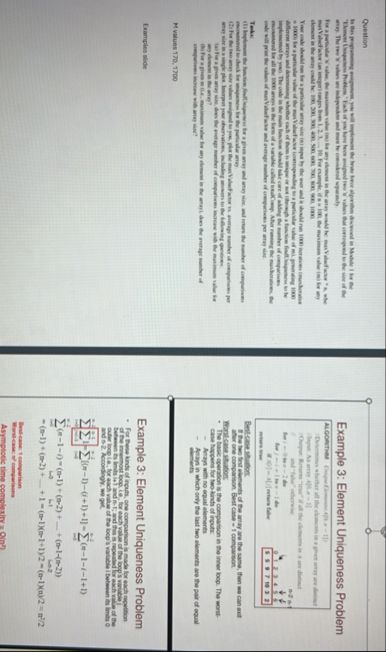
Question dement in the ange wall be M n , M n , k n , a n , k n , k n , 7 n , k n , x n , IOS Tasks sounternal to denk for mipurnen for the particular ano. by down in the arey" crepahws morcer side may wet? M values 1 7 0 , 1 7 0 0 Examples slide Example 3 : Element Uniqueness Problem Hopur At army totir - 牛 BertersesiturionsFi fre teo frost elements of the array are the same, then we can ext after one companison, Best case - 1 companison.Frollcase shation The basic aperation is the corpatison in the inver loop. The worst. case hagpens for two kinds of inputs: Anags with no equal elements Arags in which only the last two alements are the pair of equal coments Example 3 : Element Uniqueness Problem For these kinds of inpuls, one comparison is made for aach repelition of the innermost loop, Le , for each yalue of the locks vaniele ) betteren its limitsie 1 and in - 1 ; and this is meparted for axch whe - of the exter loce La , for auch value of the locp s warabli i befmeen its limits 0 and s . 2 . Accordingly, we give, ∑ = - 1 2 - i 2 [ ( n - 1 ) - ( i 1 ) 1 ] - ∑ = = 1 * * - 1 ( n - 1 - i - 1 1 ) ∑ i = 1 * * ( n - 1 - n ) = ( n - 1 ) ( n - 2 ) dots ( n - 1 - ( n - 2 ) ) = ( n - 1 ) ( n - 2 ) dots 1 = ( n - 1 ) n - 1 1 2 - ( n - 1 ) n 2 = n 2 2 Busl - cane: 1 expredison Woral - cation: als comparisens Asymptotle theng complexity , 9 ( n 2 ) .pli EEE SH i i s TI a § Li i Hit ha PIT ER ih lil Ii; HIN I lit THe | USB IN Sigs HL he TH | 4 Rf [Lil i
Question:
Question dement in the ange wall be
M
n
,
M
n
,
k
n
,
a
n
,
k
n
,
k
n
,
7
n
,
k
n
,
x
n
,
IOS
Tasks sounternal to denk for mipurnen for the particular ano. by down in the arey" crepahws morcer side may wet?
M values
1
7
0
,
1
7
0
0
Examples slide
Example
3
: Element Uniqueness Problem Hopur At army totir
-
牛
BertersesiturionsFi fre teo frost elements of the array are the same, then we can ext after one companison, Best case
-
1
companison.Frollcase shation
The basic aperation is the corpatison in the inver loop. The worst. case hagpens for two kinds of inputs:
Anags with no equal elements
Arags in which only the last two alements are the pair of equal coments
Example
3
: Element Uniqueness Problem
For these kinds of inpuls, one comparison is made for aach repelition of the innermost loop, Le
,
for each yalue of the locks vaniele
)
betteren its limitsie
1
and in
-
1
; and this is meparted for axch whe
-
of the exter loce La
,
for auch value of the locp s warabli i befmeen its limits
0
and s
.
2
.
Accordingly, we give,
∑
=
-
1
2
-
i
2
[
(
n
-
1
)
-
(
i
1
)
1
]
-
∑
=
=
1
*
*
-
1
(
n
-
1
-
i
-
1
1
)
∑
i
=
1
*
*
(
n
-
1
-
n
)
=
(
n
-
1
)
(
n
-
2
)
dots
(
n
-
1
-
(
n
-
2
)
)
=
(
n
-
1
)
(
n
-
2
)
dots
1
=
(
n
-
1
)
n
-
1
1
2
-
(
n
-
1
)
n
2
=
n
2
2
Busl
-
cane:
1
expredison
Woral
-
cation: als comparisens
Asymptotle theng complexity
,
9
(
n
2
)
. pli EEE
SH i i s
TI
a
§ Li i
Hit ha
PIT ER
ih lil Ii;
HIN
I lit
THe |
USB IN
Sigs HL he
TH | 4
Rf [Lil i
Asked by: thulasi
Created at: 2025-08-31 11:12:08
Final Answer:
📢 Instructions:
- Ask anything relatd to above question only.
- For new Question goto :