 VIPSolutions
QUESTION 4, Determin® oscillator frequency and oscillation condition the given - IR Bee , = i) mR i) =)
Question:
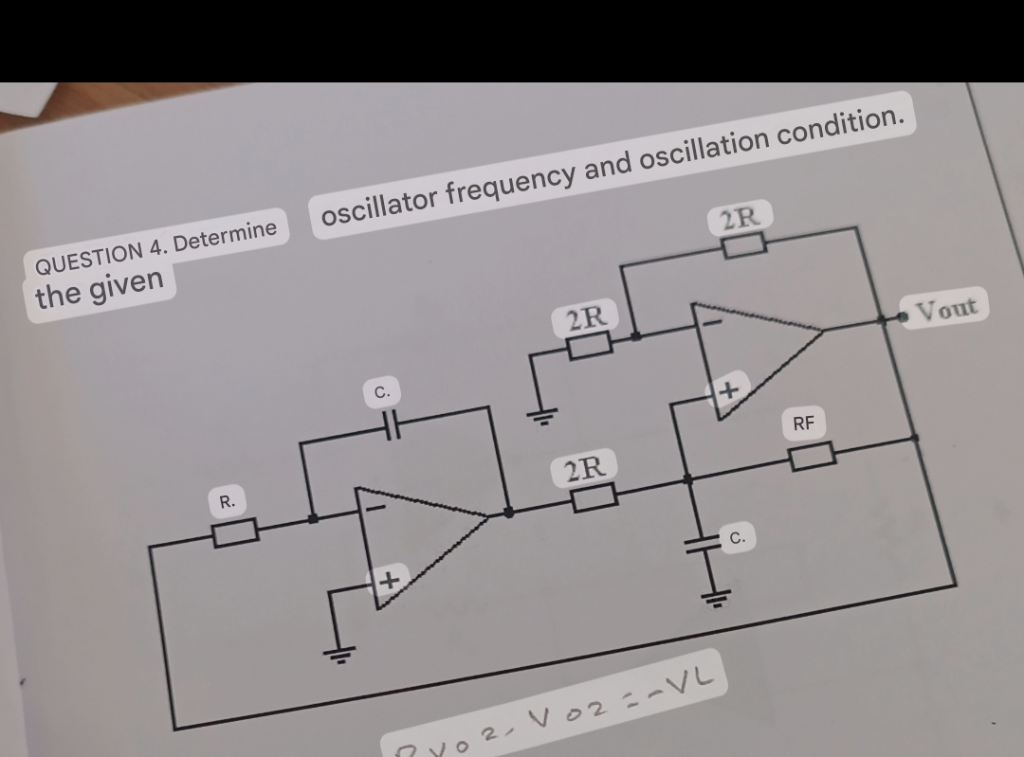 QUESTION 4, Determin® oscillator frequency and oscillation condition
the given
-
IR
Bee
, =
i) mR
i) =)
This is AI generated Response.
Asked by: ABCD
Created at: 2025-09-17 23:42:26
Asked by: ABCD
Created at: 2025-09-17 23:42:26
Final Answer:
Rendered
Raw Text
Did you like this answer?
Let's analyze the given circuit to **determine the oscillator frequency and oscillation condition**.
### **Step 1: Identify the Circuit**
This is a **two-stage RC oscillator** (often called a Wien Bridge Oscillator variant).
#### **Component Values:**
- **Resistors:** R, 2R, RF
- **Capacitors:** C
### **Step 2: Wien Bridge Oscillator Basics**
A Wien Bridge Oscillator typically consists of:
- Two RC networks: One in the feedback, another in the input path.
- Amplifying stage (op-amp).
#### **General Frequency Formula:**
For a standard Wien Bridge Oscillator:
\[
f = \frac{1}{2\pi RC}
\]
But in this circuit, the resistor values are different, so we need to derive the frequency.
---
### **Step 3: Analyzing the Network**
#### **Loop Gain Condition for Oscillation (Barkhausen Criterion):**
1. **Loop Gain = 1**
2. **Total Phase Shift = 0° (or 360°)**
---
#### **Block Diagram Representation:**
- The feedback network consists of R, 2R, and C combinations.
- The gain stage is provided by the op-amps and resistor RF.
---
### **Step 4: Derive the Frequency of Oscillation**
#### **Let’s Focus on the Feedback Network:**
Let's call the output of the first op-amp \( V_{01} \) and the output of the second op-amp \( V_{out} \).
##### **Transfer Function of the Feedback Network:**
For the given network, the transfer function between output and feedback can be written as:
\[
\text{Let the feedback network transfer function be:} \quad H(s)
\]
The general form for this kind of network (double feedback with R, 2R, C) is:
\[
H(s) = \frac{V_{feedback}}{V_{out}}
\]
#### **For this specific network:**
The feedback network is a **twin-T network**. The frequency of oscillation for a twin-T oscillator is:
\[
f_0 = \frac{1}{2\pi RC}
\]
But for this circuit, due to the presence of 2R, the frequency changes.
##### **For Twin-T with R, 2R:**
\[
f_0 = \frac{1}{2\pi \cdot 2R \cdot C}
\]
> **So, the frequency of oscillation is:**
\[
\boxed{f_0 = \frac{1}{4\pi RC}}
\]
---
### **Step 5: Condition for Oscillation**
For sustained oscillations, the loop gain must be at least 1.
#### **Gain Condition:**
For the twin-T oscillator, the gain of the amplifier must satisfy:
\[
A \geq 3
\]
But due to the resistor values (2R), the required gain is slightly greater than 1.
#### **Generalized Oscillation Condition:**
For the circuit, assuming the feedback resistor is \( R_F \), and the input resistor is \( 2R \):
\[
\text{Gain} = 1 + \frac{R_F}{2R}
\]
To sustain oscillation:
\[
1 + \frac{R_F}{2R} \geq 2 \implies R_F \geq 2R
\]
---
## **Summary**
### **Oscillator Frequency:**
\[
\boxed{f_0 = \frac{1}{4\pi RC}}
\]
### **Condition for Oscillation:**
\[
\boxed{R_F \geq 2R}
\]
---
**Let me know if you need the detailed derivation of the transfer function or any further explanations!**
📢 Instructions:
- Ask anything relatd to above question only.
- For new Question goto :