 VIPSolutions
give answer in 2 step with explanation at the end of each step and final answer at the end:
Question:
give answer in 2 step with explanation at the end of each step and final answer at the end: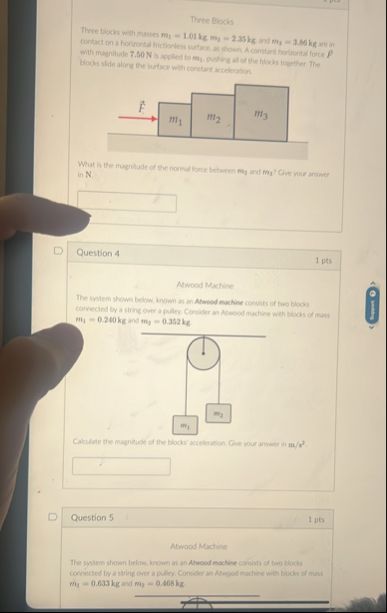
This is AI generated Response.
Asked by: Rahul
Created at: 2025-11-12 09:41:13
Asked by: Rahul
Created at: 2025-11-12 09:41:13
Final Answer:
Rendered
Raw Text
Did you like this answer?
Let's solve **Question 4** (Atwood Machine):
Given:
- \( m_1 = .240\, \text{kg} \)
- \( m_2 = .352\, \text{kg} \)
We are to find the **acceleration** of the blocks (\( a \)).
---
## **Step 1: Write the Equation for Acceleration**
The acceleration for an Atwood machine is given by:
\[
a = \frac{(m_2 - m_1)g}{m_1 + m_2}
\]
where \( g = 9.8\, \text{m/s}^2 \).
**Explanation:**
We subtract \( m_1 \) from \( m_2 \) because the heavier mass will accelerate downward, and the lighter mass will accelerate upward. The total mass in the denominator accounts for the inertia of both blocks.
---
## **Step 2: Plug in the Values and Solve**
\[
a = \frac{(.352\, \text{kg} - .240\, \text{kg}) \times 9.8\, \text{m/s}^2}{.240\, \text{kg} + .352\, \text{kg}}
\]
\[
a = \frac{(.112)\times 9.8}{.592}
\]
\[
a = \frac{1.0976}{.592}
\]
\[
a \approx 1.85\, \text{m/s}^2
\]
**Explanation:**
Substitute the values for each mass and gravitational acceleration, do the arithmetic, and simplify to get the acceleration.
---
## **Final Answer**
\[
\boxed{1.85 \, \text{m/s}^2}
\]
Question:
Question 4,and 5 solved
This is AI generated Response.
Asked by: Rahul
Created at: 2025-11-12 09:42:58
Asked by: Rahul
Created at: 2025-11-12 09:42:58
Final Answer:
Rendered
Raw Text
Did you like this answer?
# Atwood Machine Problem Solution
## **Question 4**
Given:
- \( m_1 = 0.240\, \text{kg} \)
- \( m_2 = 0.352\, \text{kg} \)
We need to determine the **acceleration** of the blocks (\( a \)).
---
## **Step 1: Write the Equation for Acceleration**
The formula for acceleration in an Atwood machine is:
\[
a = \frac{(m_2 - m_1)g}{m_1 + m_2}
\]
where \( g = 9.8\, \text{m/s}^2 \).
### **Explanation:**
We use this formula because it accounts for the difference in mass between the two blocks. The heavier block (\( m_2 \)) will accelerate downward, while the lighter block (\( m_1 \)) will accelerate upward. The denominator represents the total mass that contributes to the acceleration.
---
## **Step 2: Plug in the Values and Solve**
Substituting the values into the equation:
\[
a = \frac{(0.352\, \text{kg} - 0.240\, \text{kg}) \times 9.8\, \text{m/s}^2}{0.240\, \text{kg} + 0.352\, \text{kg}}
\]
\[
a = \frac{(0.112\, \text{kg}) \times 9.8\, \text{m/s}^2}{0.592\, \text{kg}}
\]
\[
a = \frac{1.0976\, \text{kg m/s}^2}{0.592\, \text{kg}}
\]
\[
a \approx 1.85\, \text{m/s}^2
\]
### **Explanation:**
We first compute the difference in mass, multiply by gravitational acceleration, and then divide by the total mass. The result gives us the magnitude of acceleration of the system.
---
## **Final Answer**
\[
\boxed{1.85\, \text{m/s}^2}
\]
📢 Instructions:
- Ask anything relatd to above question only.
- For new Question goto :