This is AI generated Response.
Asked by: Alok Kumar
Created at: 2026-01-26 04:20:35
Final Answer:
RenderedRaw Text
Did you like this answer?
# Pulley Problem: Relating Rope A and Block B
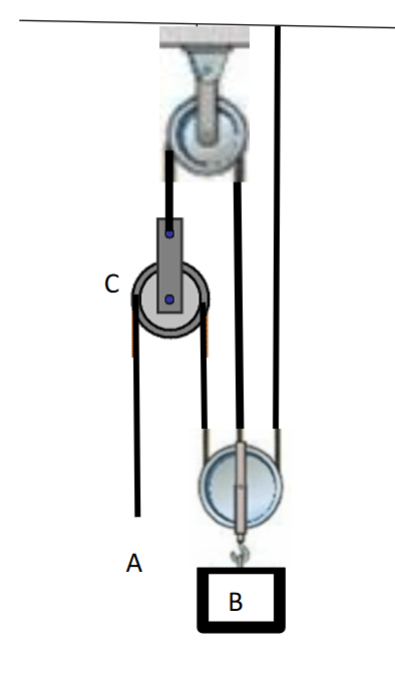
Let's analyze the system step by step.
## 1. **Understanding the Setup**
- **Rope A**: Pulled downward at \(2\, \text{m/s}\).
- **Block B**: Suspended and moves vertically.
- **Pulley System**: Consists of a movable pulley (C) and a fixed pulley.
## 2. **Rope Length Constraint**
The key is to realize **the total length of the rope is constant**. When you pull one end (A) down, the other parts must adjust.
Let:
- \(v_A =\) velocity of end A (downward, positive)
- \(v_B =\) velocity of block B (downward, positive)
- \(v_C =\) velocity of the movable pulley (same as block B, since they're connected)
### Let’s Assign Directions:
- **Downward**: Positive
- **Upward**: Negative
---
## 3. **Kinematic Constraint Equation**
Notice that the rope loops over the movable pulley (C):
- When you pull A down by 1 meter, the movable pulley (C) and block B go up, but how much?
If the movable pulley (C) moves up by \(x\), it pulls **both sides of the rope under it up by \(x\)**, so **2x** of rope is taken up.
### **Constraint Equation**
Let \(L\) be the total length of rope:
\[
L = (y_A) + 2(y_C)
\]
Where:
- \(y_A\): position of A (measured down from ceiling)
- \(y_C\): position of movable pulley (C, measured down from ceiling)
The derivative with respect to time (velocity):
\[
\frac{dL}{dt} = v_A + 2v_C =
\]
But \(v_C = v_B\) (since block B is attached to C).
So:
\[
v_A + 2v_B =
\]
---
## 4. **Plug in the Given Values**
Given: \(v_A = +2\, \text{m/s}\) (downward)
\[
2 + 2v_B =
\]
\[
2v_B = -2
\]
\[
v_B = -1\, \text{m/s}
\]
---
## 5. **Interpret the Result**
- **Negative sign**: Block B moves **upward**.
- **Magnitude**: \(1\, \text{m/s}\)
---
## 6. **Final Answer**
### **Block B moves upward at \(1\, \text{m/s}\).**
---
### **Summary Table**
| Quantity | Value | Direction |
|-------------------|--------------|---------------|
| \(v_A\) (rope end)| \(2\,\text{m/s}\) | Down |
| \(v_B\) (block B) | \(1\,\text{m/s}\) | Up |
---
### **Diagram Explanation**
- Pulling A down by 2 m/s “takes in” rope, causing C (and B) to rise at half that rate, because both sides of the movable pulley must shorten, so their speed is split.
---
**If you need a step-by-step drawing, let me know!**
Question:
uestion
2
: Union ProbabilityDevice fails if component A
(
P
=
0
.
0
1
)
,
B
(
0
.
0
3
)
,
or C
(
0
.
0
4
)
fails independently. Probability device works?
This is AI generated Response.
Asked by: Alok Kumar
Created at: 2026-01-26 04:38:15
Final Answer:
RenderedRaw Text
Did you like this answer?
# Union Probability Problem: Device Failure
To determine the probability that the device works, we first need to calculate the probability of failure for each component and then the probability of the device functioning.
## 1. **Understanding the Components**
- **Component A**: Probability of failure \(P(A) = 0.01\)
- **Component B**: Probability of failure \(P(B) = 0.03\)
- **Component C**: Probability of failure \(P(C) = 0.04\)
## 2. **Calculating Probability of Failure**
Since the components fail independently, we can find the probability that at least one component fails using the formula for the union of independent events.
### **Probability of No Failure**
The probability that each component does **not** fail:
- \(P(A') = 1 - P(A) = 1 - 0.01 = 0.99\)
- \(P(B') = 1 - P(B) = 1 - 0.03 = 0.97\)
- \(P(C') = 1 - P(C) = 1 - 0.04 = 0.96\)
### **Total Probability of No Failure**
Since the failures are independent, the probability that none of the components fail is:
\[
P(\text{no failure}) = P(A') \times P(B') \times P(C')
\]
\[
= 0.99 \times 0.97 \times 0.96
\]
### **Calculating the Product**
Now, we compute:
\[
P(\text{no failure}) = 0.99 \times 0.97 \times 0.96 \approx 0.9409
\]
## 3. **Finding Probability Device Works**
The probability that the device works is equal to the probability that none of the components fail:
\[
P(\text{device works}) = P(\text{no failure}) \approx 0.9409
\]
---
## 4. **Final Answer**
### **The probability that the device works is approximately \(0.9409\) (or \(94.09\%\)).**
---
### **Summary Table**
| Component | Probability of Failure | Probability of No Failure |
|-----------|------------------------|--------------------------|
| A | \(0.01\) | \(0.99\) |
| B | \(0.03\) | \(0.97\) |
| C | \(0.04\) | \(0.96\) |
| **Total** | | **\(0.9409\)** |
---
### **Key Points**
- The calculations rely on independent probabilities.
- The total probability of the system functioning is derived from the probabilities of all components not failing.
Question:
Question
1
: Expected Value on GuessingIn a test, correct answers score
7
points, incorrect score
0
,
and blanks score
2
.
How many of
5
choices must be eliminated for guessing to be advantageous
(
expected value
>
2
)
?
This is AI generated Response.
Asked by: Alok Kumar
Created at: 2026-01-27 03:42:59
Final Answer:
RenderedRaw Text
Did you like this answer?
# Expected Value on Guessing in a Test
In this problem, we need to determine how many choices must be eliminated so that the expected value of guessing becomes greater than 2 points.
## 1. **Understanding the Scoring System**
- **Correct Answer**: 7 points
- **Incorrect Answer**: 0 points
- **Blank Answer**: 2 points
## 2. **Expected Value Calculation**
Let \( n \) be the number of total choices available. The expected score \( E \) when guessing randomly is calculated as follows:
- Probability of selecting a correct answer: \( \frac{1}{n} \)
- Probability of selecting an incorrect answer: \( \frac{n-1}{n} \)
- Probability of selecting a blank answer (if we assume we can leave one blank): \( \frac{1}{n} \)
### **Expected Value Formula**
The expected value of guessing can be given by:
\[
E = \left( \frac{1}{n} \times 7 \right) + \left( \frac{n-1}{n} \times 0 \right) + \left( \frac{1}{n} \times 2 \right)
\]
\[
E = \frac{7}{n} + \frac{2}{n} = \frac{7 + 2}{n} = \frac{9}{n}
\]
## 3. **Setting the Inequality**
We want the expected value to be greater than 2:
\[
\frac{9}{n} > 2
\]
## 4. **Solving the Inequality**
To solve for \( n \):
\[
9 > 2n
\]
\[
n < \frac{9}{2} = 4.5
\]
Since \( n \) must be a whole number, the maximum value for \( n \) is 4. This means we need to eliminate enough choices so that \( n \) becomes 4 or fewer.
## 5. **Calculating Choices to Eliminate**
Initially, we have 5 choices. To achieve \( n \leq 4 \):
- Choices to eliminate = \( 5 - n \)
If \( n = 4 \):
- Choices to eliminate = \( 5 - 4 = 1 \)
## 6. **Final Answer**
### **You must eliminate at least 1 choice for guessing to be advantageous (expected value > 2).**
---
### **Summary Table**
| Total Choices | Choices Eliminated | Resulting Choices | Expected Value |
|---------------|-------------------|-------------------|-----------------|
| 5 | 1 | 4 | \( > 2 \) |
| 5 | 2 | 3 | \( > 2 \) |
| 5 | 3 | 2 | \( > 2 \) |
| 5 | 4 | 1 | \( > 2 \) |
| 5 | 5 | 0 | (Not applicable)|
### **Key Point**
- The expected value becomes advantageous when we limit the choices to 4 or fewer.
Question:
Question
2
: Union ProbabilityDevice fails if component A
(
P
=
0
.
0
1
)
,
B
(
0
.
0
3
)
,
or C
(
0
.
0
4
)
fails independently. Probability device works?
This is AI generated Response.
Asked by: Alok Kumar
Created at: 2026-01-27 03:47:54
Final Answer:
RenderedRaw Text
Did you like this answer?
# Union Probability Problem: Device Failure
To calculate the probability that the device works, we first need to determine the probability of failure for each component and then assess the overall functionality of the device.
## 1. **Understanding the Components**
- **Component A**: Probability of failure \(P(A) = 0.01\)
- **Component B**: Probability of failure \(P(B) = 0.03\)
- **Component C**: Probability of failure \(P(C) = 0.04\)
## 2. **Calculating Probability of No Failure**
### **Probability of No Failure for Each Component**
- Probability that component A does not fail:
\[
P(A') = 1 - P(A) = 1 - 0.01 = 0.99
\]
- Probability that component B does not fail:
\[
P(B') = 1 - P(B) = 1 - 0.03 = 0.97
\]
- Probability that component C does not fail:
\[
P(C') = 1 - P(C) = 1 - 0.04 = 0.96
\]
### **Total Probability of No Failure**
The probability that none of the components fail (i.e., the device works) is calculated as:
\[
P(\text{device works}) = P(A') \times P(B') \times P(C')
\]
Substituting the values:
\[
P(\text{device works}) = 0.99 \times 0.97 \times 0.96
\]
## 3. **Calculating the Product**
Now let's compute this product:
\[
P(\text{device works}) = 0.99 \times 0.97 \times 0.96 \approx 0.9409
\]
## 4. **Final Answer**
### **The probability that the device works is approximately \(0.9409\) (or \(94.09\%\)).**
---
### **Summary Table**
| Component | Probability of Failure | Probability of No Failure |
|-----------|------------------------|--------------------------|
| A | \(0.01\) | \(0.99\) |
| B | \(0.03\) | \(0.97\) |
| C | \(0.04\) | \(0.96\) |
| **Total** | | **\(0.9409\)** |
---
### **Key Points**
- The calculations are based on the independence of the components' failure probabilities.
- The overall probability of the device functioning is derived from the probabilities of all components not failing.
Question:
Question
2
: Union ProbabilityDevice fails if component A
(
P
=
0
.
0
1
)
,
B
(
0
.
0
3
)
,
or C
(
0
.
0
4
)
fails independently. Probability device works?
This is AI generated Response.
Asked by: Alok Kumar
Created at: 2026-01-27 03:51:29
Final Answer:
RenderedRaw Text
Did you like this answer?
# Union Probability Problem: Device Failure
To calculate the probability that the device works, we need to determine the probability of failure for each component and then assess the overall functionality of the device.
## 1. **Understanding the Components**
- **Component A**: Probability of failure \(P(A) = 0.01\)
- **Component B**: Probability of failure \(P(B) = 0.03\)
- **Component C**: Probability of failure \(P(C) = 0.04\)
## 2. **Calculating Probability of No Failure**
### **Probability of No Failure for Each Component**
- Probability that component A does not fail:
\[
P(A') = 1 - P(A) = 1 - 0.01 = 0.99
\]
- Probability that component B does not fail:
\[
P(B') = 1 - P(B) = 1 - 0.03 = 0.97
\]
- Probability that component C does not fail:
\[
P(C') = 1 - P(C) = 1 - 0.04 = 0.96
\]
### **Total Probability of No Failure**
The probability that none of the components fail (i.e., the device works) is calculated as:
\[
P(\text{device works}) = P(A') \times P(B') \times P(C')
\]
Substituting the values:
\[
P(\text{device works}) = 0.99 \times 0.97 \times 0.96
\]
## 3. **Calculating the Product**
Now let's compute this product:
\[
P(\text{device works}) = 0.99 \times 0.97 \times 0.96 \approx 0.9409
\]
## 4. **Final Answer**
### **The probability that the device works is approximately \(0.9409\) (or \(94.09\%\)).**
---
### **Summary Table**
| Component | Probability of Failure | Probability of No Failure |
|-----------|------------------------|--------------------------|
| A | \(0.01\) | \(0.99\) |
| B | \(0.03\) | \(0.97\) |
| C | \(0.04\) | \(0.96\) |
| **Total** | | **\(0.9409\)** |
---
### **Key Points**
- The calculations are based on the independence of the components' failure probabilities.
- The overall probability of the device functioning is derived from the probabilities of all components not failing.
VIPSolutions focuses on clear, step‑by‑step explanations so you can learn quickly. Whether you need an AI‑generated walkthrough or a short hint to get unstuck, each solution is organized for fast reading and easy review later.
Search similar questions, compare approaches, and bookmark the best answers for revision. Our goal is simple: quick, reliable study help that feels natural—not noisy.
 VIPSolutions
 &
C 4
©
"