 VIPSolutions
question 1 is i have attached the image ......question 2).Atoms are spherical in shape. Therefore, the Mg atoms, and the cube cannot fill all the available space. If only 7 4 . 0 percent of the space inside, the cube is taken up by Mg atoms, calculate the radius in pico - meters of an MG atomDraw a skeletal ("line") structure of this molecule: 1 CH3—N-—C—CHj3 °v o oO Click and drag to start drawing a structure.
Question:
question 1 is i have attached the image ......question 2).Atoms are spherical in shape. Therefore, the Mg atoms, and the cube cannot fill all the available space. If only
7
4
.
0
percent of the space inside, the cube is taken up by Mg atoms, calculate the radius in pico
-
meters of an MG atom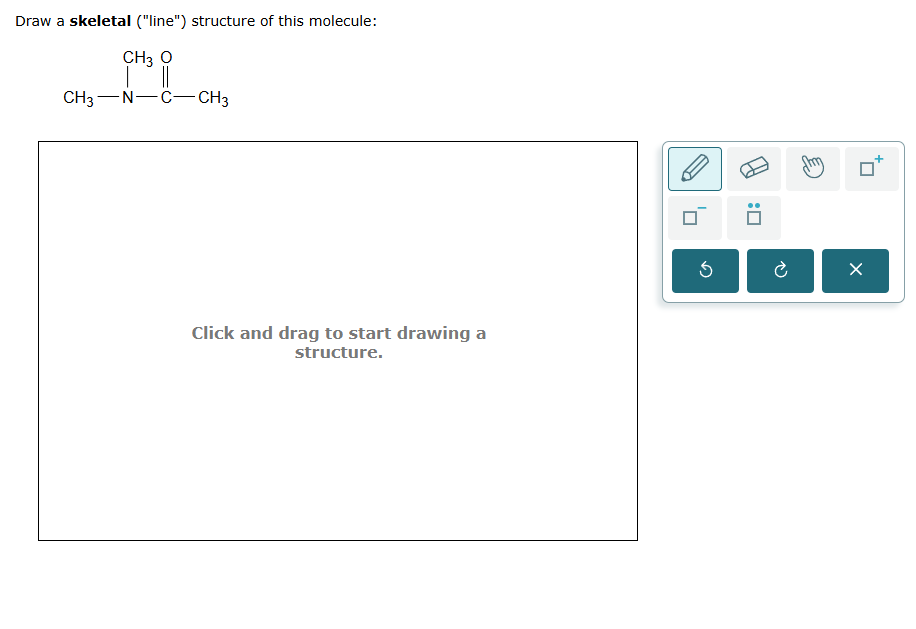 Draw a skeletal ("line") structure of this molecule:
1
CH3—N-—C—CHj3
°v
o oO
Click and drag to start drawing a
structure.
This is AI generated Response.
Asked by: srivalli Mattaparthi
Created at: 2025-08-27 13:56:01
Asked by: srivalli Mattaparthi
Created at: 2025-08-27 13:56:01
Final Answer:
Rendered
Raw Text
Did you like this answer?
Let's address your questions one by one:
---
### **Question 1: Skeletal Structure**
**Molecule Given:**
```
CH3
|
CH3—N—C—CH3
||
O
```
#### **How to Draw the Skeletal Structure ("Line" Structure):**
- In skeletal structures, **hydrogens attached to carbons are not shown**, and **carbon atoms are represented by the ends or bends of lines**.
- **Heteroatoms** (like N, O) and their directly attached hydrogens are shown.
- The molecule is **N,N-dimethylacetamide** (DMA).
**Skeletal structure:**
```
N
/ | \
C | C=O
\ /
(CH3)
```
Or, drawn simply (lines for C-C and C-N bonds, explicit N and O):
```
N
/ \
CH3 C=O
\ /
CH3
```
Where the lines represent C-N and C-C bonds, and the O is double-bonded to the central carbon.
---
### **Question 2: Mg Atom Radius Calculation**
Given:
- Atoms are spherical in shape.
- Only **74.0%** of the space inside the cube is taken up by Mg atoms (this is the packing efficiency for **face-centered cubic (FCC)** unit cell).
- Need to **calculate the radius (r) of an Mg atom in picometers**.
#### **Step-by-Step Solution:**
1. **Let the edge length of the cube = a**
2. **Volume of cube = \( a^3 \)**
3. **Volume occupied by atoms = 74.0% of \( a^3 \)**
\[
\text{Volume occupied by atoms} = 0.740 \times a^3
\]
4. **In FCC, 4 atoms per unit cell**.
5. **Volume of 4 atoms (spheres):**
\[
4 \times \frac{4}{3} \pi r^3 = \frac{16}{3} \pi r^3
\]
6. **Equate occupied volume to actual atom volume:**
\[
0.740 \, a^3 = \frac{16}{3} \pi r^3
\]
7. **Relationship between r and a in FCC:**
- In FCC, \( a = 2\sqrt{2}r \), so \( r = \frac{a}{2\sqrt{2}} \)
8. **Plug \( r \) in terms of \( a \) into volume equation:**
\[
0.740 \, a^3 = \frac{16}{3} \pi \left( \frac{a}{2\sqrt{2}} \right)^3
\]
\[
0.740 \, a^3 = \frac{16}{3} \pi \left( \frac{a^3}{8 \cdot 2\sqrt{2}} \right)
\]
\[
0.740 \, a^3 = \frac{16}{3} \pi \cdot \frac{a^3}{16\sqrt{2}}
\]
\[
0.740 \, a^3 = \frac{1}{3} \pi \cdot \frac{a^3}{\sqrt{2}}
\]
\[
0.740 = \frac{\pi}{3\sqrt{2}}
\]
(This confirms the 74% packing.)
**If you have the value of 'a' (unit cell edge length),** you can directly calculate the atomic radius:
\[
r = \frac{a}{2\sqrt{2}}
\]
If no value for \( a \) is given, this is the formula you would use **once you have the unit cell edge length** (usually given in pm or Å).
---
**Summary:**
- **Skeletal structure**: see drawing above.
- **Mg atom radius**: \( r = \frac{a}{2\sqrt{2}} \) (where \( a \) is the unit cell length).
Let me know if you have the value for \( a \), and I can plug in the numbers for you!
📢 Instructions:
- Ask anything relatd to above question only.
- For new Question goto :