 VIPSolutions
Act like a helpful tutor and exlain me :b) A system is characterised through the transfer function G(s) = es O The system is of PDT2 characteristic. O The system is stable. O The system is not causal. O The step response of the system converges to 7; when t — co.
Question:
Act like a helpful tutor and exlain me :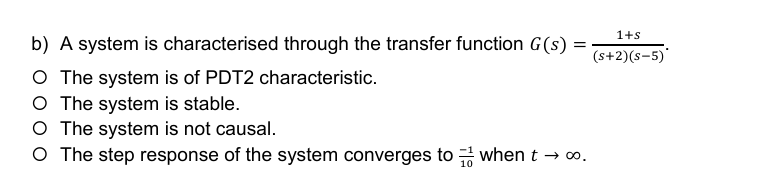 b) A system is characterised through the transfer function G(s) = es
O The system is of PDT2 characteristic.
O The system is stable.
O The system is not causal.
O The step response of the system converges to 7; when t — co.
This is AI generated Response.
Asked by: Alok Kumar
Created at: 2026-01-26 03:21:46
Asked by: Alok Kumar
Created at: 2026-01-26 03:21:46
Final Answer:
Rendered
Raw Text
Did you like this answer?
Let's analyze the transfer function and each statement:
## **Given Transfer Function**
\[
G(s) = \frac{1+s}{(s+2)(s-5)}
\]
---
### **1. The system is of PDT2 characteristic.**
- **PDT2** refers to a second-order system with two real poles (the "2") and potentially a zero.
- Here, the denominator is \((s+2)(s-5)\), so there are two real poles: \(s = -2\) and \(s = 5\).
- The numerator \(1 + s\) introduces a zero at \(s = -1\).
- **So, yes, this fits a second-order system with a real zero and two real poles.**
✔️ **This statement is correct.**
---
### **2. The system is stable.**
- **Stability** depends on the location of the poles:
- Poles: \(s = -2\) (left-half), \(s = 5\) (right-half).
- Because of the pole at \(s = 5\) (right-half plane), the system is **unstable**.
- **This statement is incorrect.**
---
### **3. The system is not causal.**
- **Causality**: For physical systems, the order of the numerator must be less than or equal to the denominator.
- Degree of numerator: 1 (\(s\))
- Degree of denominator: 2 (\(s^2\))
- Since \(1 < 2\), the system is **causal**.
- **This statement is incorrect.**
---
### **4. The step response of the system converges to \(-\frac{1}{10}\) when \(t \to \infty\).**
- The final value of the step response can be found using the **Final Value Theorem**:
\[
\lim_{t \to \infty} y(t) = \lim_{s \to } s G(s) \cdot \frac{1}{s}
\]
\[
= \lim_{s \to } G(s) = \frac{1+}{(+2)(-5)} = \frac{1}{2 \cdot (-5)} = -\frac{1}{10}
\]
- **This statement is correct** (mathematically), but since the system is unstable, the actual response diverges due to the unstable pole. Final Value Theorem does not apply to unstable systems.
---
## **Summary Table**
| Statement | True/False | Explanation |
|-----------|------------|-------------|
| PDT2 characteristic | ✔️ | 2 real poles, 1 zero |
| Stable | ❌ | Pole at \(s=5\) (RHP) |
| Not causal | ❌ | Numerator degree < denominator degree |
| Step response converges to \(-\frac{1}{10}\) | ❌ | Theoretically correct, but system is unstable |
---
## **Key Points**
- The system is **PDT2**.
- The system is **unstable** and **causal**.
- The step response does **not** actually converge due to instability, despite what the calculation suggests.
Question:
Question 1 : Expected Value on GuessingIn a test, correct answers score 7 points, incorrect score 0 , and blanks score 2 . How many of 5 choices must be eliminated for guessing to be advantageous ( expected value > 2 ) ?
This is AI generated Response.
Asked by: Alok Kumar
Created at: 2026-01-26 03:26:05
Asked by: Alok Kumar
Created at: 2026-01-26 03:26:05
Final Answer:
Rendered
Raw Text
Did you like this answer?
To determine how many choices must be eliminated for guessing to be advantageous in a test with the given scoring system, we can use the concept of expected value.
## **Scoring System**
- Correct answer: \(7\) points
- Incorrect answer: \(0\) points
- Blank answer: \(2\) points
## **Expected Value Calculation**
Let \(n\) be the total number of choices, and \(k\) be the number of choices eliminated.
### **Remaining Choices**
The remaining choices after eliminating \(k\) choices will be \(n - k\).
### **Probability of Correct Answer**
The probability of guessing correctly is:
\[
P(\text{Correct}) = \frac{1}{n - k}
\]
### **Probability of Incorrect Answer**
The probability of guessing incorrectly is:
\[
P(\text{Incorrect}) = \frac{n - 1 - k}{n - k}
\]
### **Expected Value Formula**
The expected value \(E\) for guessing is given by:
\[
E = P(\text{Correct}) \cdot (\text{Score for Correct}) + P(\text{Incorrect}) \cdot (\text{Score for Incorrect}) + P(\text{Blank}) \cdot (\text{Score for Blank})
\]
Considering one option is blank:
- Probability of blanking (not choosing any option) is \(1 - P(\text{Correct}) - P(\text{Incorrect})\).
Substituting the values:
\[
E = \frac{1}{n - k} \cdot 7 + \frac{(n - 1 - k)}{n - k} \cdot 0 + \left(1 - \frac{1}{n - k} - \frac{(n - 1 - k)}{n - k}\right) \cdot 2
\]
This simplifies to:
\[
E = \frac{7}{n - k} + 2 \cdot \left(1 - \frac{1}{n - k} - \frac{(n - 1 - k)}{n - k}\right)
\]
\[
E = \frac{7}{n - k} + 2 \cdot \left(1 - \frac{(n - 1)}{n - k}\right)
\]
\[
E = \frac{7}{n - k} + \frac{2(k + 1)}{n - k}
\]
\[
E = \frac{7 + 2(k + 1)}{n - k}
\]
### **Condition for Advantageous Guessing**
We want the expected value to be greater than \(2\):
\[
\frac{7 + 2(k + 1)}{n - k} > 2
\]
### **Solving the Inequality**
Now we substitute \(n = 5\) (total choices):
\[
\frac{7 + 2(k + 1)}{5 - k} > 2
\]
Cross-multiplying gives:
\[
7 + 2(k + 1) > 2(5 - k)
\]
\[
7 + 2k + 2 > 10 - 2k
\]
\[
4k > 1 \quad \Rightarrow \quad k > \frac{1}{4}
\]
Since \(k\) must be a whole number, the smallest integer satisfying this condition is:
\[
k \geq 1
\]
### **Conclusion**
At least **1 choice** must be eliminated for guessing to be advantageous (expected value > 2).
📢 Instructions:
- Ask anything relatd to above question only.
- For new Question goto :