This is AI generated Response.
Asked by: gvr
Created at: 2025-06-24 20:50:26
Final Answer:
RenderedRaw Text
Did you like this answer?
Let's go through each part step-by-step:
---
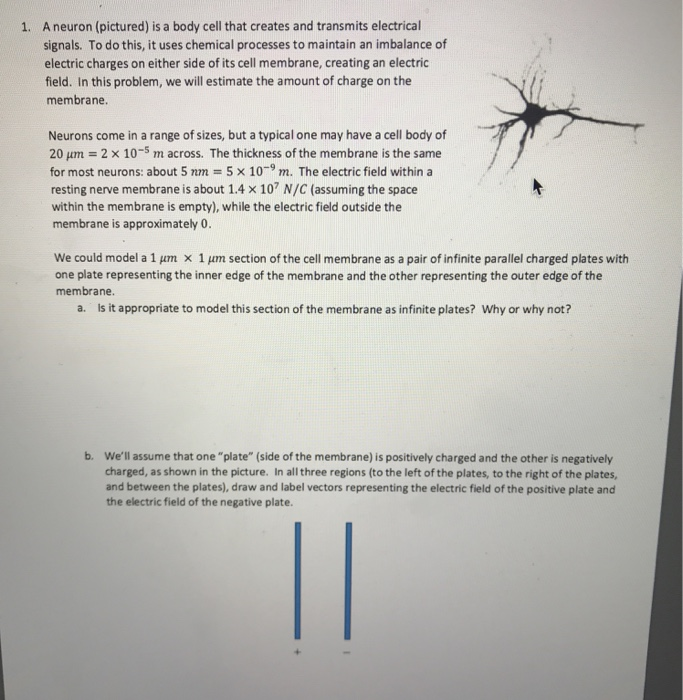
### **a. Is it appropriate to model this section of the membrane as infinite plates? Why or why not?**
**Solution:**
- **Infinite plates** are an idealization used when the size (length and width) of the plates is much larger than the distance between them.
- In this case, the section is \(1 \mu m \times 1 \mu m\), and the thickness of the membrane is \(5 \, nm = 0.005 \mu m\). Since \(1 \mu m \gg 0.005 \mu m\), the area is much larger than the separation.
- **Conclusion:** Yes, it is appropriate to model this membrane section as infinite plates because the area is much larger than the separation, minimizing edge effects.
---
### **b. Draw and label vectors representing the electric field of the positive and negative plates.**
**Explanation:**
- For parallel plates:
- The electric field due to a **positive plate** points **away** from the plate.
- The electric field due to a **negative plate** points **toward** the plate.
- **Between the plates:** The fields from each plate add up (point in the same direction, from + to -).
- **Outside the plates:** The fields from each plate cancel (opposite directions).
**(A sketch should show arrows pointing from the + plate to the - plate between them, and the fields outside pointing away from + and toward - but canceling.)**
---
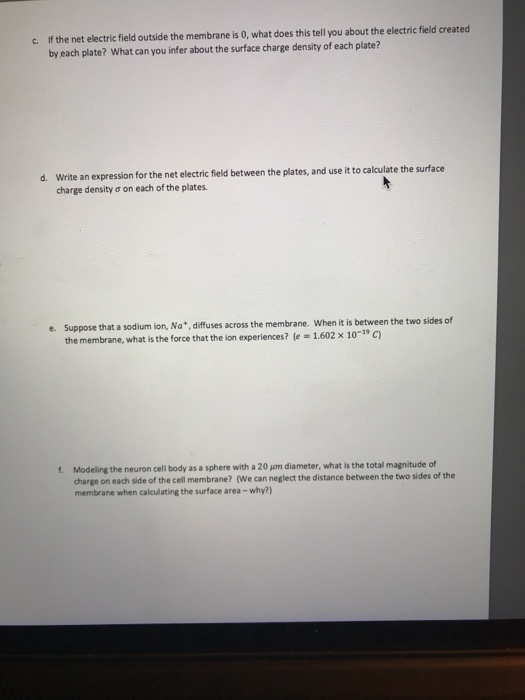
### **c. If the net electric field outside the membrane is 0, what does this tell you about the electric field created by each plate? What can you infer about the surface charge density of each plate?**
**Solution:**
- **Net field outside = 0:** The field from the positive plate cancels the field from the negative plate outside.
- The **magnitude** of the field produced by each plate must be equal and opposite outside.
- Therefore, the **surface charge densities** (\(\sigma\)) must be **equal in magnitude and opposite in sign**.
---
### **d. Write an expression for the net electric field between the plates, and use it to calculate the surface charge density \(\sigma\) on each plate.**
**Solution:**
1. **Electric field from a single infinite plate:**
\( E = \frac{\sigma}{2\epsilon_0} \)
2. **Net field between plates:**
The fields add:
\( E_{net} = \frac{\sigma}{2\epsilon_0} + \frac{\sigma}{2\epsilon_0} = \frac{\sigma}{\epsilon_0} \)
3. **Given:**
\( E_{net} = 1.4 \times 10^7 \, N/C \)
4. **Solve for \(\sigma\):**
\[
\sigma = E_{net} \cdot \epsilon_0
\]
Where \(\epsilon_0 = 8.85 \times 10^{-12} \, C^2/(N \cdot m^2)\).
\[
\sigma = (1.4 \times 10^7) \cdot (8.85 \times 10^{-12}) = 1.239 \times 10^{-4} \, C/m^2
\]
---
### **e. Suppose that a sodium ion (\(Na^+\)) diffuses across the membrane. What force does the ion experience? (\(e = 1.602 \times 10^{-19} \, C\))**
**Solution:**
\[
F = qE
\]
\[
q = +1.602 \times 10^{-19} \, C
\]
\[
E = 1.4 \times 10^7 \, N/C
\]
\[
F = (1.602 \times 10^{-19}) \times (1.4 \times 10^7) = 2.243 \times 10^{-12} \, N
\]
---
### **f. Modeling the neuron cell body as a sphere with a \(20 \mu m\) diameter, what is the total magnitude of charge on each side of the cell membrane?**
**Solution:**
1. **Radius:** \( r = 10 \mu m = 10 \times 10^{-6} m \)
2. **Surface area of a sphere:**
\( A = 4\pi r^2 \)
\[
A = 4\pi (10 \times 10^{-6})^2 = 4\pi \times 100 \times 10^{-12} = 4\pi \times 10^{-10} \, m^2
\]
\[
A \approx 1.257 \times 10^{-9} \, m^2
\]
3. **Total charge:**
\[
Q = \sigma \cdot A = (1.239 \times 10^{-4}) \cdot (1.257 \times 10^{-9})
\]
\[
Q \approx 1.56 \times 10^{-13} \, C
\]
**Final Answer:**
- **a.** Yes, the infinite plate model is appropriate because the area is much larger than the separation.
- **b.** Draw electric field lines from + to - between the plates, and canceling outside.
- **c.** Surface charge densities are equal in magnitude and opposite in sign.
- **d.** \(\sigma = 1.24 \times 10^{-4} \, C/m^2\)
- **e.** \(F = 2.24 \times 10^{-12} \, N\)
- **f.** \(Q \approx 1.56 \times 10^{-13} \, C\) per side
If you need diagrams for part (b), let me know!
Question:
yes please draaw
This is AI generated Response.
Asked by: gvr
Created at: 2025-06-24 20:58:55
Final Answer:
RenderedRaw Text
Did you like this answer?
Certainly! Here's a detailed description of the diagrams for part (b):
---
### **b. Draw and label vectors representing the electric field of the positive and negative plates**
**Diagram Description:**
1. **Two parallel infinite plates:**
- **Left plate:** labeled **Positive Plate (+)**.
- **Right plate:** labeled **Negative Plate (−)**.
- The plates are separated by a distance \( d \).
2. **Electric field vectors:**
- **Between the plates:**
- Draw arrows pointing **from the positive plate toward the negative plate**.
- These arrows represent the **electric field in the region between the plates**.
- Label this **\(\vec{E}_{\text{between}}\)**.
- **Outside the plates:**
- To the **left of the positive plate**, draw arrows pointing **away from the positive plate**.
- To the **right of the negative plate**, draw arrows pointing **toward the negative plate**.
- These arrows **cancel out** outside the plates if the charges are equal and opposite, representing zero net external field.
3. **Vector labels:**
- Indicate the **direction** of the electric field vectors.
- The vectors **inside the gap** point from **positive to negative**.
- Outside the plates, the vectors are equal in magnitude but opposite in direction, canceling each other.
---
### **Sketch of the diagram:**
```
Outside region (left) Inside region
(field cancels out) (field points from + to -)
<----- ------>
| | | |
| | | |
| | | ---> | (Electric field vectors)
| | | |
| | | |
| | | |
| | | |
| | | |
| | | |
| | | |
| | | |
| | | |
+-----+----------------------------+----------+
Positive Plate Negative Plate
```
**Notes:**
- The arrows **inside the gap** point **from the positive to the negative plate**.
- **Outside the plates**, the arrows point **away from the positive plate** and **toward the negative plate**, but since the fields cancel outside, there’s effectively no net external field.
---
This visualizes the electric field configuration around the membrane modeled as parallel charged plates, capturing the direction and behavior of the fields both inside and outside the membrane.
If you'd like, I can generate a more precise graphical sketch or provide a digital drawing!
Question:
yes
This is AI generated Response.
Asked by: gvr
Created at: 2025-06-24 21:01:05
Final Answer:
RenderedRaw Text
Did you like this answer?
Certainly! Here's a clear schematic illustration of the electric field vectors around the two parallel charged plates representing the neuron membrane:
---
### **Diagram: Electric Field of Parallel Plates**
```
Outside region (left):
<---------------------------
Inside the membrane (between the plates):
------------------------------> (Electric field vectors point from + to -)
Outside region (right):
--------------------------->
Legend:
- The vertical lines represent the positive (+) and negative (−) plates.
- The arrows show the direction of the electric field vectors.
---
Visual Representation:
Outside (left) Inside (between plates) Outside (right)
(Field cancels out) --------------------------------> (Field cancels out)
| | |
| | |
| | |
+-----|----------------------------+ +---|----------------------------+ +-----|----------------------------+
| | | | | | | | |
| | | | | | | | |
| | | | | | | | |
| | | | | | | | |
| | | | | | | | |
+-----|----------------------------+ +---|----------------------------+ +-----|----------------------------+
| | |
| | |
| | |
- The **positive plate** is on the left, and the **negative plate** is on the right.
- **Arrows inside** point from the positive to the negative plate, illustrating the direction of the electric field in the region between them.
- **Outside arrows** point away from the positive plate and toward the negative plate, indicating the field lines extend outward but cancel outside if charges are equal and opposite.
---
This diagram helps visualize how the electric fields are oriented in the system modeled as parallel plates, with the field between the plates directed from positive to negative, and canceling outside when charges are balanced.
Let me know if you'd like me to provide a digital graphic version or further explanation!
Question:
i need pure theory in 3 lines for wxplanation of d,e,f
This is AI generated Response.
Asked by: gvr
Created at: 2025-06-24 21:41:38
Final Answer:
RenderedRaw Text
Did you like this answer?
Certainly! Here's a concise, three-line explanation for parts (d), (e), and (f):
**d.** The net electric field between two infinite charged plates is given by \( E = \sigma / \epsilon_0 \); solving for \(\sigma\) with \(E = 1.4 \times 10^7\, N/C\) yields \(\sigma \approx 1.24 \times 10^{-4}\, C/m^2\).
**e.** A sodium ion (\(q=1.602 \times 10^{-19}\, C\)) experiences a force \(F = qE\), which calculates to approximately \(2.24 \times 10^{-12}\, N\).
**f.** The total charge on each side of the spherical neuron membrane is \(Q = \sigma \times 4\pi r^2\), approximately \(1.56 \times 10^{-13}\, C\).
Question:
pure theory need no need any terms
This is AI generated Response.
Asked by: gvr
Created at: 2025-06-24 21:42:10
Final Answer:
RenderedRaw Text
Did you like this answer?
Certainly! Here's a concise, three-line theoretical explanation for parts (d), (e), and (f):
**d.** The electric field between the plates equals the surface charge density divided by the permittivity, allowing calculation of the charge density from the given field.
**e.** The force on a charged particle in an electric field is the product of its charge and the field strength.
**f.** The total charge on the membrane is the surface charge density multiplied by the surface area of the sphere.
VIPSolutions focuses on clear, step‑by‑step explanations so you can learn quickly. Whether you need an AI‑generated walkthrough or a short hint to get unstuck, each solution is organized for fast reading and easy review later.
Search similar questions, compare approaches, and bookmark the best answers for revision. Our goal is simple: quick, reliable study help that feels natural—not noisy.
 VIPSolutions
 1. Aneuron (pictured) is a body cell that creates and transmits electrical 3
signals. To do thi, it uses chemical processes to maintain an imbalance of ' y
electric charges on either side of its cell membrane, creating an electric a 2
field. In ths problem, we will estimate the amount of charge on the ho E
membrane. I Ee
Neurons come in a range of sizes, but atypical one may have a cell body of ~~ H :
20 jam = 2 x 10⁻⁵ m across. The thickness of the membrane is the same /
for most neurons: about § am = 5 x 10-° m. The electric field within a /
resting nerve membraneis about 1.4 x 10⁷ N/C (assuming the space 3
Within the membrane is empty), while the electric field outside the
membrane is approximately 0.
We could model a 1 um x 1 fom section of the cell membrane as a par of infinite parallel charged plates with
‘one plate representing the inner edge of the membrane and the other representing the outer edge of the ]
membrane.
2. Ist appropriate to model this section of the membrane as infinite plates? Why or why not?
EE A
We'll assume that one “plate” (side of the membrane) s positively charged and the other is negatively
charged, as shown in the picture. n ll three regions (to the left ofthe plates, to the right of the plates,
and between the plates) draw and label vectors representing the electric field of the positive plate and.
e electric field of the negative plate. po
ad
Pe fer
Y
© the ne crc ed ouside the membrane 0, what does his ell you about the electric ed created
oy sach plate? What canyou fer about he sufacechrge density of each pate?
inte an expression forthe net lect ud between the pes, and set to cate the surface
charge density 7 on exch of th pistes x
esse th cl marae? (a nlc th ditancs betwee the wo sides of the