 VIPSolutions
Give step-by-step solution with explanation and final answer:ies a = i ASR bY Exercise 14-47 (Algo) Compare Current Cost to Historical Cost (LO 14-2,8) ~The Street Division of Labrosse Logistics Just started operations. It purchased depreciable assets costing $38.0 mil lionand havinga * fouryear expected life, after which the assets can be salvaged for $7.60 million. In addition, the division has $38.0 mil ion In assets th L080, are notdepreciable. After four years, the division will have $38.0 million available from these nondepreciable assets. Thi Tea nsthat ~~ thedivision has invested $76.0 million in assets with a salvage value of $45.60 million. Annual operating cash flows are $14.0 ommend 09k In computing ROI this division uses end-of-year asset values In the denominator. Depreciation is computed on a straight-line basis, Nay recognizing the salvage values noted. Ignore taxes. Bann rar og 5 Coe In computing ROL, this division uses end-of-year asset values. Assume that all cash flows increase 10 percent at the end of year. This has the following effect on the assets’ replacement cost and annual cash flows: Tn Fa End of 5 7 HAE BR BE Replacement. Cost wom EE Le a 1 $76,000,000 x 1.1 - $83,600,000 $14,000,000 x 1.1 = $15,400,000 EERE 2 $83,600,000 x 1.1 = $91,960,000 $15,408,000 x 1.1 = $16,948,008 HER Depreciation is as follows. SB BEYER Eon the Year “Accumulated” ay 1 $ 8,360,000 $8,360,000 (= 10% x $83,600,000) ed 2 9,196,000 18,392,000 (= 26% x 91,960,000) Artie 3 10,115,600 30,346,500 os 4 11,127,160 44,508,640 dee Note that “accumulated” depreciation is 10 percent of the gross book value of depreciable assets after one year, 20 percent fief two Er PONY RT 2k a - ou ¢ Prev 8of10 HE Next > = EE. Year For the Year "Accumulated" 1 $ 8,360,000 $8,360,000 (~ 10% x $83,600,000) 2 9,196,000 18,392,000 (= 20% x 91,960,000) 3 10,115, 600 30,346,800 a 11,127,160 44,508,640 x Note that "accumulated" depreciation is 10 percent of the gross book value of depreciable assets after one year, 20 percent after two years, and so forth. Required: a. &b. Compute ROI using historical cost, net book value and gross book value. &. ® I [¥ [ Q Search L] p L a \ RE X 3 I C omplete this question by entering your answers in the tabs below. ge Se 5 25, Req A and B | Req Cand D 2 2 Ta | Compute ROI using historical cost, net book value and gross book value. CE Note: Enter your answers as a percentage rounded to 2 decimal place (ie, 32.10). hedo ¢ Prev 8 of10 == ' Next >
Question:
Give step-by-step solution with explanation and final answer: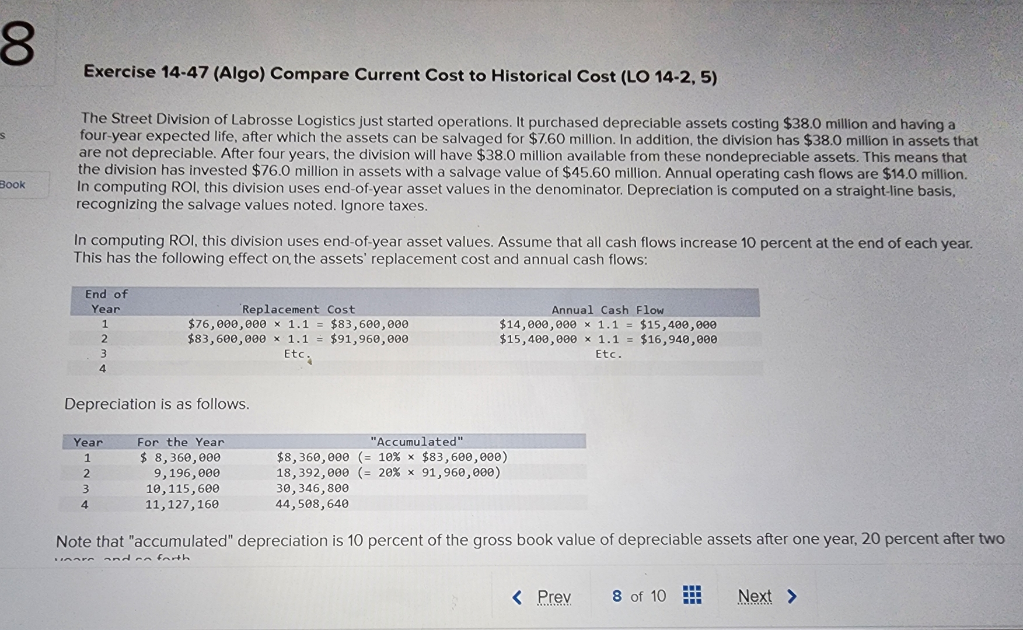
 ies a = i
ASR bY
Exercise 14-47 (Algo) Compare Current Cost to Historical Cost (LO 14-2,8)
~The Street Division of Labrosse Logistics Just started operations. It purchased depreciable assets costing $38.0 mil lionand havinga
* fouryear expected life, after which the assets can be salvaged for $7.60 million. In addition, the division has $38.0 mil ion In assets th L080,
are notdepreciable. After four years, the division will have $38.0 million available from these nondepreciable assets. Thi Tea nsthat
~~ thedivision has invested $76.0 million in assets with a salvage value of $45.60 million. Annual operating cash flows are $14.0 ommend
09k In computing ROI this division uses end-of-year asset values In the denominator. Depreciation is computed on a straight-line basis, Nay
recognizing the salvage values noted. Ignore taxes. Bann rar og
5 Coe
In computing ROL, this division uses end-of-year asset values. Assume that all cash flows increase 10 percent at the end of year.
This has the following effect on the assets’ replacement cost and annual cash flows: Tn Fa
End of 5 7 HAE BR
BE Replacement. Cost wom EE Le a
1 $76,000,000 x 1.1 - $83,600,000 $14,000,000 x 1.1 = $15,400,000 EERE
2 $83,600,000 x 1.1 = $91,960,000 $15,408,000 x 1.1 = $16,948,008 HER
Depreciation is as follows. SB
BEYER Eon the Year “Accumulated” ay
1 $ 8,360,000 $8,360,000 (= 10% x $83,600,000) ed
2 9,196,000 18,392,000 (= 26% x 91,960,000) Artie
3 10,115,600 30,346,500 os
4 11,127,160 44,508,640 dee
Note that “accumulated” depreciation is 10 percent of the gross book value of depreciable assets after one year, 20 percent fief two
Er PONY RT 2k a
- ou
¢ Prev 8of10 HE Next > =
EE.
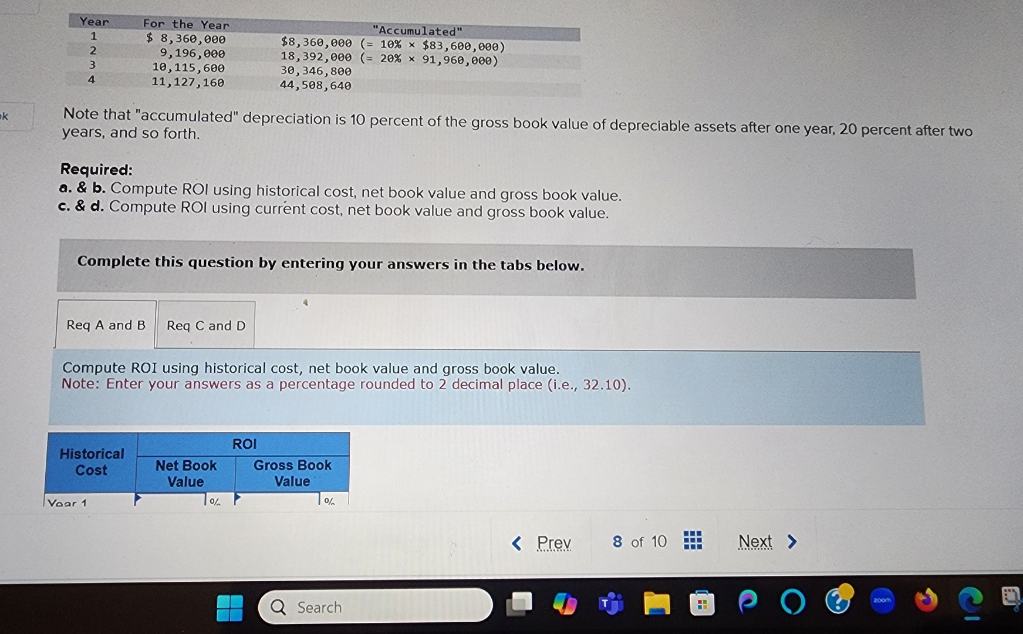
Year For the Year "Accumulated"
1 $ 8,360,000 $8,360,000 (~ 10% x $83,600,000)
2 9,196,000 18,392,000 (= 20% x 91,960,000)
3 10,115, 600 30,346,800
a 11,127,160 44,508,640
x Note that "accumulated" depreciation is 10 percent of the gross book value of depreciable assets after one year, 20 percent after two
years, and so forth.
Required:
a. &b. Compute ROI using historical cost, net book value and gross book value.
&. ®
I [¥
[ Q Search L] p L a \
RE X 3 I
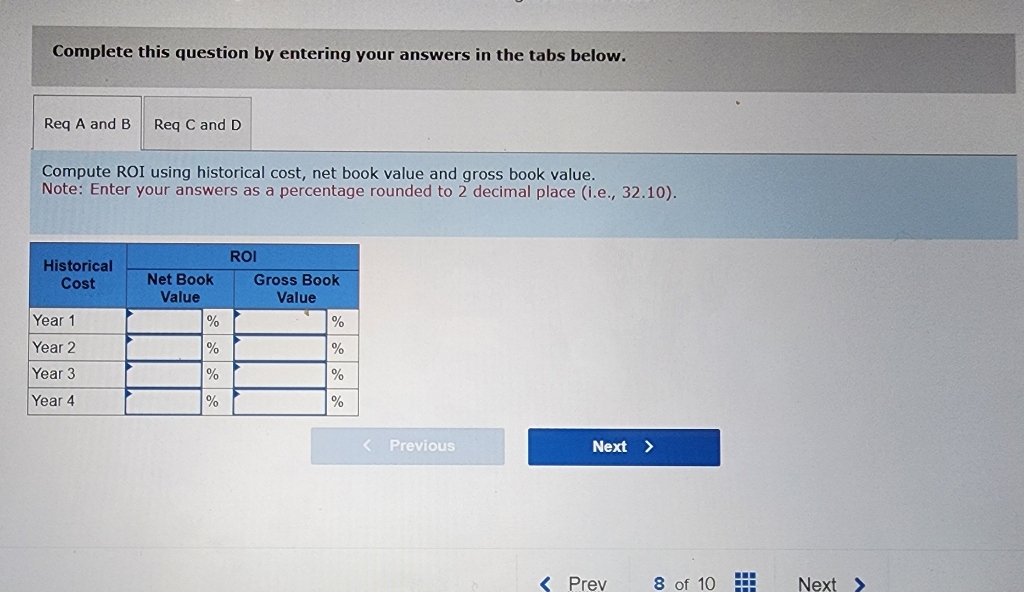
C omplete this question by entering your answers in the tabs below. ge
Se 5 25,
Req A and B | Req Cand D
2 2 Ta
| Compute ROI using historical cost, net book value and gross book value. CE
Note: Enter your answers as a percentage rounded to 2 decimal place (ie, 32.10).
hedo
¢ Prev 8 of10 == ' Next >
Asked by: Nishant Saini
Created at: 2025-09-28 08:03:48
Final Answer:
Question:
provide explanation for each step in 3 lines
Asked by: Nishant Saini
Created at: 2025-09-28 09:03:50
Final Answer:
📢 Instructions:
- Ask anything relatd to above question only.
- For new Question goto :