 VIPSolutions
provide conceptual introduction and given values and give me the answer completely of each part answer spearately with explanation,clculation in step by step and final answerFind the value of the capacitance, C, shown in the circuit so that i(t) will be in phase with the source voltage. (This means that the total impedance as seen by the source, is completely real, or has a 0° phase angle.) it) 100 209 u(t) = 0cos 00t-+ 307) (7) c S 60 mH [[: G eo(t) in the network. 40 mF Seos10t A ® 100 S 100 mF 2 50 Z(t)
Question:
provide conceptual introduction and given values and give me the answer completely of each part answer spearately with explanation,clculation in step by step and final answer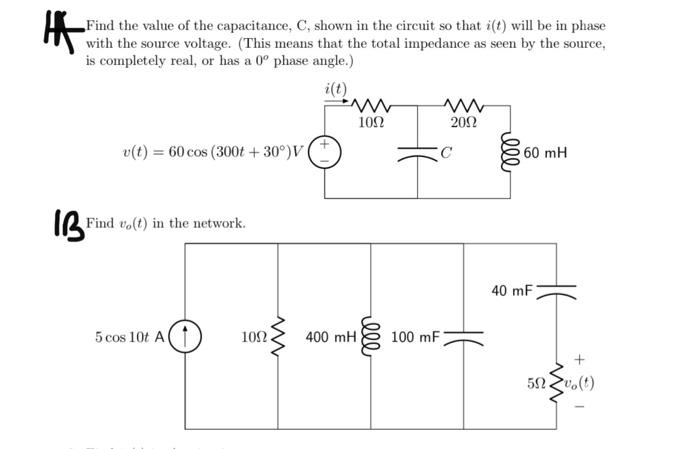 Find the value of the capacitance, C, shown in the circuit so that i(t) will be in phase
with the source voltage. (This means that the total impedance as seen by the source,
is completely real, or has a 0° phase angle.)
it)
100 209
u(t) = 0cos 00t-+ 307) (7) c S 60 mH
[[: G eo(t) in the network.
40 mF
Seos10t A ® 100 S 100 mF
2
50 Z(t)
This is AI generated Response.
Asked by: Shaik basha
Created at: 2025-09-19 14:39:49
Asked by: Shaik basha
Created at: 2025-09-19 14:39:49
Final Answer:
Rendered
Raw Text
Did you like this answer?
Let's solve each problem step by step.
---
# **Part 1A: Find the value of the capacitance, C**
### **Conceptual Introduction**
For the current \( i(t) \) to be **in phase** with the source voltage \( v(t) \), the **total impedance** seen by the source must be **purely real** (i.e., the imaginary part must be zero). This means the total reactance (inductive + capacitive) must cancel out.
---
### **Given Values**
- Source voltage: \( v(t) = 60 \cos(300t + 30^\circ) \) V
- Components:
- \( R_1 = 10\,\Omega \)
- \( R_2 = 20\,\Omega \)
- \( L = 60\,\text{mH} = 0.06\,\text{H} \)
- \( C = ? \) (to be found)
- Angular frequency: \( \omega = 300\,\text{rad/s} \)
---
### **Step-by-Step Solution**
#### **1. Write the total impedance:**
The total impedance is:
\[
Z_{\text{total}} = R_1 + \left[ \left( R_2 + j\omega L \right) \parallel \left( \frac{1}{j\omega C} \right) \right]
\]
But from the diagram, the \( 20\,\Omega \), \( C \), and \( 60\,\text{mH} \) are all **in series**; then this series combination is in series with \( 10\,\Omega \):
\[
Z_{\text{total}} = 10 + 20 + j\omega L + \frac{1}{j\omega C}
\]
\[
Z_{\text{total}} = 30 + j\omega L + \frac{1}{j\omega C}
\]
#### **2. Substitute values:**
\[
Z_{\text{total}} = 30 + j(300 \times 0.06) + \frac{1}{j300C}
\]
\[
Z_{\text{total}} = 30 + j(18) + \frac{1}{j300C}
\]
Recall that \( \frac{1}{j300C} = -j \frac{1}{300C} \):
\[
Z_{\text{total}} = 30 + j18 - j\frac{1}{300C}
\]
\[
Z_{\text{total}} = 30 + j\left(18 - \frac{1}{300C}\right)
\]
#### **3. Set imaginary part to zero:**
For the impedance to be purely real:
\[
18 - \frac{1}{300C} = 0
\]
#### **4. Solve for \( C \):**
\[
18 = \frac{1}{300C}
\]
\[
C = \frac{1}{18 \times 300}
\]
\[
C = \frac{1}{5400}
\]
\[
C \approx 1.85 \times 10^{-4} \, \text{F} = 185\,\mu\text{F}
\]
---
### **Final Answer for 1A**
\[
\boxed{C = 185\,\mu\text{F}}
\]
---
# **Part 1B: Find \( v_0(t) \) in the Network**
### **Conceptual Introduction**
This is a parallel AC circuit. We are to find the voltage \( v_0(t) \) across the 5 Ω resistor. Since all components are in parallel, \( v_0(t) \) is the same across each branch.
---
### **Given Values**
- Source: \( i_s(t) = 5 \cos(10t) \) A
- \( R_1 = 10\,\Omega \) (parallel)
- \( L_1 = 400\,\text{mH} = 0.4\,\text{H} \) (parallel)
- \( C_1 = 100\,\text{mF} = 0.1\,\text{F} \) (parallel)
- \( C_2 = 40\,\text{mF} = 0.04\,\text{F} \) (parallel with \( R_2 \))
- \( R_2 = 5\,\Omega \) (parallel with \( C_2 \))
- \( \omega = 10\,\text{rad/s} \)
---
### **Step-by-Step Solution**
#### **1. Find Impedances**
- \( Z_{R1} = 10\,\Omega \)
- \( Z_{L1} = j\omega L_1 = j(10)(0.4) = j4\,\Omega \)
- \( Z_{C1} = \frac{1}{j\omega C_1} = \frac{1}{j(10)(0.1)} = \frac{1}{j1} = -j1\,\Omega \)
- \( Z_{R2 \parallel C2} \):
- \( Z_{R2} = 5\,\Omega \)
- \( Z_{C2} = \frac{1}{j\omega C_2} = \frac{1}{j(10)(0.04)} = \frac{1}{j0.4} = -j2.5\,\Omega \)
- Parallel combination:
\[
Z_{R2 \parallel C2} = \frac{Z_{R2} \cdot Z_{C2}}{Z_{R2} + Z_{C2}}
= \frac{5 \cdot (-j2.5)}{5 - j2.5}
\]
\[
= \frac{-j12.5}{5 - j2.5}
\]
To simplify, multiply numerator and denominator by the conjugate of the denominator:
\[
= \frac{-j12.5(5 + j2.5)}{(5 - j2.5)(5 + j2.5)}
\]
\[
= \frac{-j12.5 \cdot 5 + (-j12.5)(j2.5)}{25 + 12.5}
\]
\[
= \frac{-j62.5 + 31.25}{37.5}
\]
\[
= \frac{31.25 - j62.5}{37.5}
\]
\[
= 0.833 - j1.67\,\Omega
\]
#### **2. Find Total Parallel Admittance**
Admittance \( Y = \frac{1}{Z} \):
- \( Y_{R1} = \frac{1}{10} = 0.1\,S \)
- \( Y_{L1} = \frac{1}{j4} = -j0.25\,S \)
- \( Y_{C1} = \frac{1}{-j1} = j1\,S \)
- \( Y_{R2 \parallel C2} = \frac{1}{0.833 - j1.67} \)
Let's calculate \( Y_{R2 \parallel C2} \):
Let \( Z = 0.833 - j1.67 \):
\[
|Z|^2 = 0.833^2 + 1.67^2 = 0.694 + 2.789 = 3.483
\]
\[
\frac{1}{Z} = \frac{0.833 + j1.67}{3.483} = 0.239 + j0.48\,S
\]
#### **3. Total Admittance**
\[
Y_{\text{total}} = Y_{R1} + Y_{L1} + Y_{C1} + Y_{R2 \parallel C2}
\]
\[
Y_{\text{total}} = 0.1 - j0.25 + j1 + 0.239 + j0.48
\]
\[
= (0.1 + 0.239) + [-j0.25 + j1 + j0.48]
\]
\[
= 0.339 + j(1 - 0.25 + 0.48)
\]
\[
= 0.339 + j1.23
\]
#### **4. Find Total Impedance**
\[
Z_{\text{total}} = \frac{1}{Y_{\text{total}}}
\]
\[
= \frac{1}{0.339 + j1.23}
\]
Let's find the magnitude and phase:
- Magnitude: \( \sqrt{0.339^2 + 1.23^2} = \sqrt{0.115 + 1.5129} = \sqrt{1.6279} \approx 1.276 \)
- Angle: \( \tan^{-1}\left(\frac{1.23}{0.339}\right) = \tan^{-1}(3.63) \approx 74.7^\circ \)
So,
\[
Y_{\text{total}} = 1.276\angle 74.7^\circ\,S
\]
\[
Z_{\text{total}} = \frac{1}{1.276\angle 74.7^\circ} = 0.784\angle -74.7^\circ\,\Omega
\]
#### **5. Find Output Voltage \( v_0(t) \)**
The current source: \( i_s(t) = 5\cos(10t) \)
In phasor form: \( \tilde{I}_s = 5\angle 0^\circ \) A
Voltage across all branches:
\[
\tilde{V}_0 = \tilde{I}_s \cdot Z_{\text{total}}
\]
\[
= 5\angle 0^\circ \cdot 0.784\angle -74.7^\circ
= 3.92 \angle -74.7^\circ\,\text{V}
\]
Convert back to time domain:
\[
v_0(t) = 3.92\cos(10t - 74.7^\circ)\,\text{V}
\]
---
### **Final Answer for 1B**
\[
\boxed{v_0(t) = 3.92\cos(10t - 74.7^\circ)\,\text{V}}
\]
---
**Summary of Answers:**
- **1A:** \( \boxed{C = 185\,\mu\text{F}} \)
- **1B:** \( \boxed{v_0(t) = 3.92\cos(10t - 74.7^\circ)\,\text{V}} \)
Let me know if you want step-by-step phasor diagrams or further breakdowns!
📢 Instructions:
- Ask anything relatd to above question only.
- For new Question goto :