 VIPSolutions
Provide answrr without latex7:21 me NN RB a 79%a {) 25 app.outlierai/screening?id=68a5cc2 + H J’ Outlier — 55 & 6m 54s remainin: Explain how to find the inverse of the matrix 4 = [ 2 } ]. Provide a clear step-by-step procedure for your solution and Verify the result by demonstrating that A xA™" = I, where I is the identity matrix. il © &® o & I BE I EEE EE BE BE EN EE “11 1 vr 1 L111 “1 1 111111 2a 1 1 1 11 1 ES 1#1 , English(India) . J 9 Il @] bd
Question:
Provide answrr without latex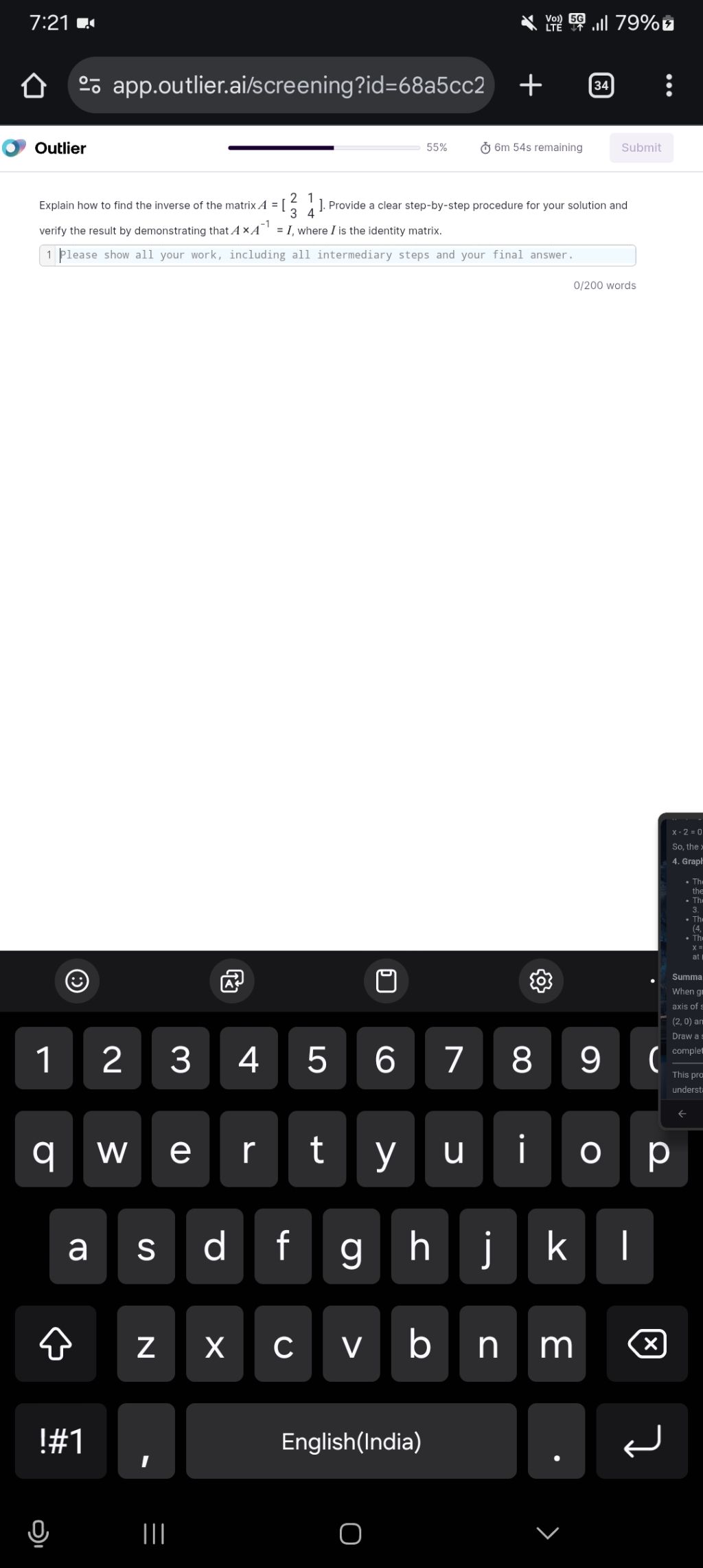 7:21 me NN RB a 79%a
{) 25 app.outlierai/screening?id=68a5cc2 + H
J’ Outlier — 55 & 6m 54s remainin:
Explain how to find the inverse of the matrix 4 = [ 2 } ]. Provide a clear step-by-step procedure for your solution and
Verify the result by demonstrating that A xA™" = I, where I is the identity matrix.
il
© &® o &
I BE I EEE EE BE BE EN EE
“11 1 vr 1 L111
“1 1 111111
2a 1 1 1 11 1 ES
1#1 , English(India) . J
9 Il @] bd
This is AI generated Response.
Asked by: Gurubindra Singh
Created at: 2025-08-20 19:22:26
Asked by: Gurubindra Singh
Created at: 2025-08-20 19:22:26
Final Answer:
Rendered
Raw Text
Did you like this answer?
Sure! Here is the step-by-step answer without using latex:
Given matrix A = [2 1 ; 3 4]
Step 1: Find the determinant of A.
Determinant = (2 * 4) - (1 * 3) = 8 - 3 = 5
Step 2: Swap the elements on the main diagonal and change the signs of the off-diagonal elements.
So, swap 2 and 4, and change the sign of 1 and 3:
This gives the matrix [4 -1 ; -3 2]
Step 3: Divide each element by the determinant.
So, the inverse A^-1 = [4/5 -1/5 ; -3/5 2/5]
Step 4: Verify by multiplying A and A^-1 to get the identity matrix:
Multiply [2 1 ; 3 4] by [4/5 -1/5 ; -3/5 2/5]:
First row: (2 * 4/5) + (1 * -3/5) = 8/5 - 3/5 = 1
(2 * -1/5) + (1 * 2/5) = -2/5 + 2/5 = 0
Second row: (3 * 4/5) + (4 * -3/5) = 12/5 - 12/5 = 0
(3 * -1/5) + (4 * 2/5) = -3/5 + 8/5 = 1
So we get the identity matrix [1 0 ; 0 1].
Final answer:
The inverse of matrix A is [4/5 -1/5 ; -3/5 2/5].
📢 Instructions:
- Ask anything relatd to above question only.
- For new Question goto :