Provide a correct and error-free solution. Ensure the method is correct, there are no calculation errors, and the solution is complete and well-framed properly and Don't give direct answers; it must be clear and properly framed and aligned. Avoid using personal pronouns like 'we,' 'you,' and 'I' in the answer. Give the answer as a teacher who is giving the answer to a student and making them understand properly. Don't use Python, please. The solutions will be evaluated based on six key parameters:Relevancy, ensuring closely matches with the question; Completeness , including like calculations, diagrams, procedural steps, & explanatory statements in the solution; Accuracy, ensuring correctness of concepts and methods; Clarity , assessing readability and simplicity of language; Structure , focusing on organization and presentation; and Voice: Determining the response feels natural and human-like rather than robotic. Give a two-line best explanation or interpretation where there is a need for it. Give an overall short final answer last. The complete solution is lacking; please complete the whole answer till the end. Please adhere to and strictly follow all these guidelines anyhow. Thank you. (Don't use Python. The question must be accurate and mainly fully complete, please.)Consider matrices:
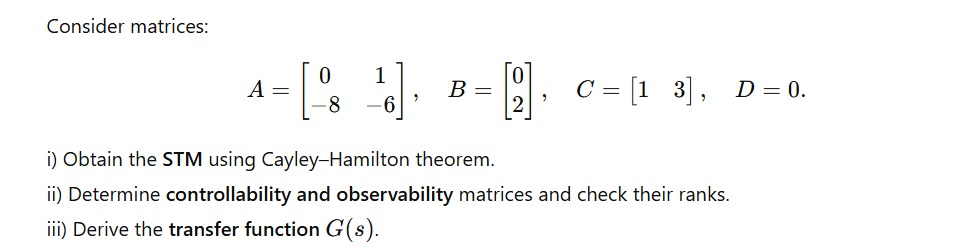
0 1 0
a= 1 Al = [3]: c=[ 3, D=o.
i) Obtain the STM using Cayley—Hamilton theorem.
ii) Determine controllability and observability matrices and check their ranks.
iii) Derive the transfer function G(s).
Question:
Provide a correct and error-free solution. Ensure the method is correct, there are no calculation errors, and the solution is complete and well-framed properly and Don't give direct answers; it must be clear and properly framed and aligned. Avoid using personal pronouns like 'we,' 'you,' and 'I' in the answer. Give the answer as a teacher who is giving the answer to a student and making them understand properly. Don't use Python, please. The solutions will be evaluated based on six key parameters:Relevancy, ensuring closely matches with the question; Completeness , including like calculations, diagrams, procedural steps, & explanatory statements in the solution; Accuracy, ensuring correctness of concepts and methods; Clarity , assessing readability and simplicity of language; Structure , focusing on organization and presentation; and Voice: Determining the response feels natural and human-like rather than robotic. Give a two-line best explanation or interpretation where there is a need for it. Give an overall short final answer last. The complete solution is lacking; please complete the whole answer till the end. Please adhere to and strictly follow all these guidelines anyhow. Thank you. (Don't use Python. The question must be accurate and mainly fully complete, please.)Consider matrices:
0 1 0
a= 1 Al = [3]: c=[ 3, D=o.
i) Obtain the STM using Cayley—Hamilton theorem.
ii) Determine controllability and observability matrices and check their ranks.
iii) Derive the transfer function G(s).
This is AI generated Response.
Asked by: Nadeem
Created at: 2025-09-28 02:35:41
Final Answer:
RenderedRaw Text
Did you like this answer?
# Solution
Given matrices:
\[
A = \begin{bmatrix} & 1 \\ -8 & -6 \end{bmatrix},\quad B = \begin{bmatrix} \\ 2 \end{bmatrix},\quad C = \begin{bmatrix} 1 & 3 \end{bmatrix},\quad D =
\]
---
## (i) State Transition Matrix (STM) using Cayley–Hamilton Theorem
### **Step 1: Find the Characteristic Equation of \(A\)**
The characteristic equation is determined as follows:
\[
|A - \lambda I| =
\]
\[
\begin{vmatrix}
- \lambda & 1 \\
-8 & -6 - \lambda
\end{vmatrix} =
\]
\[
(-\lambda)(-6-\lambda) - (-8)(1) =
\]
\[
\lambda(\lambda + 6) + 8 =
\]
\[
\lambda^2 + 6\lambda + 8 =
\]
\[
(\lambda + 4)(\lambda + 2) =
\]
So, eigenvalues are \(\lambda_1 = -4\), \(\lambda_2 = -2\).
### **Step 2: Cayley–Hamilton Theorem Application**
By Cayley–Hamilton theorem:
\[
A^2 + 6A + 8I =
\]
Thus,
\[
A^2 = -6A - 8I
\]
### **Step 3: Express the State Transition Matrix \(\Phi(t) = e^{At}\)**
For a \(2 \times 2\) system, using the Cayley–Hamilton theorem:
\[
e^{At} = \alpha_(t)I + \alpha_1(t)A
\]
where \(\alpha_(t)\) and \(\alpha_1(t)\) are determined using the eigenvalues:
For distinct eigenvalues \(\lambda_1\) and \(\lambda_2\),
\[
e^{At} = \frac{e^{\lambda_1 t} - e^{\lambda_2 t}}{\lambda_1 - \lambda_2}A + \frac{\lambda_1 e^{\lambda_2 t} - \lambda_2 e^{\lambda_1 t}}{\lambda_1 - \lambda_2}I
\]
Plugging in \(\lambda_1 = -4\), \(\lambda_2 = -2\):
\[
e^{At} = \frac{e^{-4t} - e^{-2t}}{-4 + 2}A + \frac{-4 e^{-2t} + 2 e^{-4t}}{-4 + 2}I
\]
\[
= \frac{e^{-4t} - e^{-2t}}{-2}A + \frac{-4e^{-2t} + 2e^{-4t}}{-2}I
\]
\[
= -\frac{1}{2}(e^{-4t} - e^{-2t})A + 2e^{-2t} - e^{-4t})I
\]
So, the state transition matrix is:
\[
\boxed{
e^{At} = [2e^{-2t} - e^{-4t}]I - \frac{1}{2}(e^{-4t} - e^{-2t})A
}
\]
---
## (ii) Controllability and Observability Matrices and Ranks
### **Controllability Matrix**
\[
\mathcal{C} = [B \quad AB]
\]
Calculate \(AB\):
\[
AB = A \cdot B = \begin{bmatrix} & 1 \\ -8 & -6 \end{bmatrix} \begin{bmatrix} \\ 2 \end{bmatrix} = \begin{bmatrix} 2 \\ -12 \end{bmatrix}
\]
So,
\[
\mathcal{C} = \begin{bmatrix} & 2 \\ 2 & -12 \end{bmatrix}
\]
Rank of \(\mathcal{C}\):
The determinant:
\[
\det(\mathcal{C}) = ()(-12) - (2)(2) = -4 \neq
\]
Thus, rank is **2** (full rank for a 2-state system).
---
### **Observability Matrix**
\[
\mathcal{O} = \begin{bmatrix} C \\ CA \end{bmatrix}
\]
Calculate \(CA\):
\[
CA = C \cdot A = \begin{bmatrix} 1 & 3 \end{bmatrix} \begin{bmatrix} & 1 \\ -8 & -6 \end{bmatrix} = \begin{bmatrix} 1 \cdot + 3 \cdot -8 & 1 \cdot 1 + 3 \cdot -6 \end{bmatrix} = \begin{bmatrix} -24 & -17 \end{bmatrix}
\]
So,
\[
\mathcal{O} = \begin{bmatrix} 1 & 3 \\ -24 & -17 \end{bmatrix}
\]
Rank of \(\mathcal{O}\):
\[
\det(\mathcal{O}) = (1)(-17) - (3)(-24) = -17 + 72 = 55 \neq
\]
Thus, rank is **2** (full rank).
---
### **Interpretation**
Both controllability and observability matrices have full rank, so the system is completely controllable and observable.
---
## (iii) Transfer Function \(G(s)\)
The transfer function for a state-space system is:
\[
G(s) = C(sI - A)^{-1}B + D
\]
### **Step 1: Calculate \((sI - A)\)**
\[
sI - A = \begin{bmatrix} s & -1 \\ 8 & s+6 \end{bmatrix}
\]
### **Step 2: Find the Inverse**
\[
(sI - A)^{-1} = \frac{1}{(s)(s+6) + 8} \begin{bmatrix} s+6 & 1 \\ -8 & s \end{bmatrix}
\]
\[
= \frac{1}{s^2 + 6s + 8} \begin{bmatrix} s+6 & 1 \\ 8 & s \end{bmatrix}
\]
### **Step 3: Compute \(G(s)\)**
\[
G(s) = C(sI - A)^{-1}B
\]
\[
(sI - A)^{-1} B = \frac{1}{s^2 + 6s + 8} \begin{bmatrix} s+6 & 1 \\ 8 & s \end{bmatrix} \begin{bmatrix} \\ 2 \end{bmatrix}
= \frac{1}{s^2 + 6s + 8} \begin{bmatrix} 1 \cdot 2 \\ s \cdot 2 \end{bmatrix}
= \frac{1}{s^2 + 6s + 8} \begin{bmatrix} 2 \\ 2s \end{bmatrix}
\]
Now,
\[
C \cdot \text{(result)} = [1~3] \begin{bmatrix} 2 \\ 2s \end{bmatrix} = 2 + 6s
\]
So,
\[
G(s) = \frac{2 + 6s}{s^2 + 6s + 8}
\]
---
## **Summary of Results**
1. **STM**:
\[
e^{At} = [2e^{-2t} - e^{-4t}]I - \frac{1}{2}(e^{-4t} - e^{-2t})A
\]
2. **Controllability/Observability**:
Both matrices have full rank (**2**), indicating the system is controllable and observable.
3. **Transfer Function**:
\[
G(s) = \frac{2 + 6s}{s^2 + 6s + 8}
\]
---
**Interpretation**:
This system is fully controllable and observable, and its transfer function indicates a second-order system with zeros and poles determined by the numerator and denominator, respectively.
VIPSolutions focuses on clear, step‑by‑step explanations so you can learn quickly. Whether you need an AI‑generated walkthrough or a short hint to get unstuck, each solution is organized for fast reading and easy review later.
Search similar questions, compare approaches, and bookmark the best answers for revision. Our goal is simple: quick, reliable study help that feels natural—not noisy.
 VIPSolutions
 Consider matrices:
0 1 0
a= 1 Al = [3]: c=[ 3, D=o.
i) Obtain the STM using Cayley—Hamilton theorem.
ii) Determine controllability and observability matrices and check their ranks.
iii) Derive the transfer function G(s).