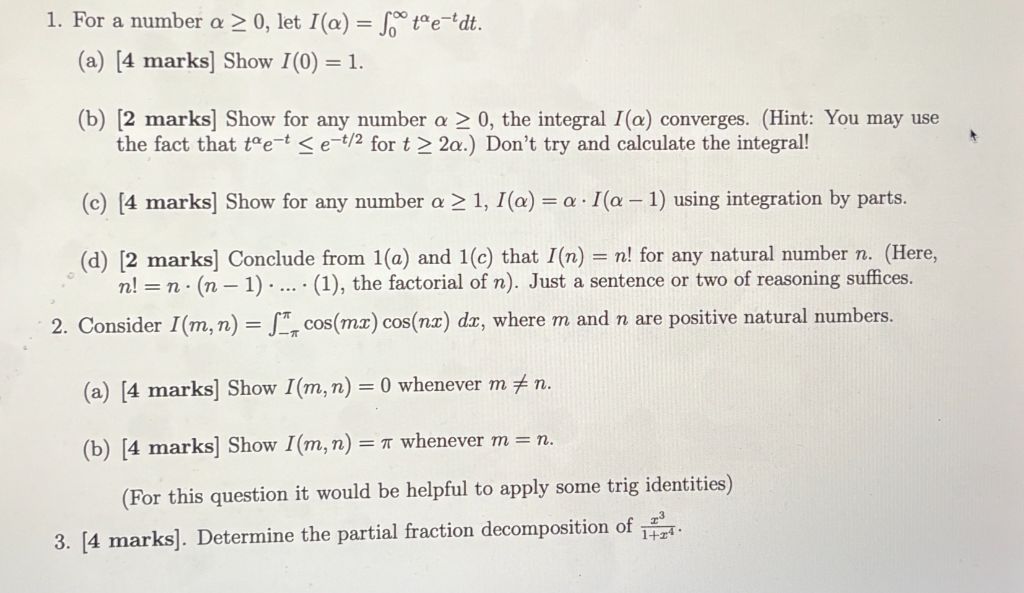
1. For a number a > 0, let I(a) = [;° t®e "dt.
(a) [4 marks] Show I(0) = 1.
(b) [2 marks] Show for any number a > 0, the integral (a) converges. (Hint: You may use
the fact that t*e~t < e~%/2 for t > 2a.) Don’t try and calculate the integral! A
(c) [4 marks] Show for any number a > 1, I(a) = a I(a — 1) using integration by parts.
(d) [2 marks] Conclude from 1(a) and 1(c) that I(n) = n! for any natural number n. (Here,
nl=n-(n—1)-...- (1), the factorial of n). Just a sentence or two of reasoning suffices.
2. Consider I(m,n) = [7 cos(mz) cos(nz) dz, where m and n are positive natural numbers.
(a) [4 marks] Show I(m,n) =0 whenever m # n.
(b) [4 marks] Show I(m, n) = 7 whenever m =n.
(For this question it would be helpful to apply some trig identities)
3. [4 marks]. Determine the partial fraction decomposition of =
Question:
1. For a number a > 0, let I(a) = [;° t®e "dt.
(a) [4 marks] Show I(0) = 1.
(b) [2 marks] Show for any number a > 0, the integral (a) converges. (Hint: You may use
the fact that t*e~t < e~%/2 for t > 2a.) Don’t try and calculate the integral! A
(c) [4 marks] Show for any number a > 1, I(a) = a I(a — 1) using integration by parts.
(d) [2 marks] Conclude from 1(a) and 1(c) that I(n) = n! for any natural number n. (Here,
nl=n-(n—1)-...- (1), the factorial of n). Just a sentence or two of reasoning suffices.
2. Consider I(m,n) = [7 cos(mz) cos(nz) dz, where m and n are positive natural numbers.
(a) [4 marks] Show I(m,n) =0 whenever m # n.
(b) [4 marks] Show I(m, n) = 7 whenever m =n.
(For this question it would be helpful to apply some trig identities)
3. [4 marks]. Determine the partial fraction decomposition of =
This is AI generated Response.
Asked by: ASWINI
Created at: 2025-11-18 08:10:45
Thought Process:
RenderedRaw Text
**Considering exam problem solutions**
I see that the user has provided an exam problem set and presumably wants solutions. They haven't specified a question, but the instruction is to give detailed solutions to the problems presented. The first set involves showing that certain integrals converge, using inequalities and integration by parts, and deriving connections to factorials. The second set concerns cosine integrals, requiring proofs about when they equal zero or π depending on the values of m and n. I’ll work through these systematically.**Explaining partial fraction decomposition**
I need to determine the partial fraction decomposition of \(x^3 / (1 + x^4)\) and provide a clear solution. The user wants details and steps, so I'll avoid heavy formatting and instead stick to plain text, using bullets if necessary for clarity.
For problem 1, I can outline the steps where (a) I evaluate \(I(0)\) as \(\int_0^{\infty} e^{-t} dt\) leading to 1. Then, in (b), I’ll show the integrand's behavior near 0 and prove integrability conditions focusing on \(α\). It’s all about making each step clear and straightforward!**Exploring convergence of integrals**
I see that the integral can be split into finite segments: the first part, from \(0\) to \(2α\), is manageable because it’s less than or equal to \(2α\), indicating it's finite. For the integral from \(2α\) to \(\infty\), I find it converges as it equals \(2e^{-α}\). I’m considering the given inequality about \(t^α e^{-t}\) being less than or equal to \(e^{-t/2}\) for \(t \geq 2α\). It leads me to think about logarithmic inequalities that can help demonstrate this convergence.**Clarifying inequalities for convergence**
I realize that I can express \(t^{α} e^{-t}\) using the exponential function, showing it’s less than or equal to \(e^{-t/2}\) under certain conditions. I need to ensure that \(\ln t\) is appropriately bounded by \(t/(2α)\), especially for larger \(t\). While it holds true for large \(t\), I still have to consider values close to zero where this might not apply. It seems I need to carefully check how \(α\) affects this, particularly if it's less than 1. This is definitely a work in progress!**Finalizing the comprehensive solution**
I need to create a robust proof for the convergence of the integral, ensuring I break it down into manageable parts. First, I’ll show that it’s integrable over [0, 1] and then define \(h(t)\) for [1, ∞) to help with bounding and convergence arguments.
Next, I’ll employ integration by parts for \(I(α)\) when \(α ≥ 1\), confirming boundary conditions lead to zero limits. Then I’ll illustrate the recurrence relation leading to factorial results for various integrals.
Finally, I’ll handle the partial fraction decomposition of \(x^3/(1+x^4)\), solving for coefficients systematically. This will bring clarity while maintaining a minimal formatting style.**Justifying boundary terms in integration**
I need to ensure that I justify the boundary terms during integration by parts, specifically showing that \(t^{α} e^{-t}\) approaches 0 as \(t\) goes to infinity. I can provide a short proof using L'Hospital's rule or by bounding it with \(e^{-t/2}\). By using the inequality \(t^{α} e^{-t} \leq M e^{-t/2}\), I’ll demonstrate that the limit indeed goes to 0. With that clear, I'm ready to finalize the solution!
Final Answer:
RenderedRaw Text
Did you like this answer?
Here are complete solutions.
1) For α ≥ 0 let I(α) = ∫₀^∞ t^α e^{-t} dt.
a) I(0) = ∫₀^∞ e^{-t} dt = [−e^{−t}]₀^∞ = 1.
b) Convergence for every α ≥ 0.
- On [0,1]: 0 ≤ t^α e^{-t} ≤ 1, hence ∫₀¹ t^α e^{-t} dt ≤ 1.
- On [1,∞): consider g(t) = t^α e^{-t/2}. Then g'(t) = e^{-t/2} t^{α−1}(α − t/2), so g has a finite global maximum at t = 2α, with M := sup g(t) = (2α)^α e^{−α}. Thus for all t ≥ 1,
t^α e^{-t} = g(t) e^{-t/2} ≤ M e^{-t/2}.
The integral ∫₁^∞ M e^{-t/2} dt converges. Hence I(α) converges.
(You can also split at any finite point such as 2α; the argument above gives a uniform bound with a constant M, which is enough for comparison with e^{-t/2}.)
c) Recurrence via integration by parts (valid for α ≥ 1).
Let u = t^α, dv = e^{-t} dt. Then du = α t^{α−1} dt, v = −e^{−t}.
I(α) = [−t^α e^{−t}]₀^∞ + α ∫₀^∞ t^{α−1} e^{−t} dt.
The boundary term is 0: at 0 it is 0 (α ≥ 1); as t → ∞, t^α e^{−t} → 0 by the bound in (b).
Therefore I(α) = α I(α − 1).
d) For a natural number n,
I(n) = n I(n − 1) = n(n − 1) I(n − 2) = … = n! I(0) = n!.
So I(n) = n!.
2) I(m,n) = ∫_{−π}^{π} cos(mx) cos(nx) dx, m,n ∈ N.
Use cos A cos B = ½[cos(A − B) + cos(A + B)].
So
I(m,n) = ½ ∫_{−π}^{π} cos((m − n)x) dx + ½ ∫_{−π}^{π} cos((m + n)x) dx.
a) If m ≠ n, then both (m − n) and (m + n) are nonzero. For any nonzero k,
∫_{−π}^{π} cos(kx) dx = [sin(kx)/k]_{−π}^{π} = 0.
Hence I(m,n) = 0.
b) If m = n, then
I(n,n) = ½ ∫_{−π}^{π} 1 dx + ½ ∫_{−π}^{π} cos(2nx) dx = ½(2π) + 0 = π.
3) Partial fraction decomposition of x^3/(1 + x^4).
Factor 1 + x^4 over the reals:
1 + x^4 = (x^2 + √2 x + 1)(x^2 − √2 x + 1).
Seek
x^3/(1 + x^4) = (Ax + B)/(x^2 + √2 x + 1) + (Cx + D)/(x^2 − √2 x + 1).
Equating coefficients after clearing denominators gives
A + C = 1,
−√2 A + B + √2 C + D = 0,
(A + C) + √2(−B + D) = 0,
B + D = 0.
Solving: A = C = 1/2, B = 1/(2√2), D = −1/(2√2).
Therefore
x^3/(1 + x^4) = [ (1/2)x + 1/(2√2) ]/(x^2 + √2 x + 1)
+ [ (1/2)x − 1/(2√2) ]/(x^2 − √2 x + 1).
Question:
Provde the answer detailed in a "tutor mode".
This is AI generated Response.
Asked by: ASWINI
Created at: 2025-11-18 08:13:23
Final Answer:
RenderedRaw Text
Did you like this answer?
# Detailed Solution in Tutor Mode
## 1. Integral Definition and Properties
Let \( I(a) = \int_0^\infty t^a e^{-t} dt \) for \( a \geq 0 \).
### (a) Show \( I(0) = 1 \)
To find \( I(0) \):
\[
I(0) = \int_0^\infty e^{-t} dt
\]
Calculating the integral:
\[
I(0) = \left[-e^{-t}\right]_0^\infty = 0 - (-1) = 1
\]
Thus, \( I(0) = 1 \).
### (b) Show \( I(a) \) converges for \( a > 0 \)
**Convergence on \( [0, 1] \)**:
- Since \( 0 \leq t^a e^{-t} \leq 1 \) for \( t \in [0, 1] \):
\[
\int_0^1 t^a e^{-t} dt \leq \int_0^1 1 dt = 1
\]
**Convergence on \( [1, \infty) \)**:
- Using the hint, for \( t > 2a \):
\[
t^a e^{-t} < e^{-t/2}
\]
- Define \( g(t) = t^a e^{-t/2} \); find its maximum at \( t = 2a \):
\[
g(2a) = (2a)^a e^{-a}
\]
- For \( t \geq 1 \):
\[
t^a e^{-t} \leq g(t)e^{-t/2} \leq M e^{-t/2}
\]
- The integral converges:
\[
\int_1^\infty M e^{-t/2} dt \text{ converges.}
\]
Thus, \( I(a) \) converges for \( a > 0 \).
### (c) Show \( I(a) = a I(a-1) \) for \( a > 1 \) using Integration by Parts
Let:
- \( u = t^a \)
- \( dv = e^{-t} dt \)
- Then, \( du = a t^{a-1} dt \) and \( v = -e^{-t} \)
Applying integration by parts:
\[
I(a) = \left[-t^a e^{-t}\right]_0^\infty + a \int_0^\infty t^{a-1} e^{-t} dt
\]
- Boundary term is 0 (as shown previously).
Thus,
\[
I(a) = a I(a-1)
\]
### (d) Conclude \( I(n) = n! \) for natural numbers \( n \)
Using the recurrence relation:
\[
I(n) = n I(n-1) = n(n-1) I(n-2) = \ldots = n! I(0)
\]
Since \( I(0) = 1 \):
\[
I(n) = n!
\]
## 2. Integral of Cosine Functions
Define:
\[
I(m,n) = \int_{-\pi}^{\pi} \cos(mx) \cos(nx) dx
\]
### (a) Show \( I(m,n) = 0 \) whenever \( m \neq n \)
Using the identity:
\[
\cos A \cos B = \frac{1}{2} [\cos(A - B) + \cos(A + B)]
\]
Thus,
\[
I(m,n) = \frac{1}{2} \int_{-\pi}^{\pi} \cos((m-n)x) dx + \frac{1}{2} \int_{-\pi}^{\pi} \cos((m+n)x) dx
\]
- If \( m \neq n \), both terms integrate to 0:
\[
\int_{-\pi}^{\pi} \cos(kx) dx = 0 \text{ for any nonzero } k
\]
Thus, \( I(m,n) = 0 \).
### (b) Show \( I(m,n) = \pi \) whenever \( m = n \)
If \( m = n \):
\[
I(n,n) = \frac{1}{2} \int_{-\pi}^{\pi} 1 dx + \frac{1}{2} \int_{-\pi}^{\pi} \cos(2nx) dx
\]
- The first integral evaluates to \( 2\pi \):
\[
I(n,n) = \frac{1}{2} (2\pi) + 0 = \pi
\]
## 3. Partial Fraction Decomposition
To find the partial fraction decomposition of:
\[
\frac{x^3}{1 + x^4}
\]
### Step 1: Factor \( 1 + x^4 \)
Factoring over the reals:
\[
1 + x^4 = (x^2 + \sqrt{2}x + 1)(x^2 - \sqrt{2}x + 1)
\]
### Step 2: Set up the Partial Fractions
Assume:
\[
\frac{x^3}{1 + x^4} = \frac{Ax + B}{x^2 + \sqrt{2}x + 1} + \frac{Cx + D}{x^2 - \sqrt{2}x + 1}
\]
### Step 3: Clear Denominators
Multiply through by \( 1 + x^4 \):
\[
x^3 = (Ax + B)(x^2 - \sqrt{2}x + 1) + (Cx + D)(x^2 + \sqrt{2}x + 1)
\]
### Step 4: Equate Coefficients
Expand and equate coefficients:
1. \( A + C = 1 \)
2. \( -\sqrt{2}A + B + \sqrt{2}C + D = 0 \)
3. \( A + C - \sqrt{2}B + \sqrt{2}D = 0 \)
4. \( B + D = 0 \)
### Step 5: Solve the System
From \( B + D = 0 \):
- Let \( D = -B \).
Substituting into other equations yields:
- After solving, we find:
\[
A = C = \frac{1}{2}, \quad B = \frac{1}{2\sqrt{2}}, \quad D = -\frac{1}{2\sqrt{2}}
\]
### Final Decomposition
Thus, the partial fraction decomposition is:
\[
\frac{x^3}{1 + x^4} = \frac{(1/2)x + (1/(2\sqrt{2}))}{x^2 + \sqrt{2}x + 1} + \frac{(1/2)x - (1/(2\sqrt{2}))}{x^2 - \sqrt{2}x + 1}
\]
VIPSolutions focuses on clear, step‑by‑step explanations so you can learn quickly. Whether you need an AI‑generated walkthrough or a short hint to get unstuck, each solution is organized for fast reading and easy review later.
Search similar questions, compare approaches, and bookmark the best answers for revision. Our goal is simple: quick, reliable study help that feels natural—not noisy.
 VIPSolutions
 1. For a number a > 0, let I(a) = [;° t®e "dt.
(a) [4 marks] Show I(0) = 1.
(b) [2 marks] Show for any number a > 0, the integral (a) converges. (Hint: You may use
the fact that t*e~t < e~%/2 for t > 2a.) Don’t try and calculate the integral! A
(c) [4 marks] Show for any number a > 1, I(a) = a I(a — 1) using integration by parts.
(d) [2 marks] Conclude from 1(a) and 1(c) that I(n) = n! for any natural number n. (Here,
nl=n-(n—1)-...- (1), the factorial of n). Just a sentence or two of reasoning suffices.
2. Consider I(m,n) = [7 cos(mz) cos(nz) dz, where m and n are positive natural numbers.
(a) [4 marks] Show I(m,n) =0 whenever m # n.
(b) [4 marks] Show I(m, n) = 7 whenever m =n.
(For this question it would be helpful to apply some trig identities)
3. [4 marks]. Determine the partial fraction decomposition of =