 VIPSolutions
Give step-by-step solution with explanation and final answer:~ EVEL 1 | 1 5 id: 155 2a ca A] 1) summarize the journal entries required to record the following tra = Gi 2) prepare a draft balance sheet and income statement as at December A epare a draft ba et 9) ABC Ltd is incorporated with share capital of 100 shares of $1 each. 5 shares are issued and fully paid. ABC Lids icensed to purchase and sell oly one product: Widgets. The cost of a Widget is $5. ABC Ltd sells 100 Widgets a sale price $10 each. 811d pays $1200 legal fees for the period relating to July 1% ~ june 30 December 3) There ae no unsold Widgets instock. a
Question:
Give step-by-step solution with explanation and final answer: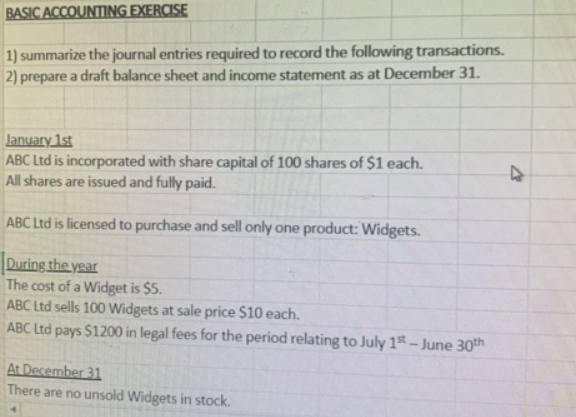 ~ EVEL 1 | 1 5
id: 155 2a ca A]
1) summarize the journal entries required to record the following tra = Gi
2) prepare a draft balance sheet and income statement as at December A
epare a draft ba
et
9)
ABC Ltd is incorporated with share capital of 100 shares of $1 each. 5
shares are issued and fully paid.
ABC Lids icensed to purchase and sell oly one product: Widgets.
The cost of a Widget is $5.
ABC Ltd sells 100 Widgets a sale price $10 each.
811d pays $1200 legal fees for the period relating to July 1% ~ june 30
December 3)
There ae no unsold Widgets instock.
a
This is AI generated Response.
Asked by: Rahul kumar
Created at: 2025-09-28 12:06:37
Asked by: Rahul kumar
Created at: 2025-09-28 12:06:37
Thought Process:
Rendered
Raw Text
**Analyzing accounting tasks**
I need to parse the image text for a basic accounting exercise. First, I’ll summarize the required journal entries for the transactions. Then, I’ll prepare a draft balance sheet and income statement as of December 31. ABC Ltd is incorporated with share capital of 100 shares at $1 each, and it sells Widgets at a cost of $5 and a sale price of $10. Plus, there's a $1200 legal fee, and no unsold Widgets by year-end. I’ll focus on journal entries and financial statements.**Clarifying accounting details**
It seems that the provided information doesn't state explicitly if inventory was purchased, but since ABC Ltd sells 100 widgets at $5 each, there must be 100 units purchased to sell. With no unsold widgets by December 31, the ending inventory is zero, so I need to record the cost of goods sold (COGS) accordingly.
Also, there's a $1200 legal fee paid for the July 1 to June 30 period. Given the fiscal year ends December 31, this means half the fees relate to the current year, while the other half is a prepaid expense as of December 31.**Calculating financial transactions**
I’m thinking about the payments possibly made on July 1. In terms of accrual accounting, revenue from selling 100 widgets at $10 each totals $1,000. The cost of goods sold (COGS) for those widgets is 100 units at $5 each, leading to a gross profit of $500.
For the legal fees, I can recognize $600 as an expense for the current fiscal year, treating the remaining $600 as a prepaid asset. Assuming cash sales for simplicity, I’ll choose a perpetual inventory method for recording purchases and sales. I’ll record purchases amounting to $500 and handle the inventory accordingly.**Formulating journal entries**
Assuming a cash purchase makes things simpler, even though accounts payable could be recorded, I’ll just treat it as cash sales for now. For journal entries, here's what I’ve got:
1) When issuing share capital, I’d debit Cash for $100 and credit Share Capital for $100.
2) For purchasing inventory, I’d debit Inventory for $500 and credit Cash or Accounts Payable for $500.
3) Recording sales involves debiting Cash or Accounts Receivable for $1,000 and crediting Sales Revenue for $1,000.
4) The cost of sales will be recorded by debiting COGS for $500 and crediting Inventory for $500.
5) I’ll record legal fees paid on July 1 as a prepaid expense by debiting Prepaid Legal Fees for $1,200 and crediting Cash for $1,200.
6) Lastly, I'll adjust the legal fees at December 31 to recognize six months as an expense by debiting Legal Expense for $600 and crediting Prepaid Legal Fees for $600. No unsold widgets to consider!**Preparing income statement and balance sheet**
For the income statement for the year ended December 31, I’ll report revenue of $1,000 and COGS of $500, leading to a gross profit of $500. After accounting for legal expenses of $600, the operating income results in a net loss of $100.
Next, the balance sheet shows assets including cash, which I need to calculate. Starting with cash at $0 and adjusting for various transactions, I realize there's a cash flow issue resulting in negative cash. This suggests assumptions about purchases on credit are necessary to maintain realistic financials. It's acceptable to consider potential liabilities like bank overdrafts in a basic exercise.**Finalizing financial statements**
I'm trying to accommodate various elements for the company’s financials. Based on the sales of 100 widgets at $10 each, implying a purchase of the same amount at $5 each, I realize that while legal fees are explicitly stated as cash paid, I will explore recording accounts receivable and payable.
As I organize entries and calculate balances, it's becoming clear that I might need to account for a bank overdraft as the company’s cash balance is negative. Balancing everything suggests the company financed its assets significantly through liabilities.
So, I’ll prepare the draft balance sheet and income statement accordingly, ensuring that my calculations and entries reflect these assumptions, then provide a logical presentation.**Finalizing financial statements**
I need to address the scenario where the company purchases inventory on credit, as the question doesn’t specify a cash payment. This helps keep the cash overdraft manageable. If inventory were paid in cash, we’d have a larger overdraft, and I should mention that.
In the income statement, sales revenue is $1,000, COGS is $500, and legal expenses are $600, leaving a net loss of $100. In the balance sheet, I’ll outline the prepaid legal fees, accounts payable, bank overdraft, share capital, and retained earnings.
The financial statements will reflect this.
Final Answer:
Rendered
Raw Text
Did you like this answer?
Below is a clean step‑by‑step solution. I state the assumptions I use, show the journal entries with brief explanations, then the income statement and balance sheet as at December 31.
Assumptions (to make cash flow consistent)
- Inventory (100 widgets) was purchased on credit. The problem does not say it was paid for, only that widgets were sold.
- All sales were for cash.
- The $1,200 legal fee was paid on July 1 for a 12‑month period (July 1 – June 30). Under accrual accounting, 6 months (Jul–Dec) is expense this year; 6 months (Jan–Jun next year) remains prepaid.
1) Journal entries
a) Jan 1 – Issue share capital
- Dr Cash 100
- Cr Share Capital 100
Explanation: 100 shares at $1 each issued and fully paid.
b) Purchase inventory (100 widgets at $5) on credit
- Dr Inventory 500
- Cr Accounts Payable 500
Explanation: Bring inventory in at cost.
c) Sell widgets (100 units at $10) for cash
- Dr Cash 1,000
- Cr Sales Revenue 1,000
Explanation: Recognize sales at selling price.
d) Record cost of goods sold (all widgets sold; no ending inventory)
- Dr Cost of Goods Sold 500
- Cr Inventory 500
Explanation: Move cost from Inventory to COGS.
e) July 1 – Pay 12 months of legal fees (prepaid)
- Dr Prepaid Legal Fees 1,200
- Cr Cash 1,200
Explanation: Payment covers 12 months; initially recorded as a prepaid asset.
f) Dec 31 – Adjust prepaid to recognize 6 months used (Jul–Dec)
- Dr Legal Expense 600
- Cr Prepaid Legal Fees 600
Explanation: 1,200 × 6/12 = 600 expense this year; 600 remains prepaid for next year.
2) Income statement for the year ended December 31
- Sales revenue: 1,000
- Cost of goods sold: (500)
- Gross profit: 500
- Operating expense – Legal: (600)
- Net profit (loss): (100)
Result: Net loss of 100 for the year.
3) Balance sheet as at December 31
Assets
- Prepaid legal fees: 600
- Inventory: 0
- Cash: overdrawn 100 (presented as a liability, see below)
Total assets: 600
Liabilities
- Accounts payable (inventory): 500
- Bank overdraft (negative cash): 100
Total liabilities: 600
Equity
- Share capital: 100
- Retained earnings (accumulated loss for the year): (100)
Total equity: 0
Check: Assets 600 = Liabilities 600 + Equity 0 — balances.
Notes
- If you instead assume the inventory was paid for in cash, replace entry (b) with Cr Cash 500. The year‑end cash position would then be a $600 overdraft and there would be no accounts payable. All other numbers (COGS 500, legal expense 600, net loss 100, prepaid 600) stay the same.
Question:
prepare income statement and balance sheet in table format
This is AI generated Response.
Asked by: Rahul kumar
Created at: 2025-09-28 12:32:58
Asked by: Rahul kumar
Created at: 2025-09-28 12:32:58
Final Answer:
Rendered
Raw Text
Did you like this answer?
# Income Statement and Balance Sheet of ABC Ltd
## Income Statement for the Year Ended December 31
| **Item** | **Amount ($)** |
|---------------------------|----------------|
| Sales Revenue | 1,000 |
| Cost of Goods Sold | (500) |
| **Gross Profit** | **500** |
| Operating Expenses | |
| - Legal Expense | (600) |
| **Net Profit (Loss)** | **(100)** |
---
## Balance Sheet as at December 31
| **Assets** | **Amount ($)** |
|---------------------------|----------------|
| Prepaid Legal Fees | 600 |
| Inventory | 0 |
| Cash | (100) |
| **Total Assets** | **600** |
| **Liabilities** | **Amount ($)** |
|---------------------------|----------------|
| Accounts Payable | 500 |
| Bank Overdraft | 100 |
| **Total Liabilities** | **600** |
| **Equity** | **Amount ($)** |
|---------------------------|----------------|
| Share Capital | 100 |
| Retained Earnings | (100) |
| **Total Equity** | **0** |
---
### Notes
- **Net Loss**: The company incurred a net loss of $100 due to total expenses exceeding gross profit.
- **Assets and Liabilities**: The balance sheet is balanced, with total assets equaling total liabilities plus total equity.
📢 Instructions:
- Ask anything relatd to above question only.
- For new Question goto :