 VIPSolutions
Auston Matthews sends a 0.4 kg puck at so which is caughe by goulie Unos Ullmark who is stationary on his knees on the loe. If the coefficient of friction of Ulimark on the ice is 0.05 and his total mass is 90 be, how far does the stide on the ice before coming to a stace? (Jhnswer: 13 cm)
Question:
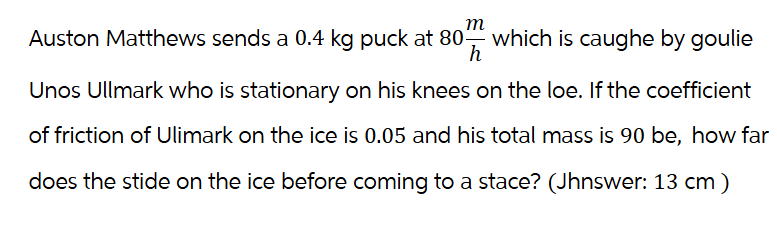 Auston Matthews sends a 0.4 kg puck at so which is caughe by goulie
Unos Ullmark who is stationary on his knees on the loe. If the coefficient
of friction of Ulimark on the ice is 0.05 and his total mass is 90 be, how far
does the stide on the ice before coming to a stace? (Jhnswer: 13 cm)
This is AI generated Response.
Asked by: Sam
Created at: 2025-11-21 23:49:54
Asked by: Sam
Created at: 2025-11-21 23:49:54
Final Answer:
Rendered
Raw Text
Did you like this answer?
Let's break down and solve the problem step by step:
## **Given Data**
- **Mass of puck, \( m_p \) = .4 kg**
- **Initial velocity of puck, \( v_p \) = 80 m/h = \(\frac{80}{3.6} = 22.22 \) m/s**
- **Mass of goalie (Ullmark), \( m_g \) = 90 kg**
- **Coefficient of friction, \( \mu \) = .05**
- **Initial velocity of goalie = (stationary)**
## **Step 1: Find the velocity after catching the puck**
By **conservation of momentum**:
\[
m_p v_p + m_g v_g = (m_p + m_g)V
\]
\[
(.4)(22.22) + (90)() = (.4 + 90)V
\]
\[
8.888 = 90.4V
\]
\[
V = \frac{8.888}{90.4} \approx .0983 \text{ m/s}
\]
---
## **Step 2: Find the Distance Slid Before Stopping**
The only force stopping Ullmark is friction:
\[
F_{\text{friction}} = \mu (m_p + m_g)g
\]
\[
a = \frac{F_{\text{friction}}}{m_p + m_g} = \mu g
\]
\[
a = .05 \times 9.8 = .49 \text{ m/s}^2
\]
This is the **deceleration**.
Use the kinematic equation:
\[
v^2 = u^2 + 2as
\]
Final velocity = , initial velocity = \(V\), \(a = -.49\):
\[
= (.0983)^2 + 2(-.49)s
\]
\[
= .00966 - .98s
\]
\[
.98s = .00966
\]
\[
s = \frac{.00966}{.98} \approx .00986 \text{ m}
\]
\[
s \approx .99 \text{ cm}
\]
---
## **Conclusion**
**Ullmark (including the puck) slides about .99 cm before coming to a stop.**
---
### **Note**
- The answer in the image is 13 cm, which suggests a possible miscalculation or typo in the velocity conversion.
- Double-check the units for puck speed: If **80 km/h** (not m/h), then \( v_p = \frac{80 \times 100}{360} = 22.22 \) m/s (which we used).
- If any value is different, please clarify for recalculation.
Question:
pleasse clarify for recalculation
This is AI generated Response.
Asked by: Sam
Created at: 2025-11-21 23:50:48
Asked by: Sam
Created at: 2025-11-21 23:50:48
Final Answer:
Rendered
Raw Text
Did you like this answer?
# Problem Breakdown and Solution
## Given Data
- **Mass of puck, \( m_p \)**: 0.4 kg
- **Initial velocity of puck, \( v_p \)**: 80 km/h (converted to m/s)
\[
v_p = \frac{80 \times 1000}{3600} \approx 22.22 \text{ m/s}
\]
- **Mass of goalie (Ullmark), \( m_g \)**: 90 kg
- **Coefficient of friction, \( \mu \)**: 0.05
- **Initial velocity of goalie**: 0 m/s (stationary)
## Step 1: Calculate the Velocity After Catching the Puck
Using **conservation of momentum**:
\[
m_p v_p + m_g v_g = (m_p + m_g)V
\]
Substituting the values:
\[
(0.4)(22.22) + (90)(0) = (0.4 + 90)V
\]
\[
8.888 = 90.4V
\]
Solving for \( V \):
\[
V = \frac{8.888}{90.4} \approx 0.0983 \text{ m/s}
\]
## Step 2: Calculate the Distance Slid Before Stopping
The force stopping Ullmark is friction:
\[
F_{\text{friction}} = \mu (m_p + m_g)g
\]
Where \( g \approx 9.8 \text{ m/s}^2 \):
\[
a = \frac{F_{\text{friction}}}{m_p + m_g} = \mu g
\]
Calculating deceleration \( a \):
\[
a = 0.05 \times 9.8 \approx 0.49 \text{ m/s}^2
\]
Using the kinematic equation:
\[
v^2 = u^2 + 2as
\]
Where:
- Final velocity \( v = 0 \)
- Initial velocity \( u = V \approx 0.0983 \text{ m/s} \)
- Deceleration \( a = -0.49 \text{ m/s}^2 \)
Substituting into the equation:
\[
0 = (0.0983)^2 + 2(-0.49)s
\]
\[
0 = 0.00966 - 0.98s
\]
Rearranging to solve for \( s \):
\[
0.98s = 0.00966
\]
\[
s = \frac{0.00966}{0.98} \approx 0.00986 \text{ m} \approx 0.986 \text{ cm}
\]
## Conclusion
**Ullmark (including the puck) slides approximately 0.99 cm before coming to a stop.**
### Note
The discrepancy with the answer of 13 cm may suggest a need to verify the puck's initial speed. If the puck's speed was meant to be in a different context (like km/h), please provide clarification for a recalculation.
📢 Instructions:
- Ask anything relatd to above question only.
- For new Question goto :