 VIPSolutions
give answer in 2 step with explanation at the end of each step and final answer at the end: question steps for4.13. Rotating nonuniformly charged hollow cylin- der. An infinitely long hollow cylinder of inner radius a and outer radius b (a < b) in air is charged with a volume charge density p(r) = pra (a
Question:
give answer in 2 step with explanation at the end of each step and final answer at the end: question steps for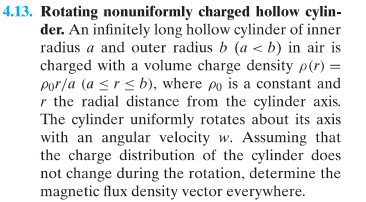 4.13. Rotating nonuniformly charged hollow cylin-
der. An infinitely long hollow cylinder of inner
radius a and outer radius b (a < b) in air is
charged with a volume charge density p(r) =
pra (a
This is AI generated Response.
Asked by: Rahul
Created at: 2025-11-09 02:52:14
Asked by: Rahul
Created at: 2025-11-09 02:52:14
Final Answer:
Rendered
Raw Text
Did you like this answer?
## Step 1: **Find the Current Density**
When the cylinder rotates with angular velocity \( \omega \), the charge density \( \rho(r = \rho r / a \) at a radius \( r \) moves with tangential velocity \( v = \omega r \). This moving charge constitutes a **current density** \( \vec{J} \):
\[
\vec{J}(r) = \rho(r) \vec{v} = \rho_ \frac{r}{a} (\omega r) \hat{\phi} = \rho_ \frac{\omega}{a} r^2 \hat{\phi}
\]
where \( \hat{\phi} \) is the azimuthal unit vector.
**Explanation:**
The current density at any point inside the shell is the product of the local charge density and the local velocity of rotation. The direction is tangential (azimuthal).
---
## Step 2: **Find the Magnetic Field Using Ampère’s Law**
Apply **Ampère’s Law** in integral form for the magnetic field inside and outside the shell:
\[
\oint \vec{B} \cdot d\vec{l} = \mu_ I_{\text{enc}}
\]
Consider a circle of radius \( r \) coaxial with the cylinder.
### **Case 1: \( r < a \) (Inside the hollow)**
There is no charge enclosed:
\[
I_{\text{enc}} = \implies \vec{B} =
\]
### **Case 2: \( a \leq r \leq b \) (Within the shell)**
Enclosed current:
\[
I_{\text{enc}} = \int_a^r J_{\phi}(r') 2\pi r' dr'
= \int_a^r \rho_ \frac{\omega}{a} (r')^2 2\pi r' dr'
= 2\pi \rho_ \frac{\omega}{a} \int_a^r (r')^3 dr'
\]
\[
= 2\pi \rho_ \frac{\omega}{a} \left[ \frac{(r')^4}{4} \right]_a^r
= 2\pi \rho_ \frac{\omega}{a} \frac{1}{4} (r^4 - a^4)
\]
By symmetry, \( \vec{B} \) is azimuthal (\( \hat{z} \)) and depends only on \( r \):
\[
B(r) (2\pi r) = \mu_ I_{\text{enc}}
\]
\[
B(r) = \frac{\mu_}{2\pi r} \cdot 2\pi \rho_ \frac{\omega}{a} \frac{1}{4} (r^4 - a^4)
= \frac{\mu_ \rho_ \omega}{4a} \frac{r^4 - a^4}{r}
\]
Direction is along the axis (\( \hat{z} \)).
### **Case 3: \( r > b \) (Outside the shell)**
Enclose the total current in the shell:
\[
I_{\text{enc}} = 2\pi \rho_ \frac{\omega}{a} \int_a^b (r')^3 dr'
= 2\pi \rho_ \frac{\omega}{a} \frac{1}{4} (b^4 - a^4)
\]
\[
B(r) (2\pi r) = \mu_ I_{\text{enc}}
\]
\[
B(r) = \frac{\mu_ \rho_ \omega}{4a} \frac{b^4 - a^4}{r}
\]
---
## **Final Answer**
\[
\boxed{
\vec{B}(r) =
\begin{cases}
, & r < a \\
\frac{\mu_ \rho_ \omega}{4a} \frac{r^4 - a^4}{r} \hat{z}, & a \leq r \leq b \\
\frac{\mu_ \rho_ \omega}{4a} \frac{b^4 - a^4}{r} \hat{z}, & r > b
\end{cases}
}
\]
**Summary:**
- **Step 1:** Find current density using charge density and rotational velocity.
- **Step 2:** Use Ampère’s Law to integrate the current and find the magnetic field in each region.
Question:
Please solved correct answer
This is AI generated Response.
Asked by: Rahul
Created at: 2025-11-09 02:53:08
Asked by: Rahul
Created at: 2025-11-09 02:53:08
Final Answer:
Rendered
Raw Text
Did you like this answer?
# Solution for the Rotating Nonuniformly Charged Hollow Cylinder
## Step 1: **Find the Current Density**
Given the volume charge density of the cylinder as
\[
\rho(r) = \rho_0 \frac{r}{a} \quad \text{for } a < r < b
\]
where \( \rho_0 \) is a constant. The tangential velocity \( v \) of a charge at a radius \( r \) is given by:
\[
v = \omega r
\]
The current density \( \vec{J} \) can be expressed as:
\[
\vec{J}(r) = \rho(r) \vec{v} = \rho_0 \frac{r}{a} (\omega r) \hat{\phi} = \rho_0 \frac{\omega}{a} r^2 \hat{\phi}
\]
**Explanation:**
The current density represents the flow of charge due to the rotation of the cylinder. It combines the charge density with the velocity of the moving charges and points in the azimuthal direction.
---
## Step 2: **Find the Magnetic Field Using Ampère’s Law**
We will apply **Ampère’s Law**:
\[
\oint \vec{B} \cdot d\vec{l} = \mu_0 I_{\text{enc}}
\]
### **Case 1: \( r < a \) (Inside the hollow)**
No charge is enclosed, hence:
\[
I_{\text{enc}} = 0 \implies \vec{B} = 0
\]
### **Case 2: \( a \leq r \leq b \) (Within the shell)**
The current enclosed is given by:
\[
I_{\text{enc}} = \int_a^r J_{\phi}(r') 2\pi r' dr'
\]
Substituting \( J_{\phi}(r') \):
\[
= \int_a^r \left(\rho_0 \frac{\omega}{a} (r')^2\right) 2\pi r' dr' = 2\pi \rho_0 \frac{\omega}{a} \int_a^r (r')^3 dr'
\]
Calculating the integral:
\[
= 2\pi \rho_0 \frac{\omega}{a} \left[ \frac{(r')^4}{4} \right]_a^r = 2\pi \rho_0 \frac{\omega}{a} \cdot \frac{1}{4} (r^4 - a^4)
\]
By symmetry, the magnetic field \( \vec{B} \) is azimuthal (\( \hat{z} \)):
\[
B(r) (2\pi r) = \mu_0 I_{\text{enc}} \implies B(r) = \frac{\mu_0}{2\pi r} \cdot 2\pi \rho_0 \frac{\omega}{a} \cdot \frac{1}{4} (r^4 - a^4)
\]
Thus:
\[
B(r) = \frac{\mu_0 \rho_0 \omega}{4a} \frac{r^4 - a^4}{r}
\]
### **Case 3: \( r > b \) (Outside the shell)**
The total current enclosed is:
\[
I_{\text{enc}} = 2\pi \rho_0 \frac{\omega}{a} \int_a^b (r')^3 dr'
\]
Calculating the integral:
\[
= 2\pi \rho_0 \frac{\omega}{a} \cdot \frac{1}{4} (b^4 - a^4)
\]
Using Ampère’s Law again:
\[
B(r) (2\pi r) = \mu_0 I_{\text{enc}} \implies B(r) = \frac{\mu_0}{2\pi r} \cdot 2\pi \rho_0 \frac{\omega}{a} \cdot \frac{1}{4} (b^4 - a^4)
\]
So,
\[
B(r) = \frac{\mu_0 \rho_0 \omega}{4a} \frac{b^4 - a^4}{r}
\]
---
## **Final Answer**
The magnetic flux density vector \( \vec{B} \) is given by:
\[
\boxed{
\vec{B}(r) =
\begin{cases}
0, & r < a \\
\frac{\mu_0 \rho_0 \omega}{4a} \frac{r^4 - a^4}{r} \hat{z}, & a \leq r \leq b \\
\frac{\mu_0 \rho_0 \omega}{4a} \frac{b^4 - a^4}{r} \hat{z}, & r > b
\end{cases}
}
\]
**Summary:**
- **Step 1:** We derived the current density based on the charge distribution and rotational velocity.
- **Step 2:** We applied Ampère’s Law to find the magnetic field in three distinct regions around the cylinder.
📢 Instructions:
- Ask anything relatd to above question only.
- For new Question goto :