This is AI generated Response.
Asked by: Rahul
Created at: 2025-12-05 07:45:42
Final Answer:
RenderedRaw Text
Did you like this answer?
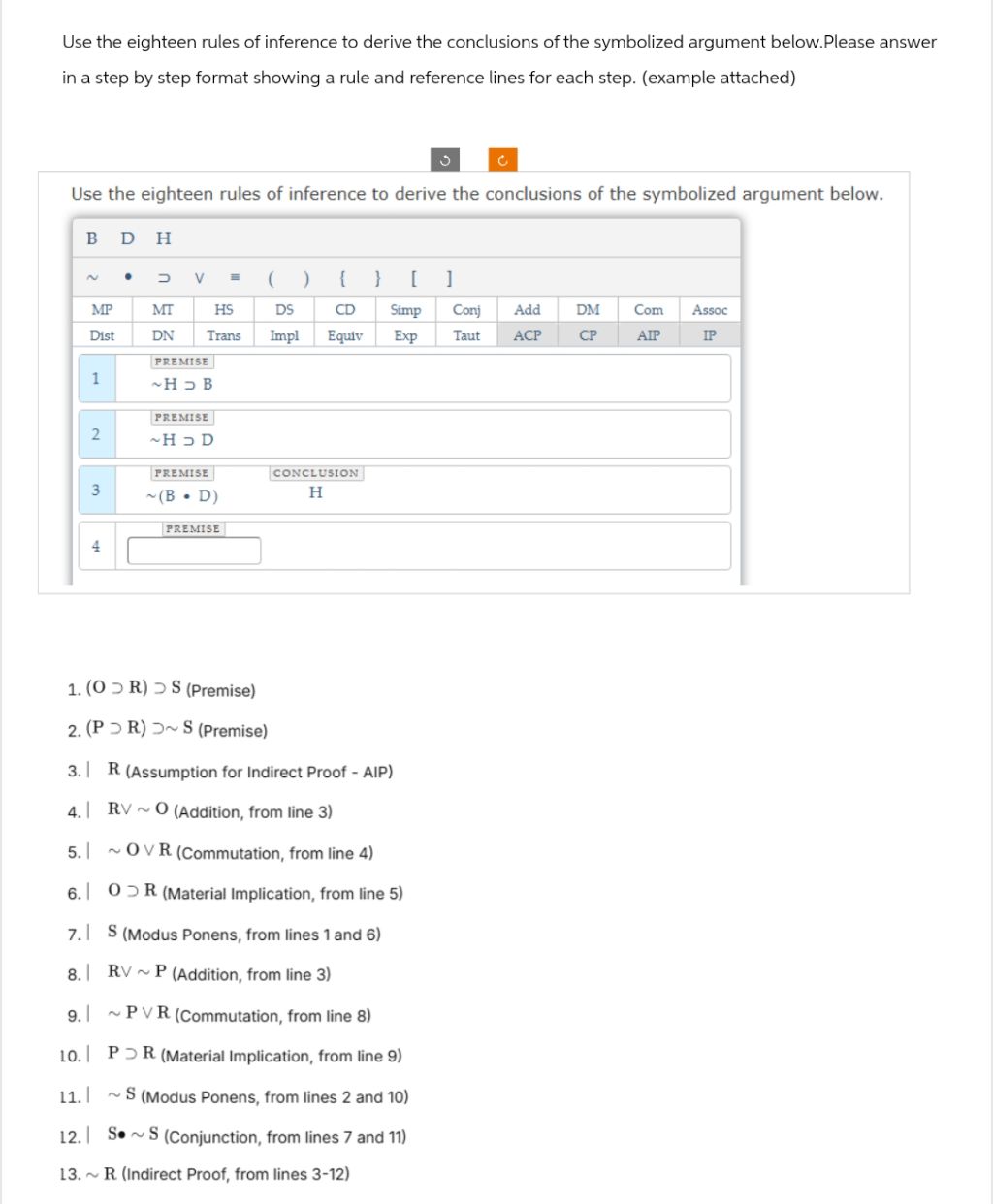
Let's proceed step by step, as you requested, for the given argument:
**Premises:**
1. ~H ⊃ B
2. ~H ⊃ D
3. ~(B • D)
**Conclusion:**
H
---
### **Step 1: Assume ~H (Indirect Proof / Reductio ad Absurdum)**
- **Assumption for Indirect Proof (AIP):**
Assume ~H.
**Explanation:**
We use indirect proof by assuming the negation of what we want to prove (i.e., assume ~H). If this leads to a contradiction, then H must be true.
---
### **Step 2: Derive B and D Using Modus Ponens, Then a Contradiction**
- **From premise 1 (~H ⊃ B) and our assumption (~H):**
By Modus Ponens, we get B.
- **From premise 2 (~H ⊃ D) and our assumption (~H):**
By Modus Ponens, we get D.
- **Now, combine B and D:**
By Conjunction, B • D.
- **But premise 3 says ~(B • D):**
We have a contradiction.
**Explanation:**
Assuming ~H leads us to both B and D, which gives us (B • D). But premise 3 says ~(B • D) is true, so our assumption (~H) must be false.
---
### **Final Answer**
#### **Therefore, H is true.**
**Summary:**
- **Step 1:** Assume ~H (AIP).
- **Step 2:** Derive B and D using premises 1 and 2, leading to a contradiction with premise 3.
- **Conclusion:** H (by Indirect Proof).
---
**Reference Lines:**
1. ~H ⊃ B (Premise)
2. ~H ⊃ D (Premise)
3. ~(B • D) (Premise)
4. ~H (Assumption for Indirect Proof)
5. B (Modus Ponens, 1, 4)
6. D (Modus Ponens, 2, 4)
7. B • D (Conjunction, 5, 6)
8. ~(B • D) (Premise, 3)
9. Contradiction (7, 8)
10. H (Indirect Proof, 4–9)
---
**Conclusion:**
**H** is the valid conclusion.
Question:
Please solved correct answer
This is AI generated Response.
Asked by: Rahul
Created at: 2025-12-05 07:46:24
Final Answer:
RenderedRaw Text
Did you like this answer?
# Deriving the Conclusion Using Rules of Inference
## **Premises**
1. \( \sim H \supset B \)
2. \( \sim H \supset D \)
3. \( \sim (B \cdot D) \)
## **Conclusion**
H
---
### **Step 1: Assume \( \sim H \) (Indirect Proof / Reductio ad Absurdum)**
- **Line 4:** Assume \( \sim H \).
**Explanation:**
We begin by assuming the negation of what we wish to prove (i.e., \( \sim H \)). If this assumption leads to a contradiction, we can conclude that H must be true.
---
### **Step 2: Derive B and D, Leading to a Contradiction**
- **Line 5:** From premise 1 and assumption \( \sim H \):
By **Modus Ponens**, we conclude \( B \) (from lines 1 and 4).
- **Line 6:** From premise 2 and assumption \( \sim H \):
By **Modus Ponens**, we conclude \( D \) (from lines 2 and 4).
- **Line 7:** Combine B and D:
\( B \cdot D \) (by **Conjunction**, from lines 5 and 6).
- **Line 8:** Reference premise 3:
\( \sim (B \cdot D) \) (premise).
- **Line 9:** Contradiction:
We have \( B \cdot D \) and \( \sim (B \cdot D) \). This is a contradiction.
**Explanation:**
The assumption \( \sim H \) allows us to derive both \( B \) and \( D \), leading to \( B \cdot D \). However, since premise 3 states \( \sim (B \cdot D) \), this creates a contradiction, indicating that our initial assumption must be false.
---
### **Final Answer**
#### **Therefore, H is true.**
**Summary of Steps:**
- **Step 1:** Assume \( \sim H \) (AIP).
- **Step 2:** Derive \( B \) and \( D \) using premises 1 and 2, leading to a contradiction with premise 3.
---
### **Reference Lines**
1. \( \sim H \supset B \) (Premise)
2. \( \sim H \supset D \) (Premise)
3. \( \sim (B \cdot D) \) (Premise)
4. \( \sim H \) (Assumption for Indirect Proof)
5. \( B \) (Modus Ponens, 1, 4)
6. \( D \) (Modus Ponens, 2, 4)
7. \( B \cdot D \) (Conjunction, 5, 6)
8. \( \sim (B \cdot D) \) (Premise, 3)
9. Contradiction (7, 8)
10. H (Indirect Proof, 4–9)
---
**Conclusion:**
**H** is the valid conclusion.
VIPSolutions focuses on clear, step‑by‑step explanations so you can learn quickly. Whether you need an AI‑generated walkthrough or a short hint to get unstuck, each solution is organized for fast reading and easy review later.
Search similar questions, compare approaches, and bookmark the best answers for revision. Our goal is simple: quick, reliable study help that feels natural—not noisy.
 VIPSolutions
 Use the eighteen rules of inference to derive the conclusions of the symbolized argument below.Please answer
in a step by step format showing a rule and reference lines for each step. (example attached)
Use the eighteen rules of inference to derive the conclusions of the symbolized argument below.
B D H
eR EE (EET
MP | MT | HS DS | CD | Simp | Conj | Add | DM | Com | Assoc
| Dist | DN | Trans | Impl | Equv | Exp | Taut | ACP | CP | AP | PP
TO mess
1 ~H>3B
| (pmesase
2 ~H>D
© (remase CONCLUSION
3 ~(B » D) H
FRENISE
4
1.(0 2 R) OS (premise)
2.(P DR) O~ 8 (Premise)
3.] R (Assumption for Indirect Proof - AIP)
4.| RV ~ O (addition, from line 3)
5.1 ~OVR (Commutation, from line 4)
6./ OD R (Material Implication, from line 5)
7.1 S (Modus Ponens, from lines 1and 6)
8. RV ~P (addition, from line 3)
9./ ~PVR (Commutation, from line 8)
10. POR (Material Implication, from line 9)
11. ~ 8 (Modus Ponens, from lines 2 and 10)
12.| Se ~S (Conjunction, from lines 7 and 11)
13. ~ R (Indirect Proof, from lines 3-12)