 VIPSolutions
give answer in 2 step with explanation at the end of each step and final answer at the end:Fo the gen cio blow, ho tht pe of cin i Seen ete year apo
Question:
give answer in 2 step with explanation at the end of each step and final answer at the end: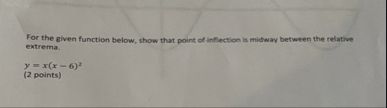 Fo the gen cio blow, ho tht pe of cin i Seen ete
year
apo
This is AI generated Response.
Asked by: Rahul
Created at: 2025-11-30 23:00:48
Asked by: Rahul
Created at: 2025-11-30 23:00:48
Final Answer:
Rendered
Raw Text
Did you like this answer?
# Step 1: Find the Relative Extrema
Given function:
\[ y = x(x-6)^2 \]
First, find the critical points (where \( y' = \)):
1. Compute the first derivative:
\[
y = x(x-6)^2
\]
Use the product rule:
\[
y' = (x)'\cdot(x-6)^2 + x\cdot[2(x-6)]
\]
\[
= (x-6)^2 + 2x(x-6)
\]
\[
= (x-6)^2 + 2x(x-6)
\]
\[
= (x-6)[(x6) + 2x]
\]
\[
= (x-6)(x-6+2x)
\]
\[
= (x-6)(3x-6)
\]
\[
= 3x^2 - 6x - 18x + 36
\]
\[
= 3x^2 - 24x + 36
\]
Or just keep as \( (x-6)(3x-6) \).
2. Set \( y' = \):
\[
(x-6)(3x-6) =
\]
So,
\[
x-6 = \implies x = 6
\]
\[
3x-6 = \implies x = 2
\]
**Explanation:** The relative extrema occur at \( x = 2 \) and \( x = 6 \).
---
# Step 2: Find the Point of Inflection
1. Compute the second derivative:
Recall:
\[
y' = (x-6)(3x-6)
\]
Use the product rule again:
\[
y'' = (x-6)'(3x-6) + (x-6)(3x-6)'
\]
\[
= (1)(3x-6) + (x-6)(3)
\]
\[
= 3x - 6 + 3(x-6)
\]
\[
= 3x - 6 + 3x - 18
\]
\[
= 6x - 24
\]
2. Set \( y'' = \):
\[
6x - 24 =
\]
\[
x = 4
\]
**Explanation:** The point of inflection is at \( x = 4 \).
---
# Final Answer
The point of inflection (\( x = 4 \)) is exactly midway between the relative extrema (\( x = 2 \) and \( x = 6 \)), since \( 4 \) is the average of \( 2 \) and \( 6 \):
\[
\frac{2+6}{2} = 4
\]
Question:
Please solved correct answer
This is AI generated Response.
Asked by: Rahul
Created at: 2025-11-30 23:02:37
Asked by: Rahul
Created at: 2025-11-30 23:02:37
Final Answer:
Rendered
Raw Text
Did you like this answer?
# Step 1: Find the Relative Extrema
Given function:
\[ y = x(x-6)^2 \]
First, find the critical points by calculating the derivative and setting it to zero:
1. **Compute the first derivative** using the product rule:
\[
y' = (x)'\cdot(x-6)^2 + x\cdot[2(x-6)(x)']
\]
\[
= (x-6)^2 + 2x(x-6)
\]
\[
= (x-6)[(x-6) + 2x]
\]
\[
= (x-6)(3x-6)
\]
2. **Set \( y' = 0 \)**:
\[
(x-6)(3x-6) = 0
\]
This gives us two equations:
\[
x-6 = 0 \implies x = 6
\]
\[
3x-6 = 0 \implies x = 2
\]
**Explanation:** The relative extrema occur at \( x = 2 \) and \( x = 6 \).
---
# Step 2: Find the Point of Inflection
1. **Compute the second derivative**:
Recall:
\[
y' = (x-6)(3x-6)
\]
Using the product rule again:
\[
y'' = (x-6)'(3x-6) + (x-6)(3x-6)'
\]
\[
= (1)(3x-6) + (x-6)(3)
\]
\[
= 3x - 6 + 3(x-6)
\]
\[
= 3x - 6 + 3x - 18
\]
\[
= 6x - 24
\]
2. **Set \( y'' = 0 \)**:
\[
6x - 24 = 0
\]
\[
x = 4
\]
**Explanation:** The point of inflection is at \( x = 4 \).
---
# Final Answer
The relative extrema occur at \( x = 2 \) and \( x = 6 \). The point of inflection is at \( x = 4 \). This point is exactly midway between the relative extrema.
📢 Instructions:
- Ask anything relatd to above question only.
- For new Question goto :