 VIPSolutions
give answer in 2 step with explanation at the end of each step and final answer at the end:1 Give the structure of the major product(s) in exch of the following reactions. Give stereochemistry where appropriate. (16 points) MCPBA (1 cq) @ NP coon MRE), 1. HOG), (1 eq), FIOH ® Ns ne 2. NaBH, NaOH 1. BH, (0.33 eq), THF © 7 ZW Lc 2 1,0, NaOH HC excess) «@ N= —_ Bry : © — = PH COOMe no 1-BuOK JEL ® Pad CHCl; F CHatyZa(Cu) [0] —_— Gicthyl ether (1) 0505, pyridine, 25°C (hy mp. (2) NaHSO;
Question:
give answer in 2 step with explanation at the end of each step and final answer at the end: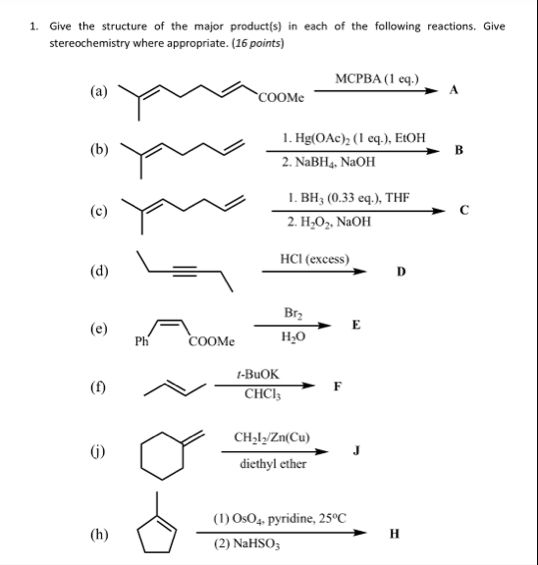 1 Give the structure of the major product(s) in exch of the following reactions. Give
stereochemistry where appropriate. (16 points)
MCPBA (1 cq)
@ NP coon MRE),
1. HOG), (1 eq), FIOH
® Ns ne
2. NaBH, NaOH
1. BH, (0.33 eq), THF
© 7 ZW Lc
2 1,0, NaOH
HC excess)
«@ N= —_
Bry :
© — =
PH COOMe no
1-BuOK
JEL
® Pad CHCl; F
CHatyZa(Cu)
[0] —_—
Gicthyl ether
(1) 0505, pyridine, 25°C
(hy mp.
(2) NaHSO;
This is AI generated Response.
Asked by: Roshan
Created at: 2025-11-07 18:24:27
Asked by: Roshan
Created at: 2025-11-07 18:24:27
Final Answer:
Rendered
Raw Text
Did you like this answer?
Let's solve each reaction in **two steps** with explanations, and provide the **final answer** for the major product(s):
---
## (a) MCPBA (1 eq.) Epoxidation
### Step 1:
**Reaction:** MCPBA (meta-chloroperoxybenzoic acid) is a peroxyacid used for epoxidation of alkenes.
**Explanation:** The double bond reacts with MCPBA to form an **epoxide** (oxirane ring). The most reactive double bond is the one closest to the electron-withdrawing COOMe group.
### Step 2:
**Product:** The double bond adjacent to the COOMe group becomes an epoxide.
**Explanation:** MCPBA does not affect the other double bonds.
**Final structure A:**
- Only the double bond next to COOMe forms an epoxide.
---
## (b) Oxymercuration-Demercuration
### Step 1:
**Reaction:** Oxymercuration (Hg(OAc)2, EtOH) adds an ethanol group across the double bond, following Markovnikov's rule.
**Explanation:** The most substituted alkene reacts first.
### Step 2:
**Product:** The ethanol (EtO-) group adds to the more substituted carbon, H adds to the less substituted.
**Explanation:** No carbocation rearrangement.
**Final structure B:**
- Markovnikov addition of EtOH across the most substituted double bond.
---
## (c) Hydroboration-Oxidation
### Step 1:
**Reaction:** BH3/THF adds boron to the least substituted carbon of the double bond (anti-Markovnikov).
**Explanation:** The most accessible alkene reacts.
### Step 2:
**Product:** H2O2/NaOH replaces B with OH at the least substituted carbon (anti-Markovnikov alcohol).
**Explanation:** Syn addition, retains stereochemistry (if chiral).
**Final structure C:**
- Anti-Markovnikov addition of OH at the terminal alkene.
---
## (d) Alkyne + HCl (excess)
### Step 1:
**Reaction:** HCl adds across the triple bond via Markovnikov addition.
**Explanation:** First equivalent adds H and Cl.
### Step 2:
**Product:** Second equivalent adds again, both Cl on same carbon (geminal dihalide).
**Explanation:** Both Cl on more substituted carbon.
**Final structure D:**
- Terminal alkene becomes a geminal dichloride (CCl2).
---
## (e) Bromohydrin Formation
### Step 1:
**Reaction:** Br2/H2O adds Br and OH across the double bond (anti addition).
**Explanation:** Br adds to less substituted, OH to more substituted carbon.
### Step 2:
**Product:** Anti addition, so products are enantiomers if chiral.
**Explanation:** Stereochemistry is anti.
**Final structure E:**
- Br and OH add anti across double bond.
---
## (f) Cyclopropanation (Simmons-Smith)
### Step 1:
**Reaction:** t-BuOK/CHCl3 forms dichlorocarbene (:CCl2).
**Explanation:** Dichlorocarbene adds to the double bond.
### Step 2:
**Product:** Cyclopropane ring with two Cl substituents.
**Explanation:** Syn addition.
**Final structure F:**
- Cyclopropane ring with two Cl atoms.
---
## (j) Simmons-Smith Reaction
### Step 1:
**Reaction:** CH2I2/Zn(Cu) forms methylene carbene (:CH2).
**Explanation:** Carbene inserts across the double bond.
### Step 2:
**Product:** Cyclopropane ring fused to the cyclohexane.
**Explanation:** Syn addition.
**Final structure J:**
- Cyclopropane fused to cyclohexane ring.
---
## (h) Syn Dihydroxylation
### Step 1:
**Reaction:** OsO4 adds two OH groups across the double bond (syn).
**Explanation:** Both OH add on the same side.
### Step 2:
**Product:** NaHSO3 reduces the osmate ester, yielding syn diol.
**Explanation:** Stereochemistry is syn.
**Final structure H:**
- Syn diol across the double bond.
---
**If you need the actual drawn structures, let me know!**
Question:
Please solved all parts step by step
This is AI generated Response.
Asked by: Roshan
Created at: 2025-11-07 18:25:11
Asked by: Roshan
Created at: 2025-11-07 18:25:11
Final Answer:
Rendered
Raw Text
Did you like this answer?
# Reaction Mechanism and Products
Let's analyze the reaction mechanisms step by step for each of the specified compounds. Each part will have a detailed explanation followed by the final product structure.
---
## (a) Epoxidation with MCPBA
### Step 1: Epoxidation Reaction
**Reaction:** MCPBA reacts with an alkene to form an epoxide.
**Explanation:** MCPBA selectively reacts with the double bond to form a three-membered cyclic ether, known as an epoxide. The most electron-rich double bond will react first, particularly near the electron-withdrawing COOMe group.
### Step 2: Product Formation
**Product:** The alkene adjacent to the COOMe group becomes an epoxide.
**Explanation:** The epoxide is formed without affecting the other double bonds in the molecule.
**Final Structure A:**
- The major product is an epoxide formed from the double bond adjacent to the COOMe.
---
## (b) Oxymercuration-Demercuration
### Step 1: Oxymercuration
**Reaction:** The alkene reacts with mercuric acetate in ethanol to add an -OH and -OEt group.
**Explanation:** This reaction follows Markovnikov's rule, where the more substituted carbon gets the -OEt group.
### Step 2: Demercuration
**Product:** The mercury is removed, leaving the -OH at the more substituted carbon.
**Explanation:** The end product is an alcohol with the -OH group at the more substituted position.
**Final Structure B:**
- The product is an alcohol with an -OEt at the more substituted position.
---
## (c) Hydroboration-Oxidation
### Step 1: Hydroboration
**Reaction:** BH3/THF adds to the double bond, yielding a trialkylborane intermediate.
**Explanation:** This step adds boron to the least substituted carbon of the alkene (anti-Markovnikov addition).
### Step 2: Oxidation
**Product:** H2O2/NaOH replaces boron with an -OH group.
**Explanation:** The result is an alcohol at the least substituted position, preserving stereochemistry.
**Final Structure C:**
- The major product is an alcohol at the terminal carbon (anti-Markovnikov).
---
## (d) Addition of HCl to Alkyne
### Step 1: First Addition
**Reaction:** HCl adds across the triple bond of the alkyne.
**Explanation:** This is a Markovnikov addition where H adds to the less substituted carbon.
### Step 2: Second Addition
**Product:** A geminal dihalide is formed after a second equivalent of HCl is added.
**Explanation:** Both Cl atoms end up on the same carbon.
**Final Structure D:**
- The product is a geminal dichloride.
---
## (e) Bromohydrin Formation
### Step 1: Bromination
**Reaction:** Br2 reacts with the alkene in the presence of water.
**Explanation:** Bromine adds to the less substituted carbon, and OH adds to the more substituted carbon (anti addition).
### Step 2: Product Formation
**Product:** A bromohydrin is formed with Br and OH on opposite sides.
**Explanation:** The reaction yields an anti addition product.
**Final Structure E:**
- The major product is a bromohydrin with anti stereochemistry.
---
## (f) Cyclopropanation
### Step 1: Forming Dichlorocarbene
**Reaction:** t-BuOK in CHCl3 generates dichlorocarbene (:CCl2).
**Explanation:** This carbene will insert into the double bond.
### Step 2: Cyclopropane Formation
**Product:** A cyclopropane ring forms with two Cl substituents.
**Explanation:** This results in a three-membered ring structure.
**Final Structure F:**
- The product is a cyclopropane containing two Cl atoms.
---
## (g) Simmons-Smith Reaction
### Step 1: Carbene Generation
**Reaction:** CH2I2 and Zn(Cu) produce methylene carbene (:CH2).
**Explanation:** The carbene adds across the double bond.
### Step 2: Cyclopropane Formation
**Product:** A cyclopropane ring is formed.
**Explanation:** The reaction involves syn addition.
**Final Structure G:**
- The product is a cyclopropane ring fused to another structure.
---
## (h) Syn Dihydroxylation
### Step 1: Dihydroxylation
**Reaction:** OsO4 adds two hydroxyl groups across the double bond (syn addition).
**Explanation:** Both -OH groups add to the same side of the double bond.
### Step 2: Product Formation
**Product:** The osmate ester is reduced with NaHSO3 to yield a diol.
**Explanation:** This maintains the syn stereochemistry.
**Final Structure H:**
- The major product is a syn diol across the double bond.
---
## Summary of Final Products
- **A:** Epoxide adjacent to COOMe
- **B:** Alcohol at the more substituted carbon
- **C:** Alcohol at the terminal carbon
- **D:** Geminal dichloride
- **E:** Bromohydrin with anti addition
- **F:** Cyclopropane with two Cl atoms
- **G:** Cyclopropane ring
- **H:** Syn diol across the double bond
If you need visual representations of these structures, please let me know!
📢 Instructions:
- Ask anything relatd to above question only.
- For new Question goto :