give answer in 2 step with explanation at the end of each step and final answer at the end:EEE
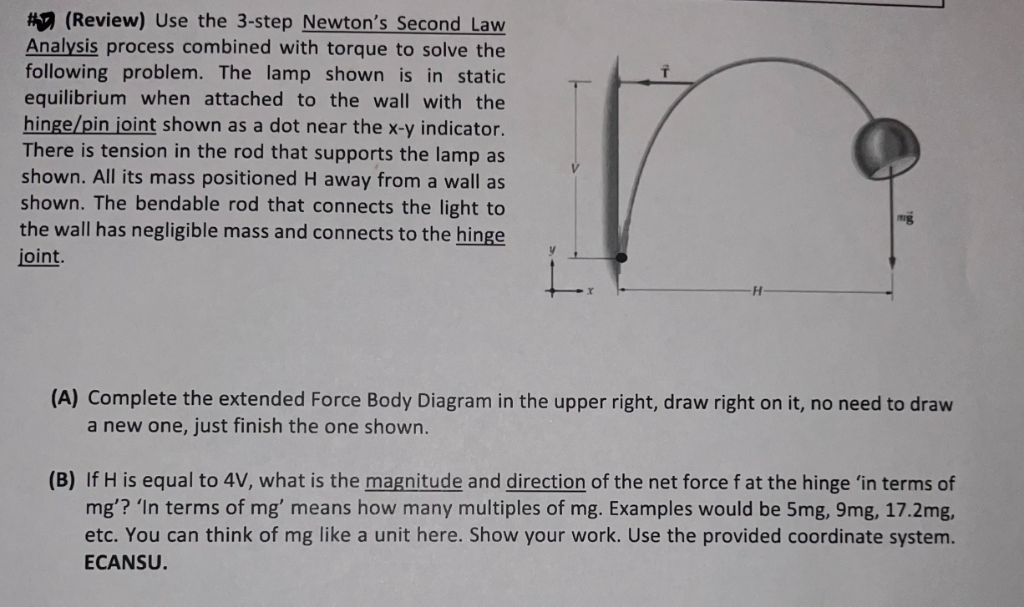
#9 (Review) Use the 3-step Newton’s Second Law
Analysis process combined with torque to solve the
following problem. The lamp shown is in static i Ls
equilibrium when attached to the wall with the
hinge/pin joint shown as a dot near the x-y indicator.
There is tension in the rod that supports the lamp as v
shown. All its mass positioned H away from a wall as
shown. The bendable rod that connects the light to ;
the wall has negligible mass and connects to the hinge :
Ioint. a
lid, Ra
(A) Complete the extended Force Body Diagram in the upper right, draw right on it, no need to draw
a new one, just finish the one shown.
(B) If His equal to 4V, what is the magnitude and direction of the net force f at the hinge ‘in terms of
mg’? ‘In terms of mg’ means how many multiples of mg. Examples would be 5mg, 9mg, 17.2mg,
etc. You can think of mg like a unit here. Show your work. Use the provided coordinate system.
ECANSU.
Question:
give answer in 2 step with explanation at the end of each step and final answer at the end:EEE
#9 (Review) Use the 3-step Newton’s Second Law
Analysis process combined with torque to solve the
following problem. The lamp shown is in static i Ls
equilibrium when attached to the wall with the
hinge/pin joint shown as a dot near the x-y indicator.
There is tension in the rod that supports the lamp as v
shown. All its mass positioned H away from a wall as
shown. The bendable rod that connects the light to ;
the wall has negligible mass and connects to the hinge :
Ioint. a
lid, Ra
(A) Complete the extended Force Body Diagram in the upper right, draw right on it, no need to draw
a new one, just finish the one shown.
(B) If His equal to 4V, what is the magnitude and direction of the net force f at the hinge ‘in terms of
mg’? ‘In terms of mg’ means how many multiples of mg. Examples would be 5mg, 9mg, 17.2mg,
etc. You can think of mg like a unit here. Show your work. Use the provided coordinate system.
ECANSU.
This is AI generated Response.
Asked by: Firdos
Created at: 2025-11-10 03:39:31
Final Answer:
RenderedRaw Text
Did you like this answer?
Let's solve part (B) as requested, in **2 steps** with explanation after each step and the **final answer at the end**.
---
## (B) If H = 4V, what is the magnitude and direction of the net force at the hinge (in terms of mg)?
### **Step 1: Force and Torque Equilibrium**
**Explanation:**
- The lamp is in **static equilibrium**:
- The sum of forces in both the x and y directions equals zero.
- The sum of torques about any point (choose the hinge) equals zero.
**Forces acting:**
- Tension, **T**, in the rod (direction as shown).
- Weight, **mg**, acting downward at the lamp.
- Hinge forces (**V** vertically, **H** horizontally).
**Take torques about the hinge:**
- The torque due to **mg** is \( mg \cdot H \) (since it is perpendicular to the rod, distance is \( H \)).
- The torque due to **T** is \( T \cdot V \) (since the tension acts perpendicular to the rod at distance \( V \) from the hinge).
Set the net torque to zero (counterclockwise positive):
\[
T \cdot V = mg \cdot H
\]
Given \( H = 4V \):
\[
T \cdot V = mg \cdot 4V
\implies T = 4mg
\]
---
### **Step 2: Find Net Force at the Hinge**
**Explanation:**
- At the hinge, the rod exerts force components \( V \) (vertical) and \( H \) (horizontal).
- The vertical force at the hinge must balance the vertical forces:
- Upward: \( V \) (from hinge), \( T \) (from tension)
- Downward: \( mg \)
- The horizontal force at the hinge must balance the horizontal forces:
- Only \( T \) acts horizontally to the right, so hinge must pull to the left with force \( H \).
**Vertical equilibrium:**
\[
V + T_y = mg
\]
But since \( T \) is horizontal (from diagram), \( T_y = \):
\[
V = mg
\]
**Horizontal equilibrium:**
\[
H = T = 4mg
\]
**Net force at the hinge:**
\[
f = \sqrt{H^2 + V^2} = \sqrt{(4mg)^2 + (mg)^2} = \sqrt{16m^2g^2 + m^2g^2} = \sqrt{17}mg
\]
**Direction:**
\[
\theta = \arctan\left(\frac{V}{H}\right) = \arctan\left(\frac{mg}{4mg}\right) = \arctan\left(\frac{1}{4}\right) \approx 14^\circ \text{ above the horizontal (to the left)}
\]
---
## **Final Answer**
- **Magnitude**: \( \boxed{\sqrt{17}\,mg} \)
- **Direction**: \( \boxed{14^\circ} \) above the horizontal, pointing to the left.
Question:
Please solved all parts
This is AI generated Response.
Asked by: Firdos
Created at: 2025-11-10 03:40:21
Final Answer:
RenderedRaw Text
Did you like this answer?
Let's solve all parts of the problem step by step.
---
# Problem Breakdown
## (A) Complete the Extended Force Body Diagram
### **Step 1: Identify Forces**
**Forces Acting on the Lamp:**
- **Weight (mg)**: Acts downward at the center of mass of the lamp.
- **Tension (T)**: Acts along the rod towards the hinge.
- **Hinge Reaction Forces (H, V)**:
- **H**: Horizontal component (to the left).
- **V**: Vertical component (upward).
### **Step 2: Draw Forces on the Diagram**
1. **Weight (mg)**: Draw an arrow pointing downwards from the lamp's center of mass.
2. **Tension (T)**: Draw an arrow along the rod towards the hinge.
3. **Hinge Forces**:
- Draw an arrow pointing left for **H**.
- Draw an arrow pointing upward for **V**.
**Note:** Ensure that the lengths of the arrows are proportional to the magnitudes of the forces.
---
## (B) If H = 4V, Find the Magnitude and Direction of the Net Force at the Hinge (in terms of mg)
### **Step 1: Force and Torque Equilibrium**
**Equilibrium Conditions:**
- The system is in static equilibrium, so:
- Sum of forces in both x and y directions = 0
- Sum of torques about the hinge = 0
**Torque Calculation:**
The torque about the hinge due to the weight of the lamp and the tension in the rod must balance.
Take torques about the hinge:
1. **Torque due to mg**:
\[
\tau_{mg} = mg \cdot H
\]
2. **Torque due to T**:
\[
\tau_T = T \cdot V
\]
Set them equal for equilibrium:
\[
T \cdot V = mg \cdot H
\]
Substituting \( H = 4V \):
\[
T \cdot V = mg \cdot 4V
\]
Dividing both sides by \( V \) (assuming \( V \neq 0 \)):
\[
T = 4mg
\]
---
### **Step 2: Find Net Force at the Hinge**
**Vertical and Horizontal Equilibrium:**
1. **Vertical Forces**:
\[
V + T_y = mg \quad \text{(where \( T_y = 0 \) since T is horizontal)}
\]
Thus:
\[
V = mg
\]
2. **Horizontal Forces**:
\[
H = T
\]
Substituting \( T \):
\[
H = 4mg
\]
**Net Force at the Hinge**:
\[
f = \sqrt{H^2 + V^2} = \sqrt{(4mg)^2 + (mg)^2}
\]
Calculating:
\[
f = \sqrt{16m^2g^2 + m^2g^2} = \sqrt{17m^2g^2} = \sqrt{17}mg
\]
**Direction**:
\[
\theta = \arctan\left(\frac{V}{H}\right) = \arctan\left(\frac{mg}{4mg}\right) = \arctan\left(\frac{1}{4}\right) \approx 14^\circ \text{ above the horizontal (to the left)}
\]
---
## **Final Answers**
- **Magnitude of Net Force**: \( \boxed{\sqrt{17}\,mg} \)
- **Direction**: \( \boxed{14^\circ} \) above the horizontal, pointing to the left.
VIPSolutions focuses on clear, step‑by‑step explanations so you can learn quickly. Whether you need an AI‑generated walkthrough or a short hint to get unstuck, each solution is organized for fast reading and easy review later.
Search similar questions, compare approaches, and bookmark the best answers for revision. Our goal is simple: quick, reliable study help that feels natural—not noisy.
 VIPSolutions
 EEE
#9 (Review) Use the 3-step Newton’s Second Law
Analysis process combined with torque to solve the
following problem. The lamp shown is in static i Ls
equilibrium when attached to the wall with the
hinge/pin joint shown as a dot near the x-y indicator.
There is tension in the rod that supports the lamp as v
shown. All its mass positioned H away from a wall as
shown. The bendable rod that connects the light to ;
the wall has negligible mass and connects to the hinge :
Ioint. a
lid, Ra
(A) Complete the extended Force Body Diagram in the upper right, draw right on it, no need to draw
a new one, just finish the one shown.
(B) If His equal to 4V, what is the magnitude and direction of the net force f at the hinge ‘in terms of
mg’? ‘In terms of mg’ means how many multiples of mg. Examples would be 5mg, 9mg, 17.2mg,
etc. You can think of mg like a unit here. Show your work. Use the provided coordinate system.
ECANSU.