 VIPSolutions
give answer in 2 step with explanation at the end of each step and final answer at the end:Problem 6. Consider the transformation u=x*-y, v=2xy, defined on the region R={(x.y): 1
Question:
give answer in 2 step with explanation at the end of each step and final answer at the end: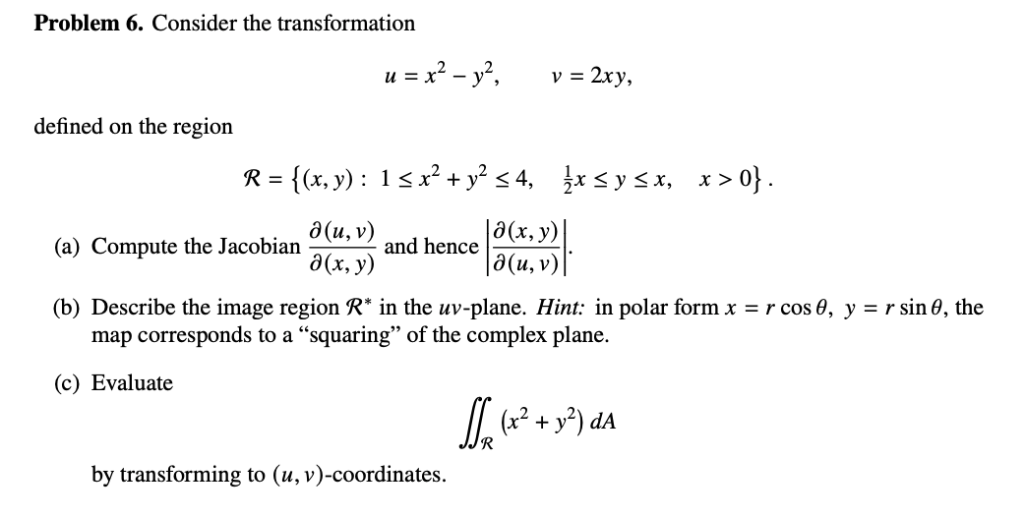 Problem 6. Consider the transformation
u=x*-y, v=2xy,
defined on the region
R={(x.y): 1
This is AI generated Response.
Asked by: Rahul
Created at: 2025-11-08 04:15:01
Asked by: Rahul
Created at: 2025-11-08 04:15:01
Final Answer:
Rendered
Raw Text
Did you like this answer?
Let's break down each part as requested, **step by step**.
---
## (a) **Compute the Jacobian**
### **Step 1: Find Partial Derivatives**
Given:
- \( u = x^2 - y^2 \)
- v = xy \)
partial derivatives:
\[
\frac{\partial u}{\partial x} = 2x, \quad \frac{\partial u}{\partial y} = -2y
\]
\[
\frac{\partial v}{\partial x} = 2y, \quad \frac{\partial v}{\partial y} = 2x
\]
The Jacobian matrix is:
\[
J = \begin{pmatrix}
\frac{\partial u}{\partial x} & \frac{\partial u}{\partial y} \\
\frac{\partial v}{\partial x} & \frac{\partial v}{\partial y}
\end{pmatrix}
=
\begin{pmatrix}
2x & -2y \\
2y & 2x
\end{pmatrix}
\]
**Explanation:**
We calculated each partial derivative to fill out the Jacobian matrix.
---
### **Step 2: Compute Determinant**
\[
\text{det}(J) = (2x)(2x) - (-2y)(2y) = 4x^2 + 4y^2 = 4(x^2 + y^2)
\]
So,
\[
\left| \frac{\partial(u,v)}{\partial(x,y)} \right| = 4(x^2 + y^2)
\]
**Explanation:**
The determinant is the product of the diagonal minus the product of the off-diagonal terms. This gives the scaling factor for the area transformation.
---
### **Final Answer (a):**
\[
\boxed{
\left| \frac{\partial(u,v)}{\partial(x,y)} \right| = 4(x^2 + y^2)
}
\]
---
## (b) **Describe the image region \(\mathcal{R}^*\) in the \(uv\)-plane**
### **Step 1: Rewrite Region in Terms of \(u, v\)**
Given \(x^2 + y^2 = r^2\), the region is
\[
1 \leq x^2 + y^2 \leq 4
\]
and \(x > \), \(\frac{1}{2}x \leq y \leq x\).
Express \(u, v\) in polar coordinates (\(x = r\cos\theta, y = r\sin\theta\)):
\[
u = x^2 - y^2 = r^2(\cos^2\theta - \sin^2\theta) = r^2\cos 2\theta
\]
\[
v = 2xy = 2r^2\cos\theta\sin\theta = r^2\sin 2\theta
\]
So, \(u + iv = r^2 e^{i2\theta}\).
**Explanation:**
The transformation "squares" the complex number \(z = x + iy = re^{i\theta}\), mapping it to \(z^2 = r^2 e^{i2\theta}\).
---
### **Step 2: Describe the Image Region**
- \(1 \leq r^2 \leq 4\) ⟹ \(1 \leq \sqrt{u^2 + v^2} \leq 4\)
- For \(x > \), \(\theta \in (-\frac{\pi}{2}, \frac{\pi}{2})\)
- \(\frac{1}{2}x \leq y \leq x\) ⟹ \(\tan\theta \in [1/2, 1]\) ⟹ \(\theta \in [\arctan(1/2), \arctan(1)]\)
But since \(2\theta\) is mapped, the region in the \(uv\)-plane is:
- \(1 \leq \sqrt{u^2 + v^2} \leq 4\)
- \(2\theta \in [2\arctan(1/2), 2\arctan(1)]\)
**Explanation:**
The region in the \(uv\)-plane is an annular sector, with radii from 1 to 4, and angles doubled from the original \(\theta\) range.
---
### **Final Answer (b):**
\[
\boxed{
\mathcal{R}^* = \left\{ (u, v) : 1 \leq \sqrt{u^2 + v^2} \leq 4,\quad 2\arctan(1/2) \leq \arg(u+iv) \leq 2\arctan(1) \right\}
}
\]
---
## (c) **Evaluate \(\iint_\mathcal{R} (x^2 + y^2) dA\) in \((u,v)\)-coordinates**
### **Step 1: Set Up the Integral in \((u,v)\)**
From part (a), \(\left| \frac{\partial(x,y)}{\partial(u,v)} \right| = \frac{1}{4(x^2 + y^2)}\).
Let \(x^2 + y^2 = r^2\), and \(u^2 + v^2 = r^4\) ⟹ \(r^2 = \sqrt{u^2 + v^2}\).
The integrand \((x^2 + y^2) dA = r^2 dA\).
So,
\[
\iint_\mathcal{R} (x^2 + y^2) dA = \iint_{\mathcal{R}^*} (x^2 + y^2) \left| \frac{\partial(x,y)}{\partial(u,v)} \right| du dv
\]
\[
= \iint_{\mathcal{R}^*} r^2 \cdot \frac{1}{4r^2} du dv = \iint_{\mathcal{R}^*} \frac{1}{4} du dv
\]
**Explanation:**
The Jacobian cancels the \(r^2\) in the numerator, leaving a constant integrand.
---
### **Step 2: Integrate Over \(\mathcal{R}^*\) (Annular Sector)**
The area of the annular sector in the \(uv\)-plane is:
- Radii: \(1 \leq \rho \leq 4\)
- Angles: \(\phi_1 = 2\arctan(1/2)\), \(\phi_2 = 2\arctan(1)\)
The area is:
\[
\int_{\phi_1}^{\phi_2} \int_{1}^{4} \frac{1}{4} \rho d\rho d\phi
\]
Integrate in \(\rho\):
\[
\int_1^4 \frac{1}{4} \rho d\rho = \frac{1}{4} \left[ \frac{\rho^2}{2} \right]_1^4 = \frac{1}{4} \left( \frac{16}{2} - \frac{1}{2} \right) = \frac{1}{4} \cdot \frac{15}{2} = \frac{15}{8}
\]
Integrate in \(\phi\):
\[
(\phi_2 - \phi_1) \cdot \frac{15}{8}
\]
Where:
- \(\phi_1 = 2\arctan(1/2)\)
- \(\phi_2 = 2\arctan(1) = 2 \cdot \frac{\pi}{4} = \frac{\pi}{2}\)
**Explanation:**
We converted the region to polar coordinates and calculated the area of the sector, multiplying by the constant integrand.
---
### **Final Answer (c):**
\[
\boxed{
\iint_\mathcal{R} (x^2 + y^2) dA = \frac{15}{8} \left( \frac{\pi}{2} - 2\arctan(1/2) \right)
}
\]
---
**Let me know if you'd like a more detailed explanation or the numeric value!**
Question:
Please solved all parts
This is AI generated Response.
Asked by: Rahul
Created at: 2025-11-08 04:15:49
Asked by: Rahul
Created at: 2025-11-08 04:15:49
Final Answer:
Rendered
Raw Text
Did you like this answer?
To solve all parts of the problem step by step, we will follow the structure provided while ensuring clarity and conciseness.
---
# Problem Breakdown
## (a) **Compute the Jacobian**
### **Step 1: Find Partial Derivatives**
Given the transformation:
- \( u = x^2 - y^2 \)
- \( v = 2xy \)
Calculate the partial derivatives:
\[
\frac{\partial u}{\partial x} = 2x, \quad \frac{\partial u}{\partial y} = -2y
\]
\[
\frac{\partial v}{\partial x} = 2y, \quad \frac{\partial v}{\partial y} = 2x
\]
The Jacobian matrix \( J \) is:
\[
J = \begin{pmatrix}
2x & -2y \\
2y & 2x
\end{pmatrix}
\]
**Explanation:**
We computed the partial derivatives to construct the Jacobian matrix, which describes how the transformation affects the area.
---
### **Step 2: Compute Determinant**
Calculate the determinant of the Jacobian:
\[
\text{det}(J) = (2x)(2x) - (-2y)(2y) = 4x^2 + 4y^2 = 4(x^2 + y^2)
\]
Thus, the absolute value of the Jacobian determinant is:
\[
\left| \frac{\partial(u,v)}{\partial(x,y)} \right| = 4(x^2 + y^2)
\]
**Explanation:**
The determinant is derived from the formula for the determinant of a 2x2 matrix, indicating how area scales under the transformation.
---
### **Final Answer (a):**
\[
\boxed{
\left| \frac{\partial(u,v)}{\partial(x,y)} \right| = 4(x^2 + y^2)
}
\]
---
## (b) **Describe the Image Region \(\mathcal{R}^*\) in the \(uv\)-plane**
### **Step 1: Rewrite Region in Terms of \(u, v\)**
The region \( \mathcal{R} \) in the \(xy\)-plane is defined by:
\[
1 < x^2 + y^2 < 4, \quad x > 0, \quad \frac{1}{2}x < y < x
\]
Using polar coordinates where \( x = r \cos \theta \) and \( y = r \sin \theta \):
The conditions become:
- For \( x^2 + y^2 \):
\[
1 < r^2 < 4 \quad \Rightarrow \quad 1 < r < 2
\]
- For the angles:
\[
\frac{1}{2} x < y < x \quad \Rightarrow \quad \frac{1}{2} \cos \theta < \sin \theta < \cos \theta
\]
This leads to:
\[
\tan \theta > \frac{1}{2} \quad \text{and} \quad \tan \theta < 1 \quad \Rightarrow \quad \theta \in \left( \arctan\left(\frac{1}{2}\right), \frac{\pi}{4} \right)
\]
### **Step 2: Map to \(uv\)-coordinates**
The transformation gives:
\[
u = r^2 \cos(2\theta), \quad v = r^2 \sin(2\theta)
\]
Thus, the image region in the \(uv\)-plane is an annular sector:
- \(1 < \sqrt{u^2 + v^2} < 4\)
- Angles: \( 2 \arctan\left(\frac{1}{2}\right) < \arg(u + iv) < \frac{\pi}{2} \)
**Explanation:**
The mapping transforms the circular region in polar coordinates to a squared sector in the \(uv\)-plane.
---
### **Final Answer (b):**
\[
\boxed{
\mathcal{R}^* = \left\{ (u, v) : 1 < \sqrt{u^2 + v^2} < 4,\quad 2 \arctan\left(\frac{1}{2}\right) < \arg(u+iv) < \frac{\pi}{2} \right\}
}
\]
---
## (c) **Evaluate \(\iint_{\mathcal{R}} (x^2 + y^2) dA\) by Transforming to \((u,v)\)-coordinates**
### **Step 1: Set Up the Integral in \((u,v)\)**
From part (a), we know:
\[
\left| \frac{\partial(x,y)}{\partial(u,v)} \right| = \frac{1}{4(x^2 + y^2)}
\]
Using \(x^2 + y^2 = r^2\), we have:
\[
\iint_{\mathcal{R}} (x^2 + y^2) dA = \iint_{\mathcal{R}^*} r^2 \cdot \frac{1}{4r^2} du dv = \iint_{\mathcal{R}^*} \frac{1}{4} du dv
\]
**Explanation:**
We simplified the integral by noting that the Jacobian cancels the \(r^2\) in the numerator, leaving a constant integrand.
---
### **Step 2: Integrate Over \(\mathcal{R}^*\) (Annular Sector)**
The area of the annular sector is found through:
\[
\text{Area} = \int_{\phi_1}^{\phi_2} \int_{1}^{2} \frac{1}{4} \rho d\rho d\phi
\]
Calculating the \(\rho\) integral:
\[
\int_{1}^{2} \frac{1}{4} \rho d\rho = \frac{1}{4} \left[ \frac{\rho^2}{2} \right]_{1}^{2} = \frac{1}{4} \left( \frac{4}{2} - \frac{1}{2} \right) = \frac{1}{4} \cdot \frac{3}{2} = \frac{3}{8}
\]
Calculating the \(\phi\) integral, where:
- \(\phi_1 = 2 \arctan\left(\frac{1}{2}\right)\)
- \(\phi_2 = \frac{\pi}{2}\)
The area becomes:
\[
\text{Area} = \left(\frac{\pi}{2} - 2 \arctan\left(\frac{1}{2}\right)\right) \cdot \frac{3}{8}
\]
Thus, the final integral evaluates to:
\[
\iint_{\mathcal{R}} (x^2 + y^2) dA = \frac{3}{8} \left(\frac{\pi}{2} - 2\arctan\left(\frac{1}{2}\right)\right)
\]
**Explanation:**
We computed the area of the annular sector and multiplied by the constant integrand.
---
### **Final Answer (c):**
\[
\boxed{
\iint_{\mathcal{R}} (x^2 + y^2) dA = \frac{3}{8} \left(\frac{\pi}{2} - 2\arctan\left(\frac{1}{2}\right)\right)
}
\]
---
This completes the solution for all parts of the problem. Let me know if you need further clarifications or detailed calculations!
📢 Instructions:
- Ask anything relatd to above question only.
- For new Question goto :