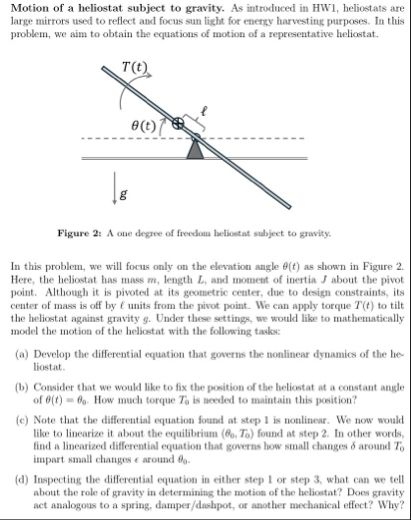
Give step-by-step solution with explanation and final answer:Motion of a heliostat subject to gravity. As introduced in HW1, heliostats are
large mirrors used to reflect and focus sun fig for enerxy harvesting purposes. Tn this
‘problem, we win to obtain the equations of motion of a represcatative heliastat
yo
t
8)
F
igure 3: A one degree of frocks belintat subject (0 gravy.
In this problem, we will focus only an the cevation sagle 0(t) as shown in Figure 2
Here, the heliostat his mass, length £, anel moment of inertia J about the pivot
paint. Although it is pivoted at its geometric ceuter, due to design constraints, its
center of mass i off by units from the pivot pois. We can apply torque 7) o tilt
the helcstat against gravity o. Under these settings, we would ike to mathematically
‘model the motion of the heliostat with the following tasks:
(a) Develop the differential equation that governs the nonlinear dynamics of the he-
liostat.
(1) Coir that we woukd like to fx the position of the heliastat a a constant angle
of 01) = fy. How much torque Ty bs sevses 10 maintain this pesition”
(6) Noto that the differential equation fou at step 1 i nonlinens. Wo now would
Tike 10 linearize it about the equilibrium (6, 7) found ot step 2. Tn other words,
ind iearized differential equation that governs bow sinall changes § around Ty
apart small changes « azound dy
() Tuspecting the differential equation in either ste | or step 3. what can we tell
abot the role of gravity in determining the motion of the belostat? Docs gravity
act analogous to 0 spring, damper dusbpot, or anther mechanical effoct? Why?
Question:
Give step-by-step solution with explanation and final answer:Motion of a heliostat subject to gravity. As introduced in HW1, heliostats are
large mirrors used to reflect and focus sun fig for enerxy harvesting purposes. Tn this
‘problem, we win to obtain the equations of motion of a represcatative heliastat
yo
t
8)
F
igure 3: A one degree of frocks belintat subject (0 gravy.
In this problem, we will focus only an the cevation sagle 0(t) as shown in Figure 2
Here, the heliostat his mass, length £, anel moment of inertia J about the pivot
paint. Although it is pivoted at its geometric ceuter, due to design constraints, its
center of mass i off by units from the pivot pois. We can apply torque 7) o tilt
the helcstat against gravity o. Under these settings, we would ike to mathematically
‘model the motion of the heliostat with the following tasks:
(a) Develop the differential equation that governs the nonlinear dynamics of the he-
liostat.
(1) Coir that we woukd like to fx the position of the heliastat a a constant angle
of 01) = fy. How much torque Ty bs sevses 10 maintain this pesition”
(6) Noto that the differential equation fou at step 1 i nonlinens. Wo now would
Tike 10 linearize it about the equilibrium (6, 7) found ot step 2. Tn other words,
ind iearized differential equation that governs bow sinall changes § around Ty
apart small changes « azound dy
() Tuspecting the differential equation in either ste | or step 3. what can we tell
abot the role of gravity in determining the motion of the belostat? Docs gravity
act analogous to 0 spring, damper dusbpot, or anther mechanical effoct? Why?
This is AI generated Response.
Asked by: Rahul
Created at: 2026-01-24 03:35:08
Final Answer:
RenderedRaw Text
Did you like this answer?
Let's go through each part of the problem step by step.
---
## **Given Data and Setup**
- **Heliostat mass:** \( m \)
- **Heliostat length:** \( L \)
- **Moment of inertia about the pivot:** \( J \)
- **Distance from pivot to center of mass:** \( \ell \)
- **Angle:** \( \theta(t) \), measured from horizontal axis
- **Torque applied at pivot:** \( T(t) \)
- **Gravity acts downwards:** \( g \)
---
## **(a) Differential Equation for the Nonlinear Dynamics**
### **Step 1: Free Body Diagram and Torques**
- **Torque from gravity** (about the pivot):
The force due to gravity acts at the center of mass, a distance \( \ell \) from the pivot.
- Magnitude: \( mg \)
- Perpendicular distance (moment arm): \( \ell \sin\theta \)
- **Torque due to gravity:** \( -mg \ell \sin\theta \) (negative sign because gravity tries to decrease \( \theta \) if \( \theta > \))
- **Applied torque:** \( T(t) \) (positive in the direction of increasing \( \theta \))
### **Step 2: Equation of Motion**
Using Newton's second law for rotation:
\[
J \ddot{\theta}(t) = \text{Sum of torques about the pivot}
\]
\[
J \ddot{\theta}(t) = T(t) - mg\ell \sin\theta(t)
\]
Or, rearranged:
\[
J \ddot{\theta}(t) + mg\ell \sin\theta(t) = T(t)
\]
---
## **(b) Find \( T_ \) to Hold at Constant Angle \( \theta_ \)**
If we want \( \theta(t) = \theta_ \) (constant), then \( \dot{\theta} = \), \( \ddot{\theta} = \).
Plug into the equation:
\[
J \cdot + mg\ell \sin\theta_ = T_
\]
\[
T_ = mg\ell \sin\theta_
\]
---
## **(c) Linearize Around \( \theta_ \) and Find the Linearized Equation**
Let \( \theta(t) = \theta_ + \delta\theta(t) \), with \( \delta\theta(t) \) small.
Expand \( \sin\theta \) using Taylor expansion:
\[
\sin\theta \approx \sin\theta_ + \cos\theta_ \cdot \delta\theta
\]
Substitute into the original equation:
\[
J \ddot{\theta}(t) + mg\ell \sin\theta(t) = T(t)
\]
\[
J \delta\ddot{\theta}(t) + mg\ell (\sin\theta_ + \cos\theta_ \cdot \delta\theta) = T_ + \delta T(t)
\]
Recall \( T_ = mg\ell \sin\theta_ \):
\[
J \delta\ddot{\theta}(t) + mg\ell \cos\theta_ \cdot \delta\theta = \delta T(t)
\]
Or,
\[
J \delta\ddot{\theta}(t) + mg\ell \cos\theta_ \cdot \delta\theta = \delta T(t)
\]
This is a linear second-order ODE for small deviations around \( \theta_ \).
---
## **(d) Nature of the Dynamics: Is It Underdamped or Overdamped?**
### **Inspection**
- The linearized equation (without any damping term) is:
\[
J \delta\ddot{\theta}(t) + mg\ell \cos\theta_ \cdot \delta\theta = \delta T(t)
\]
- The system is **undamped** because there is **no damping term** (no term proportional to \( \delta\dot{\theta} \)).
- The solution will be **oscillatory** (if \( \cos\theta_ > \)), with natural frequency:
\[
\omega_n = \sqrt{\frac{mg\ell \cos\theta_}{J}}
\]
- **Gravity alone does not provide damping**; it only acts as a restoring (or destabilizing) force depending on \( \theta_ \).
- **Damping** (mechanical friction, air resistance, etc.) would appear as a term like \( +b \delta\dot{\theta}(t) \) in the differential equation, which is absent here.
---
## **Summary of Final Answers**
### **(a) Nonlinear Equation of Motion:**
\[
J \ddot{\theta}(t) + mg\ell \sin\theta(t) = T(t)
\]
### **(b) Torque Needed to Hold at \( \theta_ \):**
\[
T_ = mg\ell \sin\theta_
\]
### **(c) Linearized Equation Around \( \theta_ \):**
\[
J \delta\ddot{\theta}(t) + mg\ell \cos\theta_ \cdot \delta\theta = \delta T(t)
\]
### **(d) Nature of Motion (Damping):**
- The equation is **undamped** (no damping term).
- Gravity provides only a restoring force (if \( \cos\theta_ > \)), not damping.
- Any damping must come from physical sources like friction or air resistance, **not gravity**.
---
Let me know if you need any further explanation or derivations!
Question:
Please solved all parts
This is AI generated Response.
Asked by: Rahul
Created at: 2026-01-24 03:36:00
Final Answer:
RenderedRaw Text
Did you like this answer?
# Motion of a Heliostat Subject to Gravity
This document outlines the step-by-step solution to the problem of a heliostat's motion, focusing on deriving the differential equations governing its dynamics.
## **Given Data and Setup**
- **Mass of heliostat:** \( m \)
- **Length of heliostat:** \( L \)
- **Moment of inertia about the pivot:** \( J \)
- **Distance from pivot to center of mass:** \( \ell \)
- **Angle:** \( \theta(t) \) (measured from the horizontal axis)
- **Torque applied at pivot:** \( T(t) \)
- **Acceleration due to gravity:** \( g \)
---
## **(a) Differential Equation for the Nonlinear Dynamics**
### **Step 1: Free Body Diagram and Torques**
1. **Torque due to gravity:**
- The force due to gravity acts at the center of mass, a distance \( \ell \) from the pivot.
- Magnitude: \( mg \)
- Perpendicular distance (moment arm): \( \ell \sin\theta \)
- **Torque from gravity:**
\[
\tau_g = -mg\ell \sin\theta
\]
(Negative sign denotes that gravity tends to decrease \( \theta \).)
2. **Applied torque:**
- \( T(t) \) (positive in the direction of increasing \( \theta \)).
### **Step 2: Equation of Motion**
Using Newton's second law for rotation:
\[
J \ddot{\theta}(t) = T(t) - mg\ell \sin\theta(t)
\]
Rearranging gives us the nonlinear equation of motion:
\[
J \ddot{\theta}(t) + mg\ell \sin\theta(t) = T(t)
\]
---
## **(b) Find \( T_ \) to Hold at Constant Angle \( \theta_ \)**
To maintain a constant angle \( \theta(t) = \theta_ \), we set:
- \( \dot{\theta} = 0 \)
- \( \ddot{\theta} = 0 \)
Substituting into the equation:
\[
J \cdot 0 + mg\ell \sin\theta_ = T_
\]
Thus, the required torque \( T_ \) to maintain the position is:
\[
T_ = mg\ell \sin\theta_
\]
---
## **(c) Linearize Around \( \theta_ \) and Find the Linearized Equation**
Let \( \theta(t) = \theta_ + \delta\theta(t) \), where \( \delta\theta(t) \) is small.
### **Taylor Expansion of \( \sin\theta \)**
Using the Taylor series expansion around \( \theta_ \):
\[
\sin\theta \approx \sin\theta_ + \cos\theta_ \cdot \delta\theta
\]
### **Substituting into the Original Equation**
The original equation becomes:
\[
J \ddot{\theta}(t) + mg\ell \sin\theta(t) = T(t)
\]
Substituting the Taylor expansion:
\[
J \delta\ddot{\theta}(t) + mg\ell \left( \sin\theta_ + \cos\theta_ \cdot \delta\theta \right) = T_ + \delta T(t)
\]
Since \( T_ = mg\ell \sin\theta_ \):
\[
J \delta\ddot{\theta}(t) + mg\ell \cos\theta_ \cdot \delta\theta = \delta T(t)
\]
This leads us to the linearized equation:
\[
J \delta\ddot{\theta}(t) + mg\ell \cos\theta_ \cdot \delta\theta = \delta T(t)
\]
---
## **(d) Nature of the Dynamics: Is It Underdamped or Overdamped?**
### **Analysis of the Linearized Equation**
The linearized equation is:
\[
J \delta\ddot{\theta}(t) + mg\ell \cos\theta_ \cdot \delta\theta = \delta T(t)
\]
- **Damping:** The equation lacks a damping term, which would typically be of the form \( b \delta\dot{\theta}(t) \). Therefore, the system is **undamped**.
- **Oscillatory Behavior:** The system will exhibit oscillatory motion if \( \cos\theta_ > 0 \). The natural frequency of oscillation is given by:
\[
\omega_n = \sqrt{\frac{mg\ell \cos\theta_}{J}}
\]
- **Gravity's Role:** Gravity acts as a restoring force that attempts to bring the heliostat back to its equilibrium position. It does not provide damping.
---
## **Summary of Final Answers**
### **(a) Nonlinear Equation of Motion:**
\[
J \ddot{\theta}(t) + mg\ell \sin\theta(t) = T(t)
\]
### **(b) Torque Needed to Hold at \( \theta_ \):**
\[
T_ = mg\ell \sin\theta_
\]
### **(c) Linearized Equation Around \( \theta_ \):**
\[
J \delta\ddot{\theta}(t) + mg\ell \cos\theta_ \cdot \delta\theta = \delta T(t)
\]
### **(d) Nature of Motion (Damping):**
- The equation is **undamped** (no damping term).
- Gravity provides only a restoring force, not damping.
- Any damping must come from external factors (e.g., friction).
---
If further clarification or additional calculations are needed, feel free to ask!
VIPSolutions focuses on clear, step‑by‑step explanations so you can learn quickly. Whether you need an AI‑generated walkthrough or a short hint to get unstuck, each solution is organized for fast reading and easy review later.
Search similar questions, compare approaches, and bookmark the best answers for revision. Our goal is simple: quick, reliable study help that feels natural—not noisy.
 VIPSolutions
 Motion of a heliostat subject to gravity. As introduced in HW1, heliostats are
large mirrors used to reflect and focus sun fig for enerxy harvesting purposes. Tn this
‘problem, we win to obtain the equations of motion of a represcatative heliastat
yo
t
8)
F
igure 3: A one degree of frocks belintat subject (0 gravy.
In this problem, we will focus only an the cevation sagle 0(t) as shown in Figure 2
Here, the heliostat his mass, length £, anel moment of inertia J about the pivot
paint. Although it is pivoted at its geometric ceuter, due to design constraints, its
center of mass i off by units from the pivot pois. We can apply torque 7) o tilt
the helcstat against gravity o. Under these settings, we would ike to mathematically
‘model the motion of the heliostat with the following tasks:
(a) Develop the differential equation that governs the nonlinear dynamics of the he-
liostat.
(1) Coir that we woukd like to fx the position of the heliastat a a constant angle
of 01) = fy. How much torque Ty bs sevses 10 maintain this pesition”
(6) Noto that the differential equation fou at step 1 i nonlinens. Wo now would
Tike 10 linearize it about the equilibrium (6, 7) found ot step 2. Tn other words,
ind iearized differential equation that governs bow sinall changes § around Ty
apart small changes « azound dy
() Tuspecting the differential equation in either ste | or step 3. what can we tell
abot the role of gravity in determining the motion of the belostat? Docs gravity
act analogous to 0 spring, damper dusbpot, or anther mechanical effoct? Why?